Fraternities and sororities are recognized by SUNY Cortland through the Campus Activities and Corey Union Office. Recognition allows chapters to have a relationship with the university along with active membership and involvement in the Greek system and its governing boards. In order to be recognized by SUNY Cortland, all fraternities and/or sororities must be associated with a National fraternal organization. Local sorority Nu Sigma Chi was grandfathered in when this requirement was put in place.
Spring 2027 Sorority Recruitment Update:
Recruitment Counselor applications for initiated members of Alpha Phi, Alpha Sigma Alpha, Delta Phi Epsilon, and Sigma Delta Tau are now available. All applications must be received no later than 4 p.m. on Thursday, October 15, 2026.
Fall 2026 Recognition Update:
National fraternity Theta Chi has officially closed its SUNY Cortland chapter. There is to be no activity in the name of Theta Chi taking place at SUNY Cortland or within the City of Cortland community. The group formally known as Theta Chi is an underground/unrecognized group. Individuals who choose to associate with them would be in violation of SUNY Cortland's Student Code of Conduct.
Fall 2026 Recruitment Updates:
- Sorority recruitment: No more offers of membership will be made this semester.
- Fraternity recruitment: No more offers of membership will be made this semester.
- Congratulations to the 33 individuals who accepted offers of membership this semester.
Reference the Underground Groups tab for information about others that may call themselves a fraternity but in reality are not and have no connection to the national organization of the same name. Joining and/or associating with these groups is a violation of the SUNY Cortland Student Code of Conduct.
2025-2026 Greek Highlights:
- By the end of the year, approximately 11.7% (650) of our undergraduate students belonged to either a fraternity or sorority -- 3% of the males and 19% of the females.
- Seven active chapters and 2 Greek Councils combined to raise $72,605 for a variety of local, regional, and national causes.
- The same groups combined to complete 1,178 community service hours. These hours were completed at events such as the Cortland Youth Bureau's Trunk or Treat and Easter Egg Hunt for local youth.
- The Fall 2025 All Greek GPA was a 3.31 with the Spring 2026 All Greek GPA being a 3.293.
- The Fall 2025 All Undergraduate GPA was a 3.2 while the Spring All Undergraduate GPA was a 3.25.
Academic Eligibility Requirements
A complete listing can be found in the Greek Recruitment page. Some requirements are:
- Cannot be a first semester first year student.
- Must have at least a 2.5 cumulative GPA (Exception being Alpha Phi Delta that requires a 2.0).
- Must have completed at least 12 credit hours at SUNY Cortland (if a continuing student).
- Must have completed at least 24 post-high school credit hours if an incoming transfer student and must provide SUNY Cortland's Greek
Advisor with an electronic transcript from any other college/university attended. Those who have only completed one semester of college elsewhere will not have earned the needed 24 credit hours.
Highlights from the 2024-2025 academic year
- Community Service: 12 chapters and 2 councils combined to complete a total of 1,322 hours.
- Chapters also held separate clothing, food, and personal hygiene supply drives.
- Fundraising: 9 chapters and 2 councils combined to raise a total of $81,376.81 for a variety of local, regional and national causes.
- Spring 2025 Grades: All Undergraduate GPA (3.25) higher than All Greek GPA (3.21).
- Fall 2024 Grades: All Greek GPA (3.25) higher than All Undergraduate GPA (3.2).
- Nine chapters combined to accept 219 new members in Spring 2025. These numbers included 21 individuals who joined newly recognized fraternity, Alpha Sigma Phi.
Reporting Options
Wondering where to report perceived violations of university policy? Check out the partial listing below.
Institutional Equity and Inclusion Office - Bias Related Incident Report
Title IX Office - Title IX and Sexual Harassment Reporting Form
Student Conduct Office - Incident Report
University Police - Silent Witness Report
What you can do if you are being hazed
Report hazing to prevent it from happening to others.
Check in with other members of your group to see if they are concerned, too.Speak up and take a stand against hazing.
Leave the group – this is hard and takes strength and integrity. You can inspire others.
Talk with someone at the Counseling Center or your health care provider.
Refuse to participate in activities that make you feel unsafe or uncomfortable.
Connect with friends and family outside the group for support.
Hazing Signs and what to do if you are worried about a friend
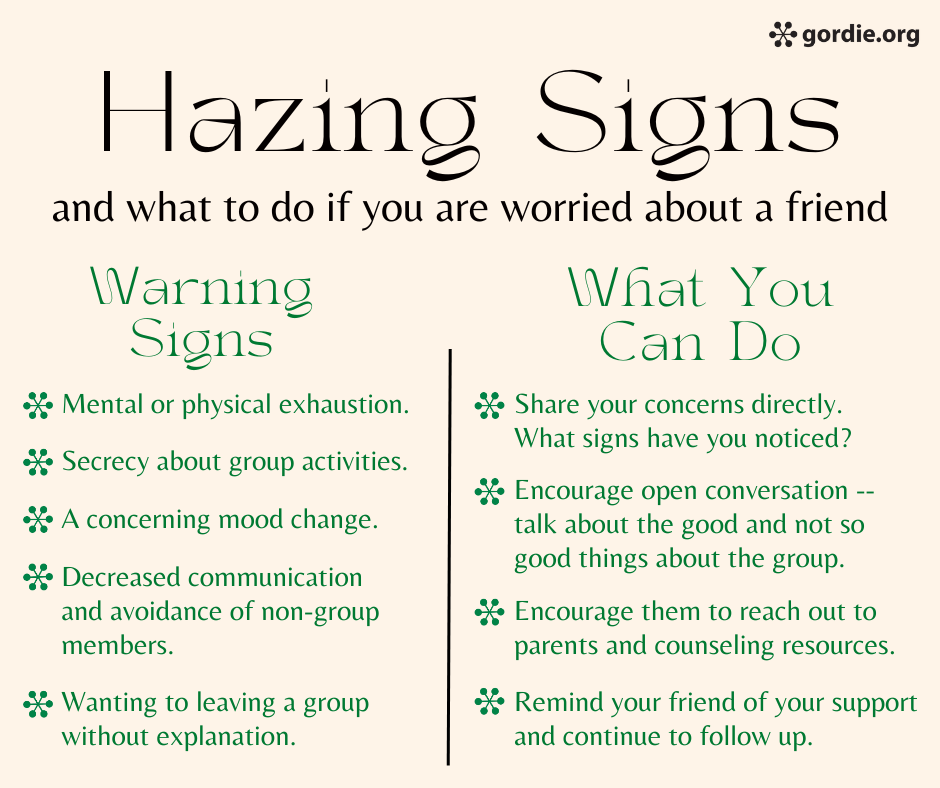
Warning Signs
- Mental or physical exhaustion.
- Secrecy about group activities.
- A concerning mood change.
- Decreased communication and avoidance of non-group members.
- Wanting to leaving a group without explanation.
What You Can Do
- Share your concerns directly.
- What signs have you noticed?
- Encourage open conversation -- talk about the good and not so good things about the group.
- Encourage them to reach out to parents and counseling resources.
- Remind your friend of your support and continue to follow up.
Questions or Concerns? Contact Sandra Wohlleber, Associate Director, Campus Activities and Greek Affairs.
Call at 607-753-5574, stop by their office (Cornish-Van Hoesen, Room B54), or send an email to [email protected]