Introduction
Congratulations on taking the first step toward seeking out and administering funds in support of your innovative and exploratory concepts! Your ideas and work will enhance the academic, commercial, and/or social communities in New York and around the globe.
The Principal Investigator Handbook’s primary goal is to help Principal Investigators (PIs) and project staff to navigate the grant process from application to close-out of an award administered by The Research Foundation for The State University of New York (RF).
While the RF is the legal recipient of the award on behalf of the campus, the PI is accountable for the proper fiscal management and conduct of the project. The RF’s central mission is to ensure that PIs and others on the project team have the necessary tools at their disposal to manage a successful project.
General Information
Using This Handbook
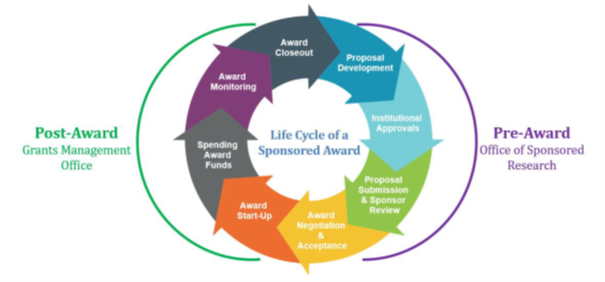
The Principal Investigators (PI) Handbook serves as a guide to help investigators understand the most fundamental processes that affect the life of a sponsored project and direct them to the appropriate resources. The structure of this handbook replicates the lifecycle from the concept of the project idea, to the award, to close out.
The reference materials provide concise explanations of the most common questions and issues as well as links to important and detailed information on federal and organization rules and regulations.
Investigators may contact the Research and Sponsored Programs Office (RSPO) for assistance in any phase of their project.
Research and Sponsored Programs Office (RSPO)
Pre-Award
At the pre-award stage, RSPO provides:
- guidance on project and proposal development
- assistance with identifying funding opportunities
- proposal preparation support including budget creation, compliance review, management of the institutional approval process, and submission to sponsors
- coordination of the award review and acceptance
Post-Award
When an award is made, RSPO staff works with the PI throughout the life cycle of the award in various ways. For example, RSPO
- acts as the liaison between the RF and SUNY Cortland
- facilitates award establishment
- performs compliance reviews (applicable regulations and sponsor requirements) on awards/contracts
- tracks cost sharing and effort reporting
- provides budget/financial tracking (order processing, vendor payments, process stipend payments, travel reconciliation/payments, account reviews); and,
- in coordination with HR, manages overall employee services responsibilities, such as processing new hire assignments
SUNY Cortland RSPO Personnel
Director
Dominick Fantacone, Ph.D.
136B Old Main
Phone: 607-753-2511
[email protected]
Associate Director for Grant Management
Elizabeth Speziale
137A Old Main
Phone: 607-753-2416
[email protected]
Grants Development Specialist
Matthew Trail
137E Old Main
Phone: 607-753-2020
[email protected]
Administrative Assistant
Zachary Braman
136 Old Main
Phone: 607-753-2511
[email protected]
The RF/SUNY Relationship
The Research Foundation for The State University of New York (RF) is the largest comprehensive university-connected research foundation in the country. It exists to serve the State University of New York (SUNY) by providing essential administrative services that enable SUNY faculty to focus their efforts on the education of students, extramural activities, and research across a wide range of disciplines. The RF is a private non-profit education corporation that is tax-exempt under Internal Revenue Code (IRC) Section 501(c) (3).
More information can be found at RF SUNY.
Roles and Responsibilities
Principal Investigator (PI) or Project Director (PD)
When researchers are funded by a sponsor, PI/PDs assume fiscal and legal responsibilities. Each PI/PD is responsible for assuring that the terms of the award are met and that the policies of the campus are followed. Sponsoring agencies, the campus, and academic departments are all stakeholders in the success of the sponsored project, and each may have specific requirements. If PI/PDs fail to abide by the policies of the RF, the campus, or the sponsor, they may be administratively, financially, and legally liable.
Generally, a PI/PD must:
- Conduct and manage the technical research
- Comply with all applicable state and university policies, procedures, and laws
- Comply with all terms and conditions of the sponsored award
- Manage project funds efficiently and effectively within approved budgets
- Ensure that the project is completed in a professional manner
- Accept fiscal responsibility on behalf of the department represented, administrative unit,and/or campus if the project becomes overextended or an unauthorized expenditure is disallowed by the auditors
Research and Sponsored Programs Office (RSPO)
RSPO has dedicated staff members who assist in the development and submission of new grant proposals. Their primary mission is to promote extramural funding of research and scholarly activity and to help PIs by:
- Providing administrative services to help meet the requirements of the sponsor, RF, and the campus
- Working with the RF’s Central Office team in reviewing the terms and conditions of an award to ensure that the PI is protected from any undue harm before the acceptance of a sponsored program
- Verifying that the project does not:-challenge institutional integrity-threaten PI’s academic freedom, or-overburden the PI with management procedures
- Protecting the campus from additional conflicts by making certain no unnecessary risks and liabilities are undertaken
- Ensuring proper stewardship of sponsored funds
- Creating mechanisms for accountability
- Developing procedures for the proper use of sponsored funds
- Interpreting sponsor’s rules
- Establishing compliance with public policies
- Filing assurances and certifications regarding regulatory compliance, and
- Serving as the official liaison between the campus, RF, and the funding agency
Research Foundation (RF)
The RF is the legal recipient of the awards administered by them. It assists campuses and faculty by:
- Reviewing, negotiating, and accepting sponsored agreements on behalf of campuses
- Managing central accounting functions including billing and fiscal reporting to sponsors
- Assisting with compliance
Additional Involved Parties
In addition to the PI’s responsibilities, the parties described below are, or may be involved in, a sponsored project.
Operations Manager (OM)
Reporting to RF, the RF Operations Manager (OM) serves as the top-level RF executive on campus and is responsible for supporting SUNY’s research mission and the successful implementation of the RF’s strategic plan. At SUNY Cortland, the OM is the Vice President for Finance and Management. The OM is responsible for all RF operations on campus, including:
- Administering sponsored program services to faculty, students, and staff
- Providing stewardship to our sponsors
- Creating an environment to support and increase sponsored program funding
- Assisting in technology transfer and commercialization in support of SUNY’s efforts to revitalize New York’s economy
Co-Principal Investigator (Co-PI) / Project Director (PD)
Other person(s) primarily responsible for the scientific, technical, and administrative conduct of a project. The appointment of Co-Principal Investigators does not supplant the need for one individual to be designated as a “corresponding” investigator. In this secondary role to the PI, a Co-PI:
- Provides leadership over a specific task of the project
- Coordinates with the RF, if at another institution
- Coordinates necessary approvals, if at another institution
- Contributes to managing the project and any reporting requirements
Collaborator
A person or entity typically volunteering some effort to conduct one minor task, measurement, or analysis. This individual is neither compensated nor involved in management or reporting a project. A Collaborator may be asked by a sponsor for a letter explaining their contribution to the project.
Sponsor
A sponsor is a person or entity who funds the sponsored program. There are three main types of sponsors:
- Federal agencies
- Other government agencies (state or local government)
- Private entities such as foundations, corporations, or individuals
Starting Out: Proposals and Funding
Overview
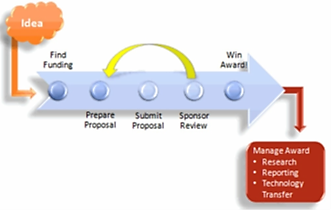
The PI has primary responsibility for obtaining and managing awarded funds, from finding funding sources to closing out the award when research is complete or the funding ends.
RSPO can assist PIs in all aspects of any phase during the grant process.
Developing a Concept
A good proposal stems from a good concept. A proposed project should link to an important problem, challenge, or new idea.
What is a "good" idea?
For research, a good idea is one that adds to the general knowledge base, brings a new perspective, or fills a gap in previously conducted research. For other types of projects, the good idea may fill a need for the institution or the community at large. In addition to presenting a good idea in a proposal, a thorough literature review will be essential to provide the background and rationale for the work.
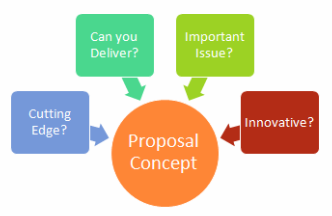
Preparing a strong proposal requires a significant investment of time, ingenuity, and energy. The sections below will help PIs focus their efforts on specific principles to help accomplish a project. It is best to use each suggestion as a guideline and not as a hard and fast rule.
PIs are advised to contact the program officer at the sponsoring agency with questions as the concept for the proposal is being developed. They might also want to solicit input from peers before discussing their new lines of research. If a proposal is petitioning for unsolicited funding, it needs to address the concept's impact on industry or the community, expertise available and needed, the cost-effectiveness of the proposed plan, and how the project will be evaluated and disseminated.*
*This is not an all-inclusive list. Refer to standard proposal guidelines from potential sponsors or grant writing resources for specific instructions.
"A good proposal is a good idea, well expressed, with a clear indication of the methods for pursuing the idea, evaluating the findings, and making them known to all who need to know."
-National Science Foundation
Clearly Identify the Project Idea
Having a clear and concise plan of how to carry out the project will help scale the project. Each potential funder will want to know how far along a project is in development, what the intended goals and objectives are (both short- and long-term), why the idea is important or revolutionary, how much the project will cost (both short- and long-term), and how long it might take until progress is made. Attempting to answer anticipated questions will help create enthusiasm for the project idea and get funders behind the proposed work. Also, being aware of the current stage of an idea will determine which solicitations are best to pursue. This exercise is important to undertake before responding to a solicitation.
Searching for Funding
SUNY Cortland subscribes to Atom Grants, an AI-powered grants search tool which is readily accessible from any campus faculty account. It matches researchers with grants based on their specific profiles and research interests, utilizing AI to analyze publications and automatically flag eligibility, and has a variety of sophisticated search tools. For more information, please contact RSPO. RSPO has also created guides to funding sources across the various major disciplines and can assist you in using these and other sources (such as Grants.Gov) in your search for funding.
Locate Fresh Leads
- Mentors/Peers - This is probably the most underutilized resource available. Advisors and former co-workers(postdocs and fellow graduate students, etc.) can also serve as a good place to start to identify previously untapped resources.
- Professional Journals - All publications stemming from funded research must provide a notation of which agency supported the work. If a PI sees a project that is similar in nature to their own, it might be beneficial to review the programs the funder offers for support on a regular basis.
- Professional Conference - Much like professional journals, conferences offer detailed information about sponsors in a PI’s area of study. Sometimes sponsor officials attend conferences and it is a good place to network.
Identify a Good Solicitation
Once a potential solicitation is identified the PI can assess the suitability of the sponsor with the prospective project. The PI can:
- Learn about the sponsor’s priorities by finding out about which specific areas they are funding and matching them with their project research priorities.
- Look at what types of proposals have been previously funded. This can be done by studying the sponsor’s annual report to see what projects have been funded, and whether the awarded grants were for projects similar to the prospective project.
- Contact the sponsor. Studies have shown that the best thing a PI can do to increase their chances of getting funded is to contact the program officer. Program officers can provide up-to-date information about available funds, discuss the project with the PI, and how it would or wouldn’t fit into their program. A program officer might even read a summary or draft of the proposal and provide feedback.
- Read the sponsor’s guidelines and procedures and call upon the resources of RSPO. Typically, they can give insight about a specific solicitation and whether other investigators at SUNY Cortland have been successful.
Award Types
Grant
A grant is defined as an award mechanism to transfer money, goods, property, services, or other items of value to universities to accomplish a public purpose. In general, the following characteristics describe a grant:
- No substantial involvement is anticipated between the sponsor and recipient during performance of activity.
- The award comes with terms, conditions, and/or other contractual requirements that need to be met.
- There are budgetary restrictions that must be followed.
- Reports may be required, including financial reports and technical or progress reports.
- Documentation of expenditures is required.
- Promised deliverables of any kind, including the sharing of research results, must be honored.
- There is a start and stop date.
Contract
A contract is defined as a binding agreement between parties for the purpose of securing goods or services. In general, the following characteristics describe a contract:
- There is extensive input from the sponsor into the tasks to be performed.
- The award mechanism used by the sponsor is a contract.
- The principal purpose of the sponsored project is to directly benefit or be used by the sponsor.
- The sponsor requires formal reports including financial or technical.
- Invoicing or billing is required.
The contracting mechanism also has terms and conditions such as:
- Ownership of intellectual property.
- Right of first refusal, or right of first negotiation of intellectual property.
- Ownership or access to research results.
- Publication review of faculty, graduate student, or postdoctoral research.
- Deliverables of any kind.
- There is a start and stop date.
Gift
A gift is defined as any item of value given by a donor who expects nothing of significant value in return, other than recognition and disposition of the gift in accordance with the donor's wishes. In general, the following characteristics describe a gift:
- No contractual requirements are imposed and there are no "deliverables" to the donor. However, the gift may be accompanied by an agreement that restricts the use of the funds to a particular purpose.
- A gift is irrevocable. While the gift may be intended for use within a certain time frame, there is no specified period of performance or start and stop dates.
- There is no formal fiscal accountability to the donor.
Subcontract
A subcontract is a contract for an institution or person to do work for another institution as part of a larger project. In sponsored research, the primary award recipient, or lead institution, is responsible to the sponsor for the terms of the grant or contract while the researcher from the non-lead institution will perform a piece of a larger project. A subcontract specifies the terms between the two institutions, outlines the work expected, and specifies the budget for the work.
Other types of agreements include Cooperative Agreements, Clinical Trials, Vendors, Data Use, Material Transfer, or Consulting. These agreement types are typically funded as contracts. Award types are managed, reported, and monitored in different ways. Once a funding opportunity has been identified, contact RSPO for guidance with the proposal development process.
Developing Proposals
Overview
There are important standard components in a good proposal; omission of any of these components jeopardizes the proposed project’s chances of getting funded. No one wants to have their application rejected without review for a technicality. Reviewing and preparing an application according to the guidelines ensures that the application will be reviewed.
Application Solicitations
All solicitations post specific guidelines on how applications must be prepared for sponsor review. “Solicitations” is the generic term; however, agencies have a variety of names for them, such as:
FOA – Funding Opportunity Announcement
NOFO – Notice of Funding Opportunity
RFP – Request for Proposals
RFA – Request for Applications
CFP – Call for Proposals
CFA – Call for Applications
NIA – Notice Inviting Applications
Some proposal guidelines prescribe sections; if so, keep them consistent; thus, not deviating from them. It is imperative that applicants follow the guidelines each sponsor posts. These guidelines outline the very specific ways in which an application should be developed, and how it will be evaluated by the sponsor.
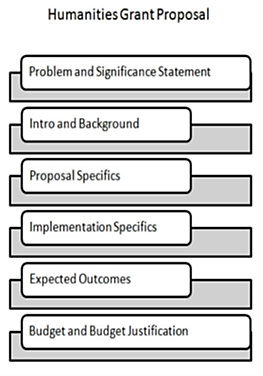
Key Components in Developing Proposals
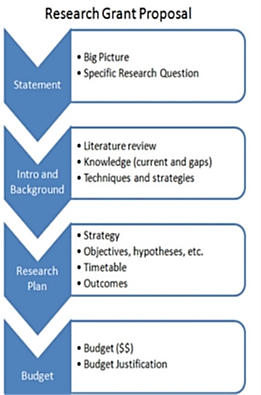
Take special note of the sections given below. These are components that should be thoroughly reviewed with RSPO staff, who give guidance in pre-award activities.
Budgeting
Developing a budget can seem like an intimidating and daunting task. RSPO is well-versed in how to draft budgets. The RSPO staff knows how to calculate the costs, is familiar with what can and cannot be included, and helps ensure that the applicant hasn't forgotten any potential budget items.
A proposal budget typically consists of two parts: the budget form and the budget justification, a narrative that explains how the costs given on the budget form were arrived at.
Some basic tenets are:
- All costs need to be reasonable. Requested budget items should reasonably reflect what is needed to complete the project.
- All costs must be allowable. There are some rules regarding what are allowable costs. The guidelines usually discuss allowable and unallowable costs, and RSPO can provide guidance.
- All costs must be allocable. This means that the costs must be used solely to advance the work of this sponsored project.
Good budget development ensures that the project team members have the financial resources to complete the project as proposed and limits the potential for difficulties in post-award fiscal management. Below is a list of the more common budget items and some guidance for each item.
Personnel Costs
The cost of personnel to conduct a project is often the largest and most important component of any budget. The RF is legally obligated to properly classify workers based on the criteria listed below. The PI is obligated to ensure that personnel budgeted in an application are properly classified.
A project may incur significant delays if an error is made in the application budget and then must be changed during the post-award phase of the project. To avoid these unnecessary delays employees and consultants are budgeted using the following guidelines:
- Employee versus Consultant - In general, an employee is someone whose primary employment is as a New York State (NYS) or RF for SUNY employee. A consultant does not have a state or RF appointment and will provide specific and measurable outcomes to a specific task in a separate scope of work. Examples include delivery of a training curriculum, review and opinion of experiment results, and development and performance of project evaluation. Typically, a consultant is not a NYS or RF for SUNY employee.
- Institutional Base Salary - This is the actual base salary of an individual who will work on the project. RSPO will be able to access this information and provide the most up-to-date and accurate figure. The budget justification is the place to explain, in some detail, why the individual was chosen for the work.
- Fringe Benefits - Fringes are the benefits package for being employed by the institution. Most employees of a project will receive fringe benefits. The time frame for work on the project determines which fringe benefit rate to use. In general, summer work has lower fringe benefit rates, which allows the most efficient use of funds.
When an award is made, the fringe benefit rates in place at the time the expenditure occurs will be assessed. Regardless of how the budget was initially proposed, the current rate will apply, so it is best to use the projected fringe rates.
Equipment
The federal definition of equipment is something with a useful life of one year or more and with a unit cost of $10,000 or more (as of October 2024). Some sponsors, however, have different criteria for what counts as equipment. Items with a lower cost, including computers, should be included in the materials and supplies budget line.
Subrecipient (Subaward) versus Contractor
Budgeting for a subaward versus an independent contractor is similar to the dilemma posed by budgeting for an employee versus a consultant. The RF’s “Subrecipient vs. Contractor Decision Tree” can help make this determination. In summary:
- A subaward is made to an academic institution or other outside entity providing significant intellectual contributions to the proposed project. It is anticipated that a subrecipient will provide results of an entirely separate project team who will be working on a separate research question or other component that will add significant intellectual value to the lead institution’s overall proposed project.
- A contractor will provide goods or services that will not require any “new” intellectual contributions to complete the work. Keep in mind that any work contracted will be fully owned by the RF, and the contractor will have no rights to the work performed.
Do not use this arrangement to avoid indirect costs of subcontractors. The terms of a contractor arrangement will not be attractive to potential collaborators.
Materials and Supplies
Materials and Supplies are the costs needed to perform the experiments or fieldwork of the project. When developing a budget, it is best to also develop a detailed justification to complement the amounts being requested. Be sure to include succinct descriptions of the cost of the materials and supplies and why they are necessary for the success of the project.
All sponsors want to know that the funds will ultimately be spent and whether the costs are an efficient and effective use of funding.
Travel Expenses
Conference and research travel are common aspects of many sponsored awards. Therefore, becoming familiar with the RF travel policy is important.
Subject Costs (Human or Animal)
Sometimes awards provide payments to human subjects as an incentive for them to participate in the study. Before supplying gift cards, cash, or other non-cash incentives be sure to discuss with RSPO how to handle these payments. There are often limits on the amounts and types of compensation that is allowable.
Direct vs. Indirect Costs
Direct Costs
- Can be identified specifically with a sponsored project, instructional activity, or other sponsored activity, and thus directly assigned relatively easily with a high degree of accuracy.
- Examples: salaries and wages, fringe benefits, equipment, supplies, utilities, travel, or publication expenses.
Indirect Costs
- Referred to as facilities and administrative (F&A) costs by the federal government; sometimes referred to as “overhead.” Defined as expenses that cannot be directly and uniquely assigned to any particular project and aligned with two categories: Facilities and Administrative. Indirect Costs include lighting, administrative personnel expenses, computer networks, telephone services, etc. SUNY Cortland has a negotiated indirect cost rate that is standard across federal sponsors and is thus reimbursed accordingly.
- Because the sponsor is providing F&A costs directly to the institution it is not acceptable to charge costs that cannot be allocated to a specific cost in a project.
To help better determine whether a cost is a direct expense vs. an indirect cost, consider first the impact the cost has on a project. For example, if a computer is being purchased by a grant, the federal sponsors require the institution to have documentation that the computer will be used to further the goals of the project.
PIs should consult with RSPO about any cost included as a direct charge. The staff will help to determine how to best proceed in what should be and should not be a direct cost for the project.
Indirect costs are calculated in the proposal budget as a percentage of the project’s direct costs. PIs should contact RSPO to find out the percentage to use and the direct cost base SUNY Cortland has negotiated.
Other budget considerations include project evaluation, participant support costs, insurance, and project-specific audit costs.
Budget Justification
A project’s success is enhanced when its budget adequately covers the costs. These necessary costs need to be explained in as much detail as possible in the budget justification. Providing a good rationale on budget items provides transparency to the application reviewers.
Compliance
Most research involves compliance with some federal laws and regulations governing the conduct of the work. The following page lists the more common regulatory areas affecting federally funded research projects. This is not an all-inclusive list. For more information, visit SUNY Cortland’s Research Policies and Procedures and RF Compliance.
Compliance Training Resources
The RF provides resources to learn about regulations and compliance standards. Course completion is tracked, giving verifiable proof to sponsors of the project team’s knowledge of the subject areas.
CITI Training: A system-wide license for all campuses to utilize specialized training on several research-related topics including Responsible Conduct of Research, Financial Conflict of Interest, and Humans Subjects and Animal Care.
For questions about regulatory issues or accessing CITI Training, contact RSPO for assistance.
Human Subjects Protections
All research involving human subjects, federally funded or not, must be reviewed and approved by SUNY Cortland’s Institutional Review Board (IRB). Many proposal applications request the IRB approval date if the research proposed involves human subjects. Be aware of the IRB protocol review schedule to schedule a complete review before the proposal deadline. Some sponsors allow just-in-time IRB approval.
Animal Protections
All research involving animals, federally funded or not, must be reviewed by SUNY Cortland’s Institutional Animal Care and Use Committee (IACUC). Many proposal applications will ask if the research proposed involves animals and, if so, request the IACUC approval date. Be aware of the IACUC protocol review schedule to schedule a complete review prior to the proposal deadline.
Conflict of Interest
To ensure the validity of research there must be no personal financial conflict of interest, real or apparent. Become familiar with SUNY Cortland’s Conflict of Interest Policy and the prospective sponsor’s conflict of interest requirements. Some sponsors, particularly those in the Public Health Service, have stringent requirements.
HIPAA
The Health Insurance Portability and Accountability Act (HIPAA) limits the use of protected health information that is held or transmitted in any form or media, whether electronic, written, or oral, to protect the privacy of patient health information. If the research involves the use of individual medical records the researchers need to follow HIPAA guidelines.
Export Controls
These federal regulations involve the disclosure, shipment, transfer, or transmission of any commodity, technology, or software that is on the Commerce Controlled List, Munitions List, or the Office of Foreign Assets Control Embargoed List for use outside of the United States. Before taking any piece of research equipment out of the U.S., or sharing it domestically with a foreign national, researchers need to determine if it falls under any of these lists. If so, they will need to get a license before leaving the country with the item. Since obtaining a license can be very time-consuming, check with RSPO early on to see if a license is needed.
Confidential/Research Data
Proprietary Data should be disclosed and marked as confidential as part of the application. Disclosure of information before taking the appropriate protections could limit researchers’ ability to commercialize research results.
Research Misconduct
Fabrication, falsification, or plagiarism in proposing, performing, and reviewing research or in reporting research results constitutes research misconduct. SUNY Cortland has a policy and procedure for handling research misconduct.
Infectious Agents, Recombinant or Synthetic Nucleic Acid Molecules
SUNY Cortland’s Institutional Biosafety Committee (IBC) provides a required Biosafety Registration Form for research involving recombinant or synthetic nucleic acid molecules or infectious agents. The form allows all research with potential hazards to be registered with, reviewed, and approved by the IBC. This ensures all research adheres to all state and federal guidelines, including NIH guidelines.
Submitting Proposals
Overview
Representatives in RSPO are designated by the RF as the primary signatory on all applications submitted on behalf of SUNY Cortland. They will review proposals before the submission of an application.
It is helpful to give RSPO notice of intent to apply for a grant as soon as possible. To obtain the necessary administrative approval signatures before submission of a sponsored research application, researchers need to provide a final budget and budget justification, and a near-final project description draft at least ten days before the submission deadline.
- Administrative Approval - Once RSPO has the documents necessary to begin the circulation of documents for institutional approval, staff members complete SUNY Cortland’s Institutional Approval Form and bundle it with the application materials for e-signatures. This form identifies the basic elements of an application, such as: What is the title? Will there be animal or human subjects? Who will be the sponsor for the proposed work? Are there additional PIs or co-PIs? Are institutional matching funds required? These internal documents are vitally important in ensuring compliance with federal and campus policies.
- Additional Institutional Requirements - Depending on the complexity of the project or sponsor requirements, additional components may also be necessary to be included with an application before review, e.g., institutional letters of support.
Award Acceptance and Negotiation
The RF negotiates and accepts all awards on behalf of the PI and the campus. RF has the knowledge and expertise to ensure that faculty, staff, and students are not adversely affected by the agreement terms.
The agreement will specify the amount of the award, the project period, budget limitations, reports and other deliverables expected, and any other terms and conditions the sponsor may require. If any of the agreement terms are unclear, it may be necessary for either party to negotiate more concise and/or mutually favorable language
Post-Award Management
Overview
This section intends to provide guidance on the financial and other post-award administration provided by RSPO upon the award of a sponsored project.
| Faculty Processes | Faculty and RSPO/RF Processes | RSPO/RF Processes |
| Conduct the research | Prepare and submit proposal to sponsor | Process transactions including hiring and payroll, and purchasing goods and services |
| Submit technical report to sponsor and disclose inventions | Negotiate and accept grant | Bill and collect payments from sponsor |
| Publish results and present to academic societies | Commercialize Intellectual Property when all other processes are complete | Complete required reports (e.g., financial, patent, property) for submission to sponsor and government agencies |
Figure 5: Lifecycle of a Grant
Revisiting the grant lifecycle above, there are processes assigned to the PI and the RF, either through the RF central office or by RSPO. RSPO is available to assist in keeping track of research and sponsor requirements. Ultimately, the PI is accountable for all requirements.
Award Establishment
The RF creates a project-specific account after an official award notice has been accepted, referred to as P.T.A.E.O. (pat-ay-oh). The account number consists of an award number, a project number, and a task number.
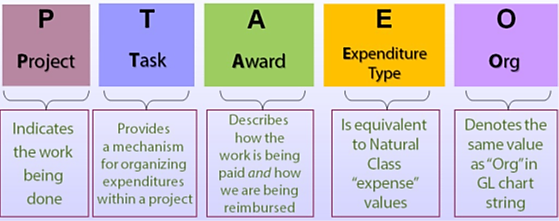
This specific account is created to track all project expenditures. The PI will be notified when the account is established. Prior to any account establishment, RSPO will verify that all appropriate compliance approvals are complete.
Monitoring Sponsored Award Financial Activity
The RF offers multiple web-based tools within the RF’s Report Center to allow PIs to monitor the financial activity of their sponsored award(s). The PI Dashboard provides PIs (or others that they designate) with the ability to see the award’s budget, what has been spent, what is encumbered, and what balance remains in each budget category.
The PI is responsible for verifying the payment of all expenses submitted and ensuring there are no unauthorized charges against the award. For this reason, it is recommended that the PI (or PI designee) reconcile the activity of the account monthly.
To access the system, contact RSPO for assistance.
Awarded Budget Revisions
Each award has a budget that has been approved by the sponsor. Part of effectively managing any award is to stay within the originally agreed-upon budget parameters. As referenced in the previous section, the RF’s PI Dashboard (RF’s Report Center) is an effective tool to help with this.
It is not uncommon to need budget category revisions. In this case, the PI cannot simply change the budget. This is because each sponsor has specific policies when it comes to making budget modifications, typically outlined in the award, which must be adhered to in the management of a project. If a PI needs to modify the budget, they must work with RSPO to make these modifications.
Key Award Considerations
Though not an all-inclusive list, the items below are all major concerns while managing an award.
Project Specific Personnel
Hiring project staff may be a necessity to conduct the project work. The RF complies with applicable laws and regulations that have been established to maintain salary and wage equity and consistent treatment of its employees. As such, measures will be taken during the search and hiring process to ensure that the final candidate was chosen fairly and has the appropriate credentials.
Before any commitments are made, verbally or in writing, the PI must contact RSPO to ensure compliance with campus policies on employee hiring.
Once an employee is on the payroll, the PI must review and sign the time reporting and the leave exception reports to verify that the reported time worked and time off are accurate. Questions regarding employee appointments and time reporting should be addressed to RSPO staff.
If there are any changes to the employee status, the PI must contact RSPO immediately. Employee appointment and change of status forms must be completed on a timely basis to ensure that salary expenditures are charged appropriately to the award.
Effort Reporting
Each project budget or award will designate an amount of effort a PI and other project staff will devote to a project. If any changes are expected to the amount of effort, the PI must contact RSPO immediately. Changes to effort generally have a ripple effect through the budget and can significantly affect the terms of the research agreement.
PIs will be required to certify their effort and the effort of their research staff for all federal and federal flow-through sponsored programs. This is done electronically via the RF’s Effort Certification and Reporting Technology, eCRT, twice per year. Certifying effort requires that the PI, or a person having firsthand knowledge, acknowledge that all personnel provided effort as agreed to in the project proposal. Failure to certify employee effort on a timely basis could result in disallowances. Any nonexempt employees participating in a project will certify their effort via their biweekly timesheets.
Purchasing
The RF must ensure that all expenditures comply with sponsor, RF, and campus guidelines. In addition, following federal requirements, all expenditures must be reasonable, allowable, and allocable to the sponsored project. RSPO and the Associate Director of Campus Services will assist PIs with the purchase of necessary project items and equipment at the best price possible, establish quality relationships with suppliers that will meet project needs, and get goods, products, and services as quickly as possible.
Travel
Travel plays an important role in many sponsored projects. Some sponsors may have specific travel conditions or restrictions. PIs are responsible for certifying that all travel undertaken in connection with sponsored projects is made for the express purpose of carrying out the project objectives. Individual travelers are responsible for the appropriate use and accurate accounting of travel funds provided to them, as well as for compliance with sponsor and RF policies. Therefore, before leaving on any trip, it is best to consult with RSPO to ensure project team members have accurate information and necessary approvals.
Important note: For any SUNY Cortland employee traveling for work, they must complete a SUNY Cortland Travel Authorization regardless of funding source. If the funding is through the SUNY Research Foundation, an RF Travel Authorization must be completed in addition to the SUNY Cortland Travel Authorization, meaning there will be two authorizations for the one trip.
Cost Transfers
A cost transfer reassigns expenditures previously recorded in one award to another award. The award to which a cost is transferred must benefit from the goods or services related to that charge, and the charge should be allowable under sponsor guidelines.
Expenditures should be charged to the appropriate award when they are incurred. If it is necessary to transfer expenditures to a different award for approved circumstances, the cost transfer should occur within 90 days of when that need is identified.
Reporting
Financial, technical, and progress reports are often required by sponsors on a fixed schedule throughout the lifetime of an award. These reports provide the sponsor with assurance that project activities are moving forward according to the terms of the agreement. Typically, the PI is responsible for submitting timely progress reports to the sponsor, providing copies of all reports, along with the transmittal letter or email, to RSPO.
Failure to provide required reports can result in funding delays in multi-year awards, and early termination of the award by the sponsor, and can lead to the RF not being able to apply for any future awards.
The RF is responsible for the submission of any required fiscal reports.
Extending Awards
Sometimes a project cannot be completed in the agreed-upon timeframe. In this case, the PI may need to request a no-cost extension to allow for time to finish the work. Requests for no-cost extensions:
- Usually include a justification and a projected budget that provides a spending plan for any unused funds
- Must be coordinated with RSPO
- This should be done at a minimum of 60 days in advance of the award’s termination date
Intellectual Property
The development of intellectual property is a natural and regular outgrowth of research programs and other scholarly activities being conducted across the SUNY system. Intellectual property includes anything marketable, such as inventions, books, articles, study guides, syllabi, workbooks or manuals, bibliographies, instructional packages, tests, video or audio recordings, films, slides, transparencies, charts, other graphic materials, photographic or similar visual materials, film strips, multimedia materials, three-dimensional materials, exhibits, and computer software.
To protect work from illegal copying, these items can be patented, copyright-protected, trademarked.
The SUNY policy on intellectual property states that the RF is the owner of all intellectual property created through the use of SUNY resources or facilities, supported directly or indirectly by funds administered by RF, developed within the scope of employment by SUNY employees or agreed upon in writing to be a specially commissioned work. Exceptions to this ownership right are regular academic work products, work created solely for the purpose of satisfying a course requirement, work covered by a contractual agreement, and work resulting from outside consulting activities.
RSPO works with PIs to ensure that their intellectual property is identified and protected. To do so, PIs must disclose their discovery or development as soon as possible. It is a requirement on federal grants to disclose intellectual property developed under the grant. Contact RSPO to assist in contacting the RF’s Technology Transfer Office.
Closing Awards
Each sponsor establishes its deadlines for the submission of final financial and technical reports, as well as final invoices. Please be aware of and ready to meet these deadlines. Typically, the close-out process is smooth, provided that all reports and all expenses have been judiciously accounted for.
Appendix A: Policies, Procedures, and Regulations
PIs and their teams are obligated to adhere to all policies, procedures, and regulations throughout the lifecycle of the award.
Policies and Procedures
PIs should familiarize themselves with the RF Policies and Procedures. However, note that campus policies and procedures may vary slightly from, and supersede, RF policies and procedures. Contact RSPO with any questions or concerns.
OMB Regulations
The U.S. Office of Management and Budget (OMB) serves as the backbone of all federal contracting and provides the guidance document that can be referred to whenever questions arise. The RF is obligated to follow the regulations provided by the federal government.
2 CFR Part 200
Uniform Guidance (2 C.F.R. Part 200) establishes uniform administrative requirements, cost principles, and audit requirements for federal awards to non-federal entities
Appendix B: Subawards vs. Contractor
A subaward is likely appropriate if the answer is “yes” to any of the following questions:
- Does the entity’s scope of work (SOW) represent an intellectually significant portion of the programmatic effort of the overall project?
- Does the entity have responsibility for programmatic decision-making?
- Could the entity’s work result in intellectual property developed or publishable results (including co-authorship)?
- Will the entity need animal and/or human subject approval for its portion of the work?
RF’s “Subrecipient vs. Contractor Decision Tree” is a helpful tool in making this determination.
The following information provides tips to distinguish a subaward from a supplier situation.
| If the situation involves an... | The relationship is a... |
| Entity selling goods or services as part of their routine business operations, usually at a fixed price or rate (e.g., pipettes, tanks of hydrogen, etc.) | Contractor |
| Entity using human subjects or animal subjects (and needs both the subrecipient’s AND campus’ IRB or IACUC approval) to do their portion of the work | Subaward |
| Entity conducting a survey using de-identified data, and annual IRB approval is not required | Contractor |
| Entity who might be a legitimate author or co-author of a paper done on the project | Subaward |
| Invention arising from the work done by the subrecipient | Subaward |
| Entity performing a test on data we provide to them and who gives us the results to analyze | Contractor |
| Entity performing a test on data we provide to them and provides routine professional services in analyzing the results (e.g., a radiologist reading an x-ray) | Contractor |
| Entity performing a test on data we provide to them and uses their professional expertise to contribute to generalized knowledge in new ways | Subaward |
Other procurement actions may be appropriate when the contractor:
- Provides the goods and services within its normal business operations
- Provides similar goods or services to many different purchasers
- Operates in a competitive environment
- Provides goods or services that are ancillary to the operation of the RF-sponsored project
- Is not subject to compliance requirements of the sponsor
Appendix C: Audits and Site Visits
Sponsors, by virtue of the fact that they are investing money in a sponsored award, are entitled to perform audits of all aspects of the award (financial and programmatic). The following is a list of audit types:
- Pre-award
- Financial statement
- Single audit – Subpart F – 2 CFR 200.501(b)
- Program Specific
- Special Review
- F&A Cost Proposal and Disclosure Statement
- Business System Review (accounting, procurement, property, etc.)
These audits may also be accompanied by site visits where the sponsor sends an individual or team to get a firsthand look at award activity to ensure that it is in compliance with the sponsor’s regulations and the scope of work outlined in the funded proposal.
The RF is obligated to comply with any requests for audits and/or site visits. The RF will provide appropriate personnel and resources to the sponsoring agency to demonstrate compliance.
PIs must notify RSPO as soon as they are informed of an audit or site visit.