10/01/2026
“The Laramie Project” is a story that must be told, even if it’s easier to look away. An unflinching look at the pain, hate and tragedy of the 1998 murder of gay University of Wyoming student Matthew Shepard, the documentary-style play will be performed this week at SUNY Cortland’s Dowd Fine Arts Center Theatre.
- Thursday, Oct. 1 at 7 p.m.
- Friday, Oct. 2 at 7 p.m.
- Saturday, Oct. 3 at 7 p.m.
- Sunday, Oct. 4 at 2 p.m.
Tickets can be purchased at SUNY Cortland’s Box Office website. Audience discretion is advised. The show includes discussion of anti-gay violence, hate speech and death.
Following Sunday’s matinee, Dennis Shepard, Matthew’s father and cofounder of the Matthew Shepard Foundation, will participate in an online Zoom discussion open to anyone who bought a ticket to one of the performances.
University and community organizations will be present at performances to share resources and spread awareness, including Cortland Pride, PFLAG and The Center.
On Oct. 6, 1998, Matthew Shepard was robbed then murdered, his body found tied to a fence 18 hours afterward. His death led to the eventual passing of new state and federal hate crime legislation.
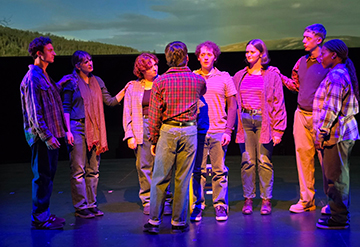
Told through the voices of Laramie’s own residents, the dialogue is transcribed from hundreds of interviews that the play’s creators shared with community members. Each actor portrays at least 10 different characters.
“It has been a deeply sensitive and challenging rehearsal process,” said director Mark Reynolds, who also directed Cortland’s earlier production of the play in 2016.
“While the tragedy is the catalyst for the story, “The Laramie Project” is about the people of Laramie, Wyoming, and how this terrible event changed a small college town,” Reynolds explained.
First staged in 1999, the play inspired an HBO movie of the same name in 2002. Cortland’s cast and crew were able to have direct question and answer sessions with those connected to death and its history. Those included Kelli Simpkins, an original member of the Tectonic Theatre Company who interviewed Laramie residents, Jedadiah Schults, a University of Wyoming student in 1998 who is now a theater professor at New York University, and Dennis Shepard.
“The challenge of ‘The Laramie Project’ compared to other productions is remembering that everything about it is real, it’s verbatim,” said Athena Molina, stage manager and junior musical theatre major. “There’s nothing to hide behind because it wasn’t just a story that someone developed on their own. In other shows, it’s easy to separate yourself from fiction, even realistic fiction.”
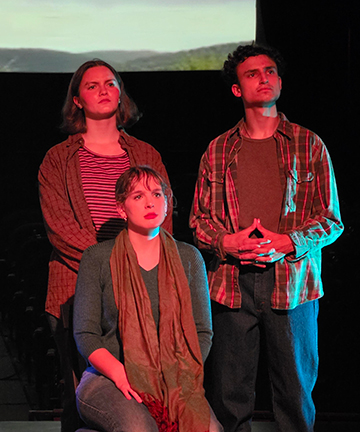
She explained that each line in this show is a quote about a tragedy — and a level of hate — that is all-too-real.
“It’s hard to ingest every day, so many rehearsals have been emotional,” Molina said. “I can’t even begin to imagine what it puts my actors through every day having to put themselves into the material over and over.”
Molina said that the play’s cast and crew have prioritized creating safe, comfortable spaces for rehearsals.
Senior musical theatre major Sidney Humes-James performs the parts played by original cast member Mercedes Herrero.
“It reminds us that the characters we are playing are human and that reminds us to bring natural speech and movement into our performances,” Humes-James said.
She mentioned the value of consulting with Kelli Simpkins, who explained that cast members should feel like they are standing side by side with their characters. Hume said that conversation with Simpkins improved her performance.
Humes-James added that those talks put the play into perspective in a way that would be impossible to imagine otherwise.
“It has been difficult because of how heavy the material is but also so rewarding to tell the story of this town and how people react to tragedy,” she said.