10/15/2026
John Gurche’s work has been featured on five covers of National Geographic and in museums across the country, from the Smithsonian to the American Museum of Natural History.
And soon, the renowned paleoartist will offer a free talk at SUNY Cortland about an intricate craft that bridges science and the visual arts.
Gurche’s presentation, “A Mystery Ancestor from Deep Time,” takes place Thursday, Oct. 22, at 7 p.m. in Bowers Hall, Room 1129. Sponsored by the Provost’s Office and United University Professions, the event is open to the public.
The illustrated talk will outline the reconstruction and the clues that helped reveal the mystery of the ancestor’s identity.
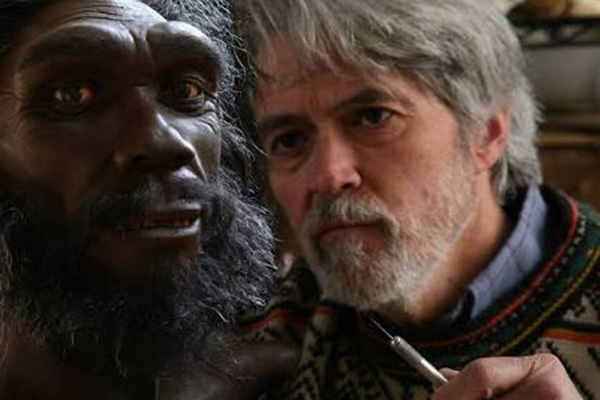
For more than 40 years, Gurche has earned international acclaim for his work as a paleoartist, particularly his sculptures of early humans. His researched reconstructions have appeared in prominent publications including National Geographic as well as the Smithsonian’s Hall of Human Origins.
Gurche, who currently serves as artist-in-residence at the Paleontological Research Institution in Ithaca, N.Y., also was commissioned in 2019 to reconstruct the face of a recently discovered species of ancient hominin that lived at least 146,000 years ago — based solely on the skull’s anatomy.
“I’ve been fortunate to have experiences that were once beyond my wildest dreams,” Gurche writes on his website.
Among the career highlights he lists: being sent to Kenya by National Geographic to search for human ancestors with the Leakey family, a prominent line of paleoanthropologists; participating in rare dissections; and studying fossils of ancient humans across the globe, from South Africa to the Republic of Georgia to various European institutions.
“My motivation for creating reconstructions of ancient hominins is to convey a sense of beings that were once alive,” Gurche writes. “Not merely dry bones that reside in a museum vault, but individuals that once felt joy and sorrow, pain and love.
“Although some aspects are speculative, this kind of work has to have the best science behind it in order to mean anything to the viewer.”
In completing a reconstruction, Gurche follows a 120-page worksheet full of data based on decades of great ape and human dissection, in addition to the study of original fossils.
“Only with such scientific backing can there be confidence that the face being created is very like the original that once looked out on the landscape, and that in turn has tremendous aesthetic power,” he writes.
Gurche has authored two books: Shaping Humanity: How Science, Art and Imagination Help Us Understand Our Origins and Lost Anatomies: The Evolution of the Human Form.
More information and samples of Gurche’s work are available on his personal website.