10/13/2026
From climate change to air pollution to water scarcity, the world’s environmental challenges pose serious threats now and in the future.
A new science-related major at SUNY Cortland will help students understand those issues — helping to prepare them for meaningful careers that protect the planet down the road.
The university recently launched a new bachelor’s degree in environmental science that allows students to take an interdisciplinary approach to the subject while following their personal interests in biology, chemistry or geology. The new program utilizes SUNY Cortland’s outdoor education resources throughout New York state and emphasizes undergraduate research experience across the sciences.
“SUNY Cortland has a history of embedding environmental science across the campus,” said Gayle Gleason, associate professor and chair of the university’s Geology Department. “This new major will highlight that work front and center.”
The program seeks to attract students who have enjoyed Advanced Placement Environmental Science previously or other courses focused on the health of the environment. The university will continue to offer an environmental geoscience major with a foundation in earth science and geology, but the new offering expands opportunities in disciplines such as biology and chemistry.
“In the past, students have said that they wanted a broader perspective — maybe more biology, more chemistry, a little less geology — and that’s what this new major does,” Gleason said. “It gives students a lot of choices (with upper-division science courses) so they can do what they’re interested in.”
Potential research projects could explore water quality and the effects of road salt on the Tioughnioga River in Cortland; soil health and development; nitrates and other pollutants; or far-reaching work that stretches across biological sciences, chemistry, geology and other disciplines at the university.
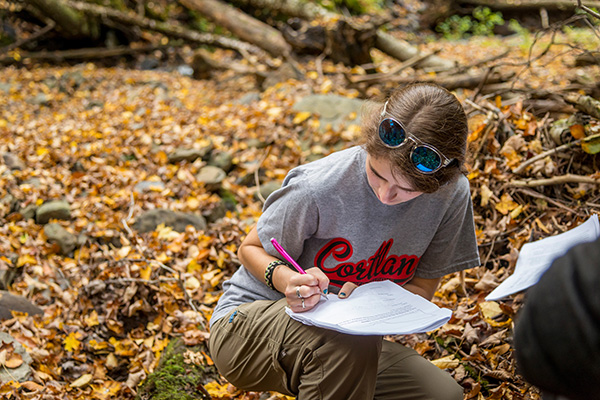
Regardless of the path they choose, all students will pursue fieldwork at SUNY Cortland’s W.H. Parks Family Center for Environmental and Outdoor Education, which includes facilities at Brauer Field Station near Albany, N.Y., Hoxie Gorge seven miles from campus, and Raquette Lake, N.Y., in the Adirondacks.
That unique outdoor campus in the Adirondack wilderness spans more than 440 acres and stands out as the only National Historic Landmark in the SUNY system. Gleason said the nearby Hoxie Gorge nature preserve and Brauer Field Station, located near the base of the Helderberg Escarpment, prove just as valuable. The latter recently added new water monitoring wells so that students can conduct pump tests to see how water flows through the ground. The facility’s plant diversity also stands out.
SUNY Cortland’s new environmental science major also will include an internship requirement, following the model of the university’s environmental geoscience major. Potential locations could span the Department of Environmental Conservation to local soil and water conservation districts. Those could also turn into potential employers, along with the U.S. Geological Survey.
“We find that (the internship) has been a really transformative experience for our students,” Gleason said. “You can just see the maturity that happens during it — the learning, the confidence. They really transition well as a result.”
She credited the new major’s development to the shared expertise of colleagues across academic departments spanning the sciences, geographic information systems and mathematics as well as the leadership of Li Jin, a professor of geology who will serve as program coordinator.
SUNY Cortland environmental science majors will be well-trained scientists “who can do the whole thing,” Gleason said, taking into account animal behavior as well as ground, soil and water quality to monitor the health of the environment.
Now more than ever, environmental science work is critical, she said.
“Our health as individuals and as a human population depends upon the health of our environment, and I think that a lot of young adults are feeling the stress of what is going to happen to our planet,” Gleason said. “This is a way that they can put that focus and that energy into productive solution building.”
Learn more online about SUNY Cortland’s new environmental science major.