10/27/2026
Assemblymember Anna Kelles visited SUNY Cortland recently for several conversations focused on the health of the environment, culminating with a talk on the value of reusing construction materials as part of a circular economy.
A knowledgeable and trusted voice on environmental topics within state government, Kelles spent an afternoon at the university on Oct. 22 to engage with members of the campus community, take a tour focused on sustainability infrastructure and deliver a presentation titled “Advancing the Circular Economy: Textiles and Construction Materials.”
Kelles represents New York state’s 125th Assembly District that includes Tompkins County and the southwest portion of Cortland County. She holds a dual bachelor’s degree in biology and environmental studies from Binghamton University and a Ph.D. in nutritional epidemiology from the University of North Carolina at Chapel Hill.
“We were honored that Assemblymember Kelles spent so much time here learning about sustainability at SUNY Cortland,” said Megan Swing, the university’s energy and sustainability engagement coordinator. “She wanted to hear from her constituents — especially our students — about the environmental topics that matter most to them, and she also wanted to share her own important work to promote more sustainable construction practices. Dr. Kelles has a deep and abiding care for our natural environment, and it showed during her visit.”
Kelles has helped craft notable environmental legislation in the State Assembly, including an initiative to block a proposed trash incinerator on the shore of Cayuga Lake. Her committee leadership roles include chairing the Assembly’s Planning, Development and Environmental Quality Committee. She also served as a director for the Green Resource Hub, a regional nonprofit organization with the mission of supporting environmentally friendly businesses, organizations and entrepreneurs.
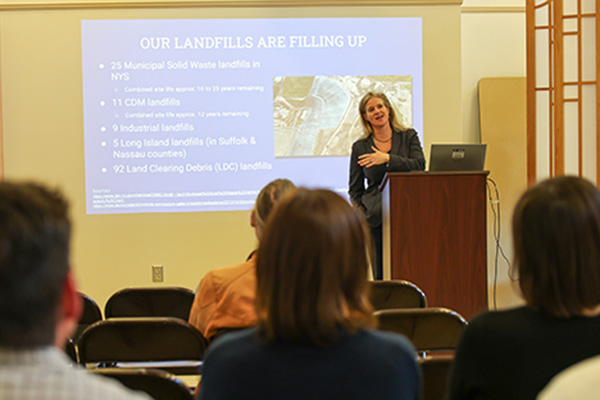
As part of her visit, Kelles offered a public talk to make the case for reusing construction materials through deconstruction rather than demolition, discussing three recent bills she has written and introduced to promote a deconstruction initiative. She urged a shift from demolishing buildings outright to carefully taking them apart and reusing their materials to reduce waste and potentially build a new industry.
Kelles said that New York state has limited landfill capacity and pointed to construction and demolition debris as a major part of the waste stream. In her presentation, she cited an estimate of 42.2 million tons of total waste annually, with 46% coming from construction and demolition.
Her proposed alternative is deconstruction — removing materials such as bricks, wood and drywall so they can be used again. She cited a Cornell University study estimating that a statewide deconstruction system could support an industry worth upwards of $4 billion and create more than 150,000 jobs. She also suggested that salvaging materials could ease supply shortages and avoid some of the emissions associated with producing new materials.
According to Kelles, New York is well-suited to build the needed infrastructure to spearhead the establishment of a circular economy for construction materials.
The sustainability-focused visit also included a meeting to gather student input with SUNY Cortland’s Green Reps and green ambassadors. Those students are entrusted to lead peer-to-peer environmental education programs at the university.
SUNY Cortland sustainability highlights throughout the past year include:
- Being named to the Princeton Review’s annual “Guide to Green Colleges.”
- SUNY Cortland’s Red Dragon Reuse program, a collaboration with Cortland ReUse, which won a nonprofit sector award from the New York State Association for Reduction, Reuse and Recycling. The effort helped rehome roughly 18,000 pounds of dorm supplies and clothing donations at the end of the academic year.
- Earning a Second Nature Catalyst Grant to strengthen campus climate action projects—one of eight campuses from across the country to receive the award.
Learn more online about SUNY Cortland’s sustainability resources and initiatives.