10/22/2026
One of SUNY Cortland’s most unique outdoor education facilities will receive upgrades thanks to a SUNY-wide initiative to make nature more accessible.
Hoxie Gorge, an expansive nature preserve located seven miles south of campus, will benefit from a grant through SUNY’s Outdoors for All program. The university is one of 14 across the system to receive funding that aims to increase year-round educational opportunities highlighting New York state’s natural beauty.
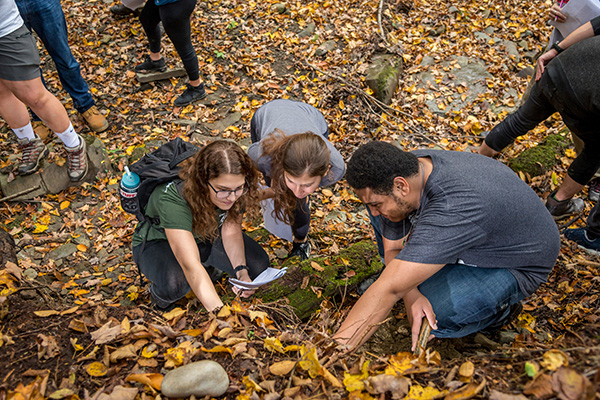
Part of SUNY Cortland’s W.H. Parks Family Center for Outdoor and Environmental Education, Hoxie Gorge covers more than 165 acres and includes the one-mile McDermott Nature Trail, offering precious space for students to enjoy the outdoors and conduct fieldwork across several academic disciplines.
Funds from the grant will add a portable toilet and permanent sanitation station to a cleared campsite along with updated trail signage and improvements to the arboretum trail loop. Work will be led by the university’s Recreation, Parks and Leisure Studies Department.
“Outdoor education provides transformative learning experiences and it highlights the importance of protecting our environment,” said SUNY Cortland President Erik J. Bitterbaum. “On a local level, SUNY’s support will help us improve Hoxie Gorge, a natural gem that affords many opportunities for our community, from recreation to undergraduate research.
“We are very pleased to make the outdoors more accessible for all.”
SUNY Cortland has maintained Hoxie Gorge for more than 50 years and uses it as a unique outdoor classroom in academic departments such as Biological Sciences, Geology and Recreation, Parks and Leisure Studies. In addition to the McDermott Nature Trail, the nature preserve includes a connection to the 1,000-mile Finger Lakes Trail, cross-country ski and snowshoe trails, three tent sites and a base camp area.
During the 2025-26 academic year, more than 40 students and community volunteers helped prepare that campsite area and update interpretive trail signage to educate visitors. The grant will continue those efforts and look to improve the existing trailhead and parking lot area near the southern portion of the McDermott Nature Trail, which now welcomes through-hikers of the Finger Lakes Trail.
Leisure studies research suggests that outdoor participation can differ by race and income, with underrepresented populations often citing barriers that include a lack of basic comfort infrastructure such as public restrooms.
An ADA-accessible portable toilet will be added at the trailhead for the duration of the grant, providing reliable restroom access at a high-traffic site for people of all abilities. A permanent, volunteer-built privy also will be added to the cleared campsite area for an additional sanitation outlet.
Updated directional and interpretive trail signage will assist wayfinding by accurately reflecting the Finger Lakes Trail’s rerouting on the McDermott Nature Trail. A current interpretive trail pamphlet and numbered post signage for the trail will utilize resources available in SUNY Cortland’s Makerspace. And a newly cleared, marked and stabilized arboretum trail loop will provide a second accessible route to explore.
Research conducted at Hoxie Gorge has attracted more than $500,000 in grants and produced roughly 30 journal publications. Those research topics include insect chemical ecology and behavior, taxonomy of mushrooms, conservation biology of amphibians, pollination biology of flowering plants and nutrient cycling in streams.
In addition to the hundreds of students who access Hoxie Gorge each year for coursework, the improvements also will directly support the university’s Outdoor Pursuits program, which uses the facility for introductory, low-barrier camping and overnight trips.
The university’s Recreation, Parks and Leisure Studies Department will work with several campus partners on the improvements, which are scheduled to be completed by the end of the 2026-27 academic year.