02/25/2026
Preparing future science teachers is about helping them design curriculum that lets children of all ages envision themselves as scientists, according to Sage Andersen, a newly appointed SUNY Cortland assistant professor of childhood/early childhood education.
As a graduate student and now as a promising university scholar, Andersen has researched a method called storyline instruction. It’s fast becoming the gold standard in teacher education given its focus on students’ sensemaking, agency and curiosity. Her work fills a very real gap in science education research through the development of a framework to prepare preservice teachers to teach using storylines.
Andersen’s ongoing research — as reflected in her doctoral dissertation on the innovative approach to teaching STEM — has not gone unnoticed. Recently, she was chosen to receive a prestigious national award for outstanding doctoral research in her academic specialty of science teaching.
Andersen will be honored with the 2026 Outstanding Doctoral Research Award by NARST: A Global Organization for Improving Science Education through Research.
NARST, which stands for National Association for Research in Science Teaching, will recognize Andersen during a ceremony on Monday, April 20, during the organization’s annual conference in Seattle. Andersen, who arrived at SUNY Cortland last fall after earning a doctorate in STEM education from the University of Texas at Austin, also will share her research with members during a 15- to 20-minute virtual talk followed by a question-and-answer session next fall.
According to Andersen, the storyline instruction method replaces hands-on demonstrations in the classroom and lab, once considered the pinnacle of teaching science, technology, engineering and mathematics (STEM).
In her dissertation, Andersen illustrated the difference between the two methods with the classic water density demonstration involving dropping two grapes into a pair of glasses of water. Salt is added to one of the glasses, causing its fruit to gain buoyancy.
The classic hands-on method has its shortcomings, however.
“While students in this class may have opportunities to engage in science practices through investigations planned across the unit, they are not positioned as capable sense makers who figure out and explain complex scientific phenomena or as agentic in this sensemaking work,” Andersen wrote in her doctoral dissertation.
“What you would do in a storyline approach is give them a phenomenon that is actually meaningful that we can only explain if we understand water density,” Andersen said.
For example, her future teachers might instead work on learning how to get the schoolchildren to discuss water density tied to something that they can relate to, for example, melting ice at the earth’s poles that is leading to less salty water and the slowing and potential collapse of one of the world’s major ocean currents — an event that would impact weather and climates around the globe.
In her Cortland classroom, future teachers engage in this very unit, using individually placed Post-it notes to model a Driving Question Board to model this approach to teaching where the children are developing their own creative new scientific avenues. The ideas can flow freely with just a little guidance from the college students or Andersen.
“The learning throughout a storyline unit is guided by their questions, their ideas and their curiosities,” she said of the schoolchildren who will ultimately benefit on her students’ preparation. “So, it’s really a student-centered approach to science teaching and learning and it gives students agency in the classroom.”
Also, the storyline lessons don’t rely on lengthy, stand-alone science lessons, lending this approach to science instruction to quick, but meaningful 20-minute sessions at schools where little or no time at all is formally set aside for a science class, she noted.
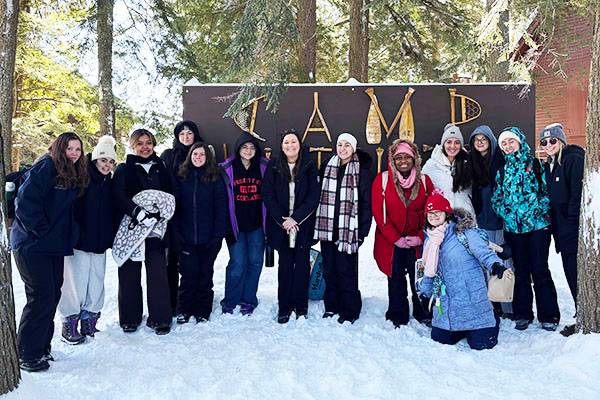
Andersen twice has taken her education students to the William H. Parks Family Center for Environmental and Outdoor Education in Raquette Lake, N.Y.
In both the fall and spring class trips she’s led to the university’s Adirondacks campus, Andersen has focused on equity and how to make science learning, both in and out of doors, accessible and meaningful to any child that participates.
“One of the things that I try to do with my preservice teachers is center these different equity lenses in the work that we’re doing in science,” Andersen said. “Many of my students think that science is separate from equity, that they’ve never even thought of doing equity work in a science education space.”
A native of California, she also has an M.S. in biological sciences and educational media design from University of California, Irvine, and a B.A. integrative biology from University of California, Berkeley.
Before joining SUNY Cortland, she taught at the University of Texas at Austin and University of California, Irvine. For almost a decade, Andersen has served Teach for America in science teaching capacities. She began her career teaching at Whittier Health Science Academy in the San Antonio Independent School District.
“I am deeply honored to receive this award and am excited to continue this important work here at SUNY Cortland with our preservice teachers,” Andersen said.
“My research and work with teachers inform one another, so I am also very grateful to have such a wonderful and supportive community here, from our amazing students to our incredibly welcoming faculty and administration.”
Select an image to begin a slide show
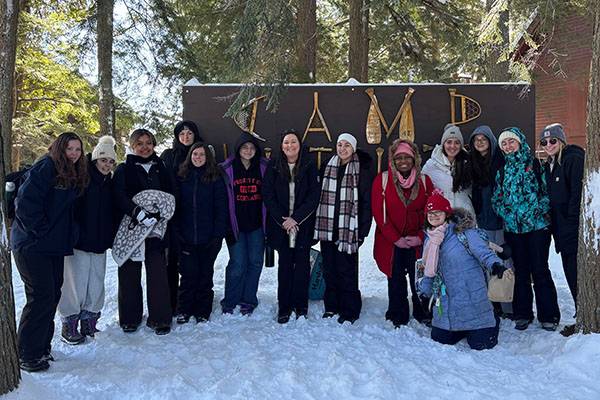
Andersen, center, gathers with her class at winter camp
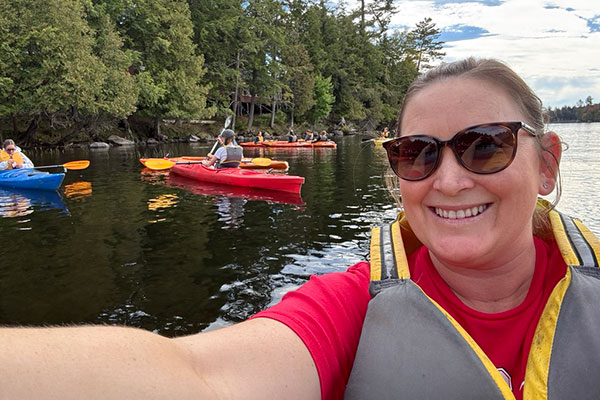
Sage Andersen on Raquette Lake with her class
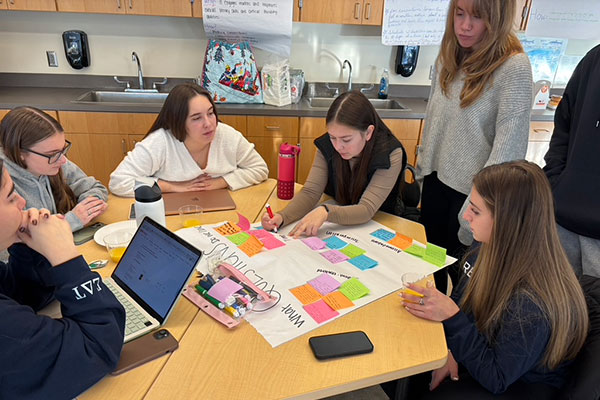
Sage Andersen's class charts their own scientific path