
02/24/2026
Audiences will be entertained when the dark, surreal comedy, “Mr. Marmalade,” brings humor and heavy topics to SUNY Cortland this week.
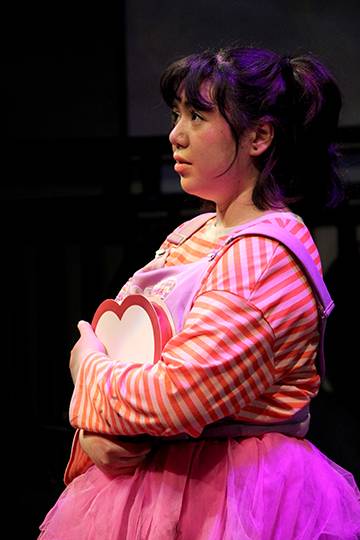
The play, written by Noah Haidle, explores the imaginative world of 4-year-old girl Lucy and how she processes adult themes with the help of a very imperfect imaginary friend, Mr. Marmalade.
Performances take place in the Dowd Fine Arts Center Lab Theatre at the following times:
- 7:30 p.m. on Thursday, Feb. 26
- 7:30 p.m. on Friday, Feb. 27
- 7:30 p.m. on Saturday, Feb. 28
- 2 p.m. on Sunday, March 1
The show is intended for mature audiences only, with references to violence, domestic abuse, suicide and child neglect. Tickets are on sale at SUNY Cortland’s online Box Office.
“While we want audiences to be prepared for these topics, we also want to remind them that it’s OK to laugh and enjoy the many light and hopeful moments,” said Benjamin Wells, production manager and publicity coordinator for the university’s Performing Arts Department.
Photos by Carlita Withers
Wells said the show relies on a strong script and deep characters addressing serious topics in smart ways.
When looking at possible shows, the Performing Arts Department reviewed options suggested by guest director Tanner Efinger. The goal was to balance larger scale productions like the upcoming “Rodger and Hammerstein’s Cinderella” with a smaller show that works well in the close-quartered Lab Theatre.
“Mr. Marmalade” features a cast of seven, including sophomore Athena Molina performing in a lead role as Lucy.
“Something that has been challenging about the show is the concept of playing a child pretending to be an adult,” said Molina, a musical theatre major from Staten Island, N.Y. “Even though (Lucy) is four, in her eyes she is very mature. I am not strictly playing a child, meaning I am not purposely doing a child-like voice and always behaving like a toddler.
“It’s difficult sometimes to find the medium between adult and child; I have to be very specific of the different characteristics that Lucy displays as she presents herself in different scenarios — especially if I want to carry the right tone and intention to the audience.”
Molina said it’s been rewarding to tap into her “inner child” while exploring Lucy’s character on a deep, emotional level, particularly in the play’s pre-show.
“While the show has very serious topics, there are still many moments that allow play and imagination,” she said.
That contrast between humor and heartbreak makes “Mr. Marmalade” a powerful artistic and emotional test for the cast and crew.
“We’ve spent time asking a fundamental question: how do you perform extreme emotional circumstances — how do you play Lady Macbeth, so to speak — without carrying that weight home with you?” said Efinger, who noted that tools for emotional boundaries, decompression and psychological safety have been an essential part of rehearsal.
Marissa Rowley, the play’s stage manager a sophomore musical theatre major from Sayreville, New Jersey, said being able to create a safe space for the cast and crew during the rehearsal process was important.
“I believe there is a different mentality for this show with the cast and crew because it does explore such serious themes and it is such an intimate show,” Rowley said.
The end goal is honest and powerful theater that also protects the well-being of the artists telling the story.
Syracuse-based Efinger said that, while living in England, he would visit fringe festivals held in the area, giving him deep appreciation of inventive theater. When approached to direct, he hoped to make something similar at SUNY Cortland, and envisioned a contemporary show with strong female roles.
The show is staged with seats surrounding the stage in a way that Efinger said invites the audience immediately into Lucy’s world.
“Having the opportunity to bring some of that spirit to Central New York — and to broaden the range of what audiences might expect from a local production — is something I find especially meaningful.”