
02/10/2026
The History Department is very proud to share the Alaskan adventures of Josiah Carnegie and Dylan McAdam. Both are Social Studies Adolescent Education - History dual majors currently student teaching in remote villages in Alaska.
A Remote Adventure
During the Spring semester of their senior year, Social Studies Adolescent Education students go out into the field to student teach, usually on Long Island, in New York City, and in the central New York region. Josiah and Dylan, however, decided to try something just a little different.
They are participating in SUNY Brockport’s student teaching program in Alaska. This NYSED-approved New York certification program allows New York teacher candidates to teach in rural schools and communities unreachable by road systems and home to strong Alaska Native cultural and tribal traditions.
While physically far from each other, the two are having similar experiences teaching in and adapting to rural Native communities.
Dylan is teaching in Chignik Lake, a village of less than 100 residents that is located on the Alaska (or Aleutian) Peninsula that separates the Bering Sea from the Pacific Ocean. Chignik Lake is part of the Lake and Peninsula School District and home to the Alutiiq.
Meanwhile, Josiah is teaching thirty miles north of Arctic Circle in Kiana, a village of 361 people not far from the Bering Sea. Kiana is part of the Northwest Arctic Borough School District and is home to the Iñupiat.
On the Aleutian Peninsula
In a recent email, Dylan shared his experience arriving in Chignik Lake and getting acquainted with his students. About his trip from Anchorage to his placement, Dylan writes, “Early the next morning, we woke up at 6 a.m., packed our belongings, and headed to the airport for our village flights. All of our gear had to be weighed, and at first, they were not sure they could bring everything.” About the flight, Dylan adds, “We boarded a small plane piloted by a 21-year-old, flew to Port Alsworth . . . to refuel and drop off passengers, and then continued to Chignik Lake (my placement). The last portion of the flight was turbulent, but we landed safely and were greeted by the principal, Melody, who brought us to the teacher's apartments and showed us around.”
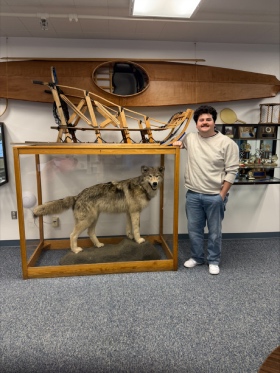
Photo by Dylan McAdam
In such a small community, he has built connections quickly. Dylan began teaching on January 11. He writes, “I worked with a class of two students and another of five, and on the first day I joined a morning circle with the elementary school. We said both the Pledge of Allegiance and the Alaska flag salute, and students greeted each other in different languages.” Dylan is also learning about the culture and language of his students. He noted, “I’ve started learning a few words in Alutiiq, the local tribal language.” One word he has learned is “Cama’i,” which means hello. He adds, “I also began helping with basketball practices, ran two sessions on my own, and started supervising the night gym program—something that reminds me of summer camp and has been a fun way to connect with students while earning extra income.”
Living so remotely can be an adjustment. Dylan adds, “Daily life here has included new responsibilities I never expected, like . . . learning how grocery orders work when shipments can take over a week to arrive. Fresh strawberries were delivered to the school one day, and the students were incredibly excited, which really put into perspective how limited access to fresh produce can be in remote communities. Weather has been another adjustment: after days near -20°F, temperatures climbed closer to 30°F, which felt almost warm.”
Reflecting on the experience so far, Dylan concluded, “Overall, this experience has already pushed me professionally and personally. Living in a small, remote village has shown me how flexible teachers need to be and how important schools are to the entire community. The students are kind, curious, and hardworking, and the staff have been incredibly supportive. I am learning far more than I expected about teaching, rural education, and daily life in Alaska and I would absolutely encourage other future educators to consider a program like this if they are looking for an unforgettable experience.”
North of the Arctic Circle
Meanwhile, Josiah has been thriving further north under the stunning colors of the northern lights. According to a recent email from Josiah, “I have had a wild experience so far as it's been nothing like what I expected it to be.” The initial arrival was a cold one with temperatures 40 below zero, not including the wind chill. Since then, Josiah shares that “Alaska has actually been much warmer than Cortland.”
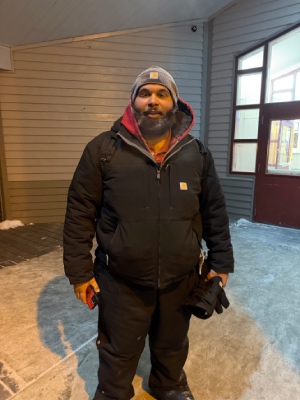
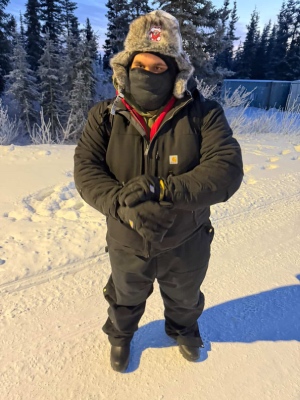
These photos of Josiah (plus the northern lights photo at the top of the page) were provided by Josiah Carnegie
Teaching has gone well for Josiah. He teaches all grades between 7-12 and on topics that include U.S. and World history, English Language Arts, Inupiaq Studies, and Art. Reflecting on those courses, Josiah shares, “I have never taught all grades in the same day before as well as multiple subjects. Although the multiple grades and subjects were hard to juggle at first, I am glad to have the opportunity to be able to facilitate my own interdisciplinary lesson plans, intersecting what students learn in history with both English and Art.”
Josiah’s story is also one of cross-cultural exchange. He writes, “I have experienced a cultural shock as I have immersed myself in the Iñupiaq culture, which has given me the opportunity to do many new things.” These included trying new foods such as “Eskimo ice cream (Akutuq), seal oil, caribou, moose, and white whale meat (Muktuk).” “Although hesitant at first,” Josiah adds, “I muscled up the courage to be open minded and embrace the opportunity to take part and try foods that I typically would not encounter back home. As a result of my open-mindedness, I began to build relationships with the students and staff. This led to me being asked to referee the student basketball tournament last weekend.”
Life in an isolated village is very different. The area is a “food desert,” where almost all groceries are flown in, so Josiah has been surviving on school breakfast and lunch. Reflecting on this, Josiah writes, “Dealing with these circumstances has been difficult and has taught me to greatly appreciate my life back home. This experience has taught me how lucky I am to have access to clean water, affordable grocery stores, and healthcare. I have a new respect for Alaska Natives and their way of life as they live on subsistence, meaning they use the resources of the land for food and other goods and have a cultural connection to the land.”
In March, both Dylan and Josiah will return to New York to finish their student teaching closer to home. Dylan will be teaching on Long Island, and Josiah will be in the city of Syracuse. In both cases, they will have wonderful stories to share with their new students and bring home with them many lessons learned for adapting their teaching to different cultural and economic contexts.