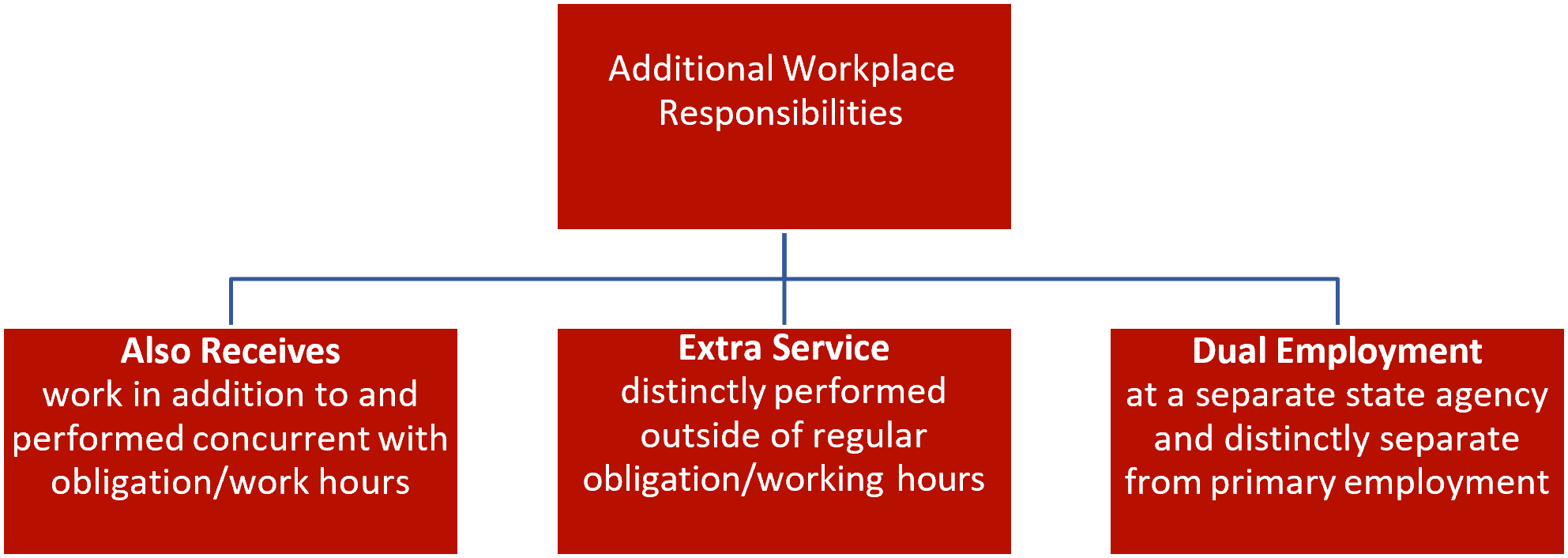
The university recognizes that there may be times when professional staff (academic and professional positions represented by United University Professions and management confidential (MC) positions) are required to perform service beyond their typical obligation as defined in their performance program or faculty obligation/workload. In this situation, one of following three compensation methods may be used.
Also Receives
Also Receives (ALR) are appropriate when employees take on additional duties or assignments, typically within their primary department, that are in addition to and substantially increase or expand the scope of the employee’s normal professional responsibilities. The performance of these additional duties is mostly indistinguishable from the employee’s regular professional obligation/work hours, although additional work hours may be necessary to complete all responsibilities. The additional duties or assignment is usually limited in nature or may be aligned with a responsibility in which the additional compensation will end when the assignment and/or funding ends.
Examples of ALR situations include:
- Taking on additional assignments for a limited time in the case of employee turnover or leave of absence.
- Example: Director of Human Resources leaves, and the Assistant Director is asked to take on some or all of those duties while a search is being
- FT faculty assuming temporary administrative assignments/responsibilities which are performed indistinguishable from their primary Examples include serving as graduate/program coordinator, serving as Faculty Senate Chair, taking on a temporary responsibility for a program review, or adding a large group of advisees due to a long-term absence of a colleague.
Limitations for ALR
- Faculty on leave (including but not limited to sabbatical or Title F) are not eligible for also receives.
- Classified employees are not eligible for also receives. They will receive overtime at the rate of time and one-half for hours worked more than 40 hours in one work Employees who have a work schedule less than 40 hours will earn comp time up to the 40 hours and time and one-half thereafter.
Compensation for ALR
Compensation for ALR shall be determined in consultation with Human Resources consistent with the Temporary Salary Increase for Professionals policy or other established compensation rates. Compensation for ALR should not exceed an amount equal to 20 percent of base annual salary in any academic or calendar year beginning July 1 or September 1 as appropriate. For example, a professional employee earning a salary of $50,000 may not be paid more than $10,000 for extra service in any 7/1 – 6/30 period; a faculty member earning a salary of $50,000 may not be paid more than $10,000 for extra service in any 9/1 – 8/31 period.
Exceptions to ALR amounts in excess of 20% may be made in writing by the President to the SUNY Office of University-wide Human Resources for approval. An employee who receives ALR can receive other forms of additional compensation where appropriate.
Timeline for Approving ALR
Employees shall have their ALR approved in advance of commencing service. Failure to obtain prior approval may jeopardize payment. Employees and their supervisors must use the appropriate form, available on the SUNY Cortland HR website, to seek approval for ALR.
Work completed prior to approval will require written justification to be considered for compensation.
ALR Approval Process
The ALR approval process should begin with a review of the proposed assignment by the employee’s direct supervisor against the current performance program or established faculty workload to ensure the proposed assignment meets the criteria for ALR. The proposed assignment must be in addition to and must substantially increase or expand the employee’s normal professional responsibilities. The proposed assignment must not be a permanent increase or expansion in duties nor be duplicative of the employee’s current responsibilities.
A Request for Approval of Extra Service or Also Receives form shall be completed by the immediate supervisor of the additional service to be performed and must ensure thorough completion of the required sections of the form. Failure to complete these sections may result in disapproval of the ALR or delay in payment. The form shall then be agreed to and endorsed by the employee performing the ALR. If an employee is not satisfactorily meeting expectation of their regular obligation, ALR should not be approved.
Upon endorsement by the employee and immediate supervisor, the form shall then be approved by each level of supervision in the organizational unit up to the vice president who shall serve as the President’s designee for UUP requests. If a UUP request exceeds the 20% cap, it shall also require the President’s approval and submission to the SUNY Office of University-wide Human Resources for final approval. MC requests for ALR require the endorsement of President and, as appropriate, may need approval by University-wide Human Resources. Upon final approval by the President’s designee, the President, or University-Wide HR as appropriate, the form shall be routed to Human Resources for final review and processing.
Form
When an ALR assignment is canceled or stopped
If an ALR assignment that was previously approved is canceled or does not start, it is the responsibility of the supervisor to immediately inform the Human Resources Office so that payment can be cancelled and/or stopped and recovered in a timely basis. This notice shall be in an email to [email protected] and shall include the name of the employee, the ALR assignment, the original start and end date of the assignment, and the date the ALR employee was notified the additional assignment was canceled. Please also attach a copy of the previously approved ALR form.
In the case of an employee receiving an ALR due to covering a vacant position, the ALR shall stop no later than the first day of employment of the new employee.
If an ALR supervisor has concerns that an ALR assignment is not being completed satisfactorily, the ALR assignment may be stopped after consultation with a member of the Human Resources Office.
Ongoing Monitoring of ALR
The timeframe for an ALR approval may not exceed one year. Open-ended approvals will be reviewed for continuation on at least a six-month basis by Human Resources with the employee’s supervisor.
A formally documented and approved request for extension or renewal should be completed when the ALR is expected to continue past a year or the pre-identified end date. The request should provide an explanation for the continuation along with evidence that the work has been completed satisfactorily. Supporting documentation should be included.
Extra Service
Extra Service (ES) is work performed by a faculty or professional employee that is substantially different from, or in addition to, their regular assigned professional responsibilities. These special assignments may be performed on the home campus or at another state agency but must not interfere with the individual’s regular professional responsibilities.
Generally, ES is used when the following conditions are met:
- For MC and professional employees, the work is performed outside regularly assigned working hours.
- For MC and professional employees, the work to be done is substantially different from their defined professional obligation, as outlined in their performance program.
- For academic employees, the work to be done is in addition to their defined obligation/workload, such as an overload course.
- The ES work does not interfere with the regular obligation and responsibilities.
Most work assigned to and performed by professional employees is considered to fall within their normal obligation and is not subject to Extra Service compensation, apart from instructional work (credit or non-credit). The following criteria must be met for Extra Service payments:
- Non-instructional work must involve only activities and expertise that fall outside of the employee’s normal professional obligation and relationship to their department/the
- Non-instructional work is generally performed in and for a unit other than the one to which they are assigned.
- Professional employees teaching a course other than COR 101, shall teach outside of their primary work hours/obligation. Those teaching COR 101 shall clearly identify when the time will be made up if it occurs during their typical workday.
Part-Time Employees: Employees whose primary appointments are part-time may be paid “concurrent” (not extra service) if the work is for another state payroll agency and the combination does not exceed full time (100%). If the work is for SUNY Cortland, a part-time employee may have their part-time payroll percent and salary increased (up to 100%) to compensate them or be paid via extra service as determined by Human Resources. In the event a part-time employee’s regular and concurrent assignments exceed a full-time (100%) obligation, any additional responsibilities above that will be considered extra service.
Graduate Assistant: Graduate Assistants are not considered full-time employees and are not eligible for extra service. A full assistantship generally requires 20 hours of service per week. Any work more than 20 hours must be pre-approved as detailed in the Graduate Assistantships – Compensation and Work Obligation policy.
Limitations for ES
- Faculty on leave (including but not limited to sabbatical or Title F) are not eligible for Extra Service.
- Classified employees are not eligible for extra They will receive overtime at the rate of time and one-half for hours worked more than 40 hours in one work week. Employees who have a work schedule less than 40 hours will earn comp time up to the 40 hours and time and one-half thereafter.
- Compensation for extra service may not exceed an amount equal to 20 percent of base annual salary in any academic or calendar year beginning July 1 or September 1 as appropriate. Summer employment of persons having an academic year obligation constitutes summer session and is not extra service. Summer session appointments and rates are subject to SUNY’s summer session policy.
- Employees may not engage in other employment whether within or outside the University which interferes with the performance of their primary professional Additional extra service activities must conform to the ethical standards mandated by Section 74 of the Public Officers’ Law. In essence, an employee may not engage in any business or transaction or professional activity of any nature, which is in substantial conflict with the proper discharge of their duties in the public interest.
- No full-time employee of the University (SUNY state-operated and community college campuses) may assume another full-time position or obligation either within or beyond the University while receiving compensation from the University.
Timeline for Approving ES
SUNY Cortland employees performing extra service at SUNY Cortland shall have their extra service approved in advance of commencing service utilizing the appropriate form(s). Failure to obtain prior approval may jeopardize payment. Assignments commencing prior to form approval must receive written acknowledgement and approval of the need for delay in form approval. Work completed prior to approval will require written justification to be considered for compensation.
Approval Process
Request for Approval of Extra Service or Also Receives forms shall be completed by the immediate supervisor of the additional service to be performed (hereafter the ES supervisor) and shall ensure thorough completion of the required sections of the form. Failure to complete these sections may result in disapproval of the ES or delay in payment. The form shall then be agreed to and endorsed by the employee performing the ES and approved by their primary obligation supervisor of record who is certifying that the ES work is outside of and in addition to their regular professional obligation. If an employee is not satisfactorily meeting expectation of their regular obligation, extra service should not be approved.
The form shall then be approved by the ES supervisor and each level of ES supervision in the organizational unit up to the vice president who shall serve as the President’s designee for UUP requests. MC requests for ES additionally require the endorsement of President and the Chancellor’s designee at SUNY. Upon final approval by the President’s or Chancellor’s designee as appropriate, the form shall be routed to Human Resources for final review and processing.
Form
Additional assignment canceled or stopped
If an ES assignment that was previously approved is canceled or does not start, it is the responsibility of the ES supervisor to immediately inform the Human Resources Office so that payment can be cancelled and/or stopped and recovered in a timely basis. This notice shall be in an email to [email protected] and shall include the name of the ES employee, the ES assignment, the original start and end date of the assignment, and the date the ES employee was notified the ES assignment was canceled. Please also attach a copy of the previously approved ES form.
If an ES supervisor has concerns that an ES assignment is not being completed satisfactorily the ES assignment may be stopped after consultation with a member of the Human Resources Office.
Certification of work completion for ES
Appropriate records shall be maintained certifying the satisfactory completion of ES work assignments. The specific format of the record will vary depending on the nature of the ES assignment. The following represent appropriate records:
- Instructional assignments: Typical academic records shall be maintained which include a syllabus, electronic records of the course, gradings, CTE’s, which are maintained at the department level and consistent with academic retention schedules.
- Non-instructional project-based assignments: The projects may not be easily quantified or scheduled in advance but culminate with a final product such as a report. An illustrative example would be work on researching and preparing a report or other final record. In these cases, the ES supervisor shall include a schedule of check-ins and progress reports by the ES employee throughout the period of ES. At the conclusion, the final product shall be submitted by the ES employee and maintained by the ES supervisor for a period of at least three years.
- Non-instructional scheduled service or “per instance” payment: In cases when the ES assignment is measurable and tied to a specific schedule, the ES assignments should be recorded on SUNY Cortland’s ES payment voucher and submitted to the Payroll Office on a biweekly basis upon completion of service. Examples when a payment voucher will be required include a specific assignment schedule per month, biweekly, week, or per day, or a fee payment “per-instance” for completion of an “event(s)” such as a workshop or specific training In circumstances where a payment voucher will be required, the Payroll Office will notify the employee and ES supervisor of the necessity for the voucher. Failure to submit the required voucher on a timely basis may result in delayed or forfeited payments.
Dual Employment
Dual employment is when an employee is working for more than one state agency on a part-time basis and the combined service in all positions and with all agencies does not exceed full-time service. This typically occurs with adjunct positions.
Dual Employment Approval Process
Prior approval must be obtained through the completion of a Dual Employment/Extra Service Approval Form (AC 1588) from the agency head where the employee is regularly/initially employed before they can begin working for, or be paid by, another state payroll agency.
Supervisors who wish to hire someone on a part-time basis who is already employed on a part-time basis at another state agency or state-operated campus within the SUNY system should advise the person to complete a dual employment form to receive approval. Community colleges in the SUNY system are not state-operated campuses.
- If a current SUNY Cortland employee anticipates working part-time at another State agency, the employee will need to complete a dual employment form and submit it to their department head or Once the supervisor receives the form and verifies that it will not interfere with the employee’s regular duties, the form should be submitted to the Human Resources Office at the secondary campus.
- If the dual employment assignment will exceed full-time service (1.00 FTE) for the employee, the SUNY Extra Service Form (UP-8) must also be approved.
Related policies
Cortland’s Temporary Salary Increase Policy - Professionals
SUNY’s Also Receives Compensation Procedures and Guidelines for Professional Staff SUNY’s
Extra Service for Professional Staff
SUNY’s Summer Session Appointment and Compensation Rates
Related forms
Dual Employment/Extra Service Approval Form (AC 1588)
Form 11 (PDF)
Extra Service Pay Voucher for SUNY Cortland
SUNY Extra Service Form UP-8