05/19/2026
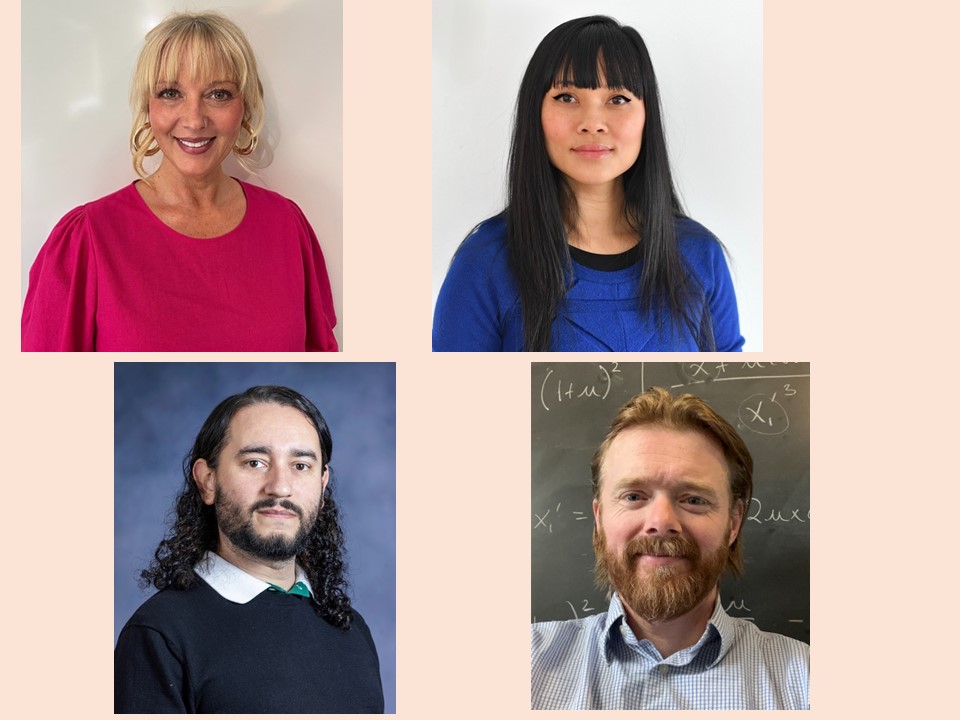
In April 2026, four faculty members became the newest Democracy Engagement Fellows. Each “DE” Fellow incorporated experiential learning into one of their syllabi; that experiential learning involves considering, reaching out to, or partnering with an appropriate government office.
The Democracy Engagement Fellowships began in spring 2023 as a focused version of the Cortland Applied Learning Practitioners (CALP) professional development program, in which CALP Fellows incorporated applied (experiential) learning, reflection, and active listening into a syllabus. Active listening skills are central to SUNY’s new General Education Civic Discourse Core Competency.
Additional information CALP sits below the descriptions of our newest DE Fellows’ work.
Caitlin Goodwin. (Pictured in upper left). Department: History. Academic Course: Writing in the Social Studies (AED 310). In this course, these future teachers create an initial lesson plan for democracy engagement knowledge and skills by leaning and practicing, themselves, active listening skills and media literacy skills. They also learn key civic engagement concepts.
Students then design a plan through which they create a classroom environment that fosters open inquiry and viewpoint diversity. This assignment gives future Social Studies teachers experience in creating the many lessons necessary to help high school students earn their New York State Seal of Civic Readiness – and engage in civic decision making.
Kim Nguyen-Nalpas. (Pictured in upper right.) Department: Psychology. Academic Course: Gender and Sexuality, PSY 329. Students learn active listening-related skills for engaging in difficult discussions and for interviewing people, especially individuals whose backgrounds are different from the student interviewer.
Students’ project is to interview someone who is either directly affected by policies related to gender and sexuality – or who has worked to change such policies. That interview and other work will be described in a report in which students identify possible avenues for creating sustainable change to improved the conditions for people who have been impacted by gender and sexuality-related policies.
Jean Costa-Silva. (Pictured in lower left.) Department: Modern Languages. Academic Course: Applied Linguistics for TESL (ESL 302). Students work on a six-part, semester-long project that begins with students learning learn active listening skills, especially in the context of cross-cultural communication. Working in pairs, they interview an international English-speaking individual in the Cortland area.
Next, students compose a compendium of their interviews and, based on that compendium, the students (a) select a city to – ideally – serve as a sister city to Cortland, and (b) co-author a letter to Cortland’s mayor, proposing their sister city project. The project wraps up with individual reflections on the experience and with each student composing a Democracy Engagement Portfolio.
Eric Edlund. (Pictured in lower right.) Department: Physics. Academic Course: Energy and Sustainability (PHY 305). This course blends science with current event issues. Students learn about energy and sustainability issues, and they learn active listening skills. They apply those skills in a project that pairs them with a student who disagrees with them on a specific issue. In preparation for the sharing of information and viewpoints on that issue, students research that issue.
Students research that issue in preparation for debating and deliberating their ideas with the other member of their duo. To emphasize the process of refining one’s perspectives, students revise their opinions, based on their interactions with their team member. Each student will then contact an appropriate elected official to advocate for their (the student’s) perspective on the issue.
The Cortland Applied Learning Practitioners (CALP) professional development program began in spring 2018.
CALP Fellows participate in six 90-minute workshops through which they incorporate applied (experiential) learning into one of their syllabi. This program’s foundation is active listening - which is key, of course, to open inquiry and viewpoint diversity.
Fellows use it in their interactions with students, and they incorporate it as a Student Learning Objective in their revised syllabi . Twenty Fellows across many disciplines received CALP stipends through a campus Institutional Assessment and Improvement Grant and a major SUNY Performance Improvement Grant.
In Spring 2024, the Institute focused that applied learning on partnerships with an appropriate government office as a way of helping students realize the additional resources that government has for creating longer-term solutions to challenges.
So far -
- Twenty-three Fellows completed this Democracy Engagement version of the program, receiving stipends through an alumna, Barbara A. Galpin.
- A total of 39 faculty members from across 16 academic departments have completed the CALP or CALP/DE program, including 3 who completed both.