10/02/2026
The SUNY system’s chief academic officer visited SUNY Cortland recently to learn more about student and faculty research and tour several of the facilities where it takes place.
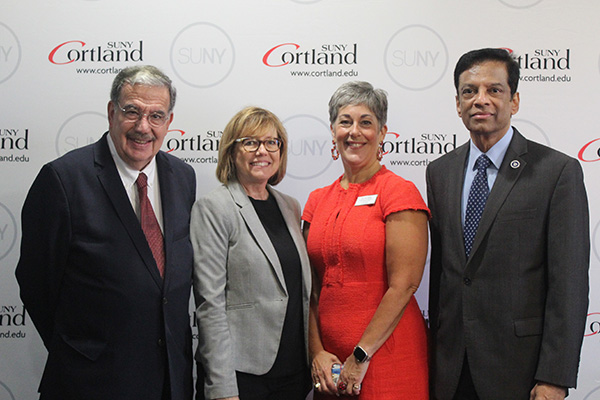
SUNY Provost Melur “Ram” Ramasubramanian, who also serves as president of the SUNY Research Foundation, spent several hours on Sept. 18 meeting faculty members leading impressive grant-funded work as well as undergraduates participating in key SUNY initiatives, including the system’s AI for Public Good initiative.
“It was an honor to host Provost Ramasubramanian,” said Ann McClellan, who serves as SUNY Cortland’s provost and vice president for academic affairs. “We like to talk about the importance of high-impact learning at SUNY Cortland, and undergraduate research is one of the clearest examples of that type of work.
“To meet and hear from the people behind the research proves critical to demonstrating the value of SUNY’s investment.”
Ramasubramanian met with representatives from all three of SUNY Cortland’s academic schools — Arts and Sciences, Education and Professional Studies — during his half-day visit.
Among the recent highlights that he learned about in person:
-
Student researchers who participated in SUNY’s AI for Public Good initiative: Two dual majors — Shreya Dhital, a biomedical sciences and mathematics major, and Camilla Piano, a criminology and social philosophy major — represented the university at SUNY’s Advancing AI for Public Good summer research program hosted at Binghamton University.
-
Faculty-led research on AI: Seven faculty and staff members contributed to a discussion about the topic. They included Erblin Shehu, an assistant professor of health, who is examining how AI-driven hiring technology affects employment opportunities for people with disabilities; Deborah Silvis, who is considering how young children engage with AI and ways to address the equity challenges it creates; and Lauren deLaubell, librarian in Memorial Library, who was selected as a SUNY AI for Public Good Fellow in 2025-26.
-
Preparing future teachers for AI topics: Representatives from the university’s School of Education highlighted additional efforts to prepare future teachers through SUNY Innovative Instruction Technology Grants. Their current project, a collaboration between university librarians and faculty in all three academic schools, focuses on six teacher education modules that support critical and effective AI use to support diverse learners.
Those topics cover information literacy for future educators; sociotechnical implications in educational contexts; and using AI in various other capacities — to promote scaffolded writing practice, design inclusive lessons, write individualized education programs for students with disabilities and support teaching learning in physical education.
Each module provides foundational concepts related to generative AI, application within various education contexts, critical evaluation of AI outputs and principles for ethical use. The team is gathering evidence of the modules’ impact through a pre- and post-administration of the GenAI Literacy Assessment Tool, faculty scoring of key assignments and a satisfaction questionnaire to inform a broader implementation in Spring 2027.
-
Recent SUNY Faculty Fellowship recipients: SUNY Cortland continues to be well-represented in the SUNY Academic Affairs Fellows Programs. Christopher Badurek, professor of geographic information systems, will focus AI for the public good while Karen Lister, associate professor of psychology, continues efforts dedicated to advance civil discourse, civic education and engagement in the classroom.
Ramasubramanian also visited several academic spaces that have benefitted from SUNY’s investment in capital funding tied to research. Those facilities spanned the sciences in Bowers Hall as well as the Professional Studies Building, which included laboratories for exercise physiology, human performance and biomechanics.
“For our students interested in exercise science — as in any science-related discipline — it’s critically important to have modern equipment,” said Professor of Kinesiology Kevin Dames, an expert on biomechanics who helped show off the space in the university’s Professional Studies Building with Associate Professor Bry Bellovary and Associate Professor Jason Parks. “One of the highlights of the provost’s visit was seeing our motion capture system, which equips students to collect, measure and interpret human movement.
“Training students on modern biomechanical tools and techniques used in clinical practice, research institutions and applied sport settings empowers us to produce competitive graduates,” Dames said. “We were honored to show off our facilities.”
Ramasubramanian’s visit also included a tour of the Cornish-Van Hoesen Hall C-Wing, which recently received a major $27 million renovation that included state-of-the-art spaces for communication and media studies majors.
“He saw a lot in a short amount of time,” McClellan said. “But more than the facilities, meeting the people behind the research and learning was the highlight of his visit.”