06/24/2026
A SUNY Cortland faculty member will join a major national effort examining how AI-driven hiring technology affects employment opportunities for people with disabilities.
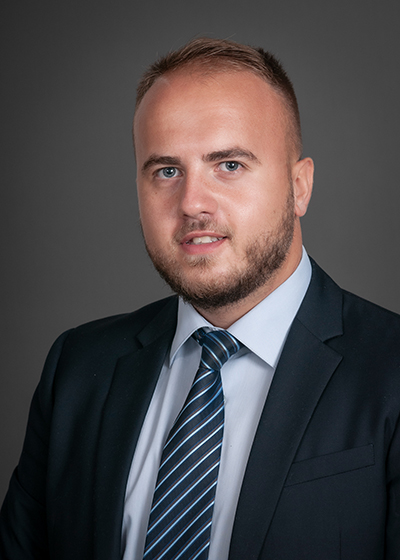
Erblin Shehu, an assistant professor who specializes in healthcare management, will serve as a co-principal investigator for the multiyear research project. A subaward worth approximately $180,000 is part of a larger $4.6 million grant awarded by the U.S. Department of Health and Human Services (HHS) to Syracuse University’s Burton Blatt Institute.
The funding is administered by HHS’ National Institute on Disability, Independent Living and Rehabilitation Research, the U.S. government’s primary federal research organization for disability. In addition to Syracuse and SUNY Cortland, the collaborative research team includes representatives from universities such as Harvard, Cornell and Rutgers as well as the data analytics firm Mathematica.
Shehu will consider how AI-assisted algorithms interpret the resumes of people with disabilities and how the technology impacts factors such as employer responses and call-back rates. This project is part of a larger five-year research agenda of coordinated projects at the Burton Blatt Institute designed to understand the conditions under which people with disabilities can enter, succeed and remain in the labor force. The research shares a commitment to policy solutions and the employment potential of people with disabilities.
“AI is reshaping how people get hired, and we need to make sure it doesn’t leave people with disabilities behind,” said Shehu, who has worked as an affiliated researcher at Syracuse University’s Burton Blatt Institute and taught at SUNY Cortland since 2025. “That’s why this project brings together researchers, practitioners and data scientists to tackle a question that affects millions of Americans. This research will help us identify where the gaps are and how to close them.”
Shehu’s work focuses primarily on healthcare policy, disability and aging and the social and community factors that shape health outcomes, with emphasis on care coordination and value-based care models. He studies quantitative and qualitative data to evaluate how healthcare programs and policies affect access, cost and quality of care.
More generally, his research on disability-related issues looks to inform workplace accommodations, inclusive practices and important national conversations.
In the upcoming project, Shehu’s role will contribute to data management and the assessment of differences in call-back rates. He also will help develop employer interview protocols, analyze employer practices related to algorithmic decision-making in hiring and share the eventual findings with wider audiences.
Shehu has published in Health Services Research, Population Health Management and the Journal of Applied Gerontology while conducting additional research on international health and humanitarian response. He has presented at leading conferences including AcademyHealth, American Public Health Association and the Gerontological Society of America. Prior to working in higher education, he held roles in public health workforce development and healthcare management in the U.S. and abroad.
He came to SUNY Cortland from the University of Iowa, where he earned a Ph.D. in health services and policy in 2025.