08/25/2026
Growing up, SUNY Cortland biomedical sciences major Anthony Santiago got lessons on hard work from a dad who worked construction and a mom who cleaned houses. Now a first-generation college student, he’s used their work ethic as motivation in his studies.
Santiago earned a donor-funded Summer Undergraduate Research Fellowship this year along with 16 other students — the most ever in the program’s 20 years.
“Taking on this opportunity ended up being one of the best experiences of my college career,” he said.
The fellowships help students develop strong research skills with a faculty mentor, leading them as far as Alaska and Turkey for their studies. Two additional students pursued similar summer work thanks to separate Chemistry Department funding.
Santiago’s work is designed to have an impact on future medical treatments. He plans to attend medical school after graduation, with the goal to pursue a career in orthopedic surgery.
“In the lab, I work on synthesizing potential DNA markers — compounds that lay the groundwork for diagnostic tools and targeted therapies,” he said. “Even if people don’t realize it, the fundamental chemical synthesis happening in research labs today is what enables early disease detection and safer, faster treatments.”
Managed by the university’s Undergraduate Research Council, the program provides students with a $4,000 stipend, campus research space and housing for eight weeks of full-time study from late May through August. The council gives an additional $2,000 to faculty members who mentor a student.
Research outside the classroom develops skills in self-organization, self-discipline and leadership, according to Andrea Dávalos, chair of the Undergraduate Research Council and associate professor of biological sciences.
For some students, the opportunity helps decide whether the subject is a career they’d like to pursue. For others it’s an effective first step toward building their abilities and resume in a professional path they’ve already chosen. But for all involved, the experience provides a unique chance to strengthen skills alongside a mentor.
“Students gain knowledge from the faculty working with them,” Dávalos said. “They're putting a lot of time and effort into their project, and they gain that insight from a person that has more experience in the field that they do. They really have an opportunity for growth.”
A committee of close to 10 representatives from the university’s three academic schools and Memorial Library review students’ project applications, judging based on criteria including intellectual quality, merit and creative experience.
Selected students present their results at the university’s annual Transformations: A Student Research and Creativity Conference.
“In the classroom, students learn what is already known; independent summer research invites students to tackle the unknown,” said Santanu Banerjee, associate professor of biological sciences and mentor to senior Rachida Ali Noma. “Solving real-world problems alongside experts and becoming proficient in using different scientific tools can completely transform a student’s resume — opening doors to top graduate programs, professional schools and high-impact jobs.”
Noma, a biomedical sciences major with a minor in chemistry, is studying the effects of bisphenol A (BPA), a known endocrine disruptor, compared to replacement bisphenol AF (BPAF). The chemical compounds are often found in plastics.
“We may not even realize it, but every time we take a receipt from a cashier, or drink from a plastic water bottle, we’re exposing ourselves to those bisphenols,” Noma explained. “As we know, industries tend to dump their waste in water — industries most of which utilize bisphenol affecting aquatic organisms and therefore directly affecting humans.”
The tests were done on zebrafish embryos, which share close to 82% of genes associated with humans.
Noma described her work as more than just the research. She said it provided a chance to actively apply concepts she’s learned in the classroom to practical problems. Noma’s work this summer has led her to choose a similar track once she earns her degree.
“I’m planning on going to graduate school in pharmaceutical science,” Noma said. “While it is true that I had doubts in the beginning regarding the ‘what’ after graduation, this research experience has cleared my mind. I know for sure that I want to make a career in the research field.”
The complete list of 2026 summer researchers includes:
Olivia Balfe
Majors: archaeology and history
Faculty mentor: Sharon Steadman
Funding: LoBracco Family Summer Research Fellowship
Research: Archaeobotany of the relative presence of legumes during the late Chalcolithic and late Bronze Age climate events.
Mackenzie Blackburn
Major: anthropology
Faculty mentor: Sharon Steadman
Funding: LoBracco Family Undergraduate Research Summer Fellowship
Research: Understanding dietary change during the late Chalcolithic and late Bronze Age climate events through faunal remains analysis.
Caitlin Bodary
Major: geographic information systems
Faculty mentor: Christopher Badurek
Funding: Sandra Laghi Cerulli ’68 and Dr. Maurice Cerulli Fellowship for Undergraduate Research
Research: Using geo artificial intelligence and machine learning to estimate exurban growth in Ontario County, N.Y.
Hayley Harrell
Major: art history
Faculty mentor: Wylie Schwartz
Funding: Nancy A. Johnson ’48, M ’56 Undergraduate Research Summer Fellowship
Research: Ancient influences on contemporary ceramics on the Ligurian Coast.
Madison Houghton
Major: archaeology and international studies
Faculty mentor: Hollis Miller
Funding: Dr. Suad Joseph ’66 Undergraduate Research Summer Fellowship
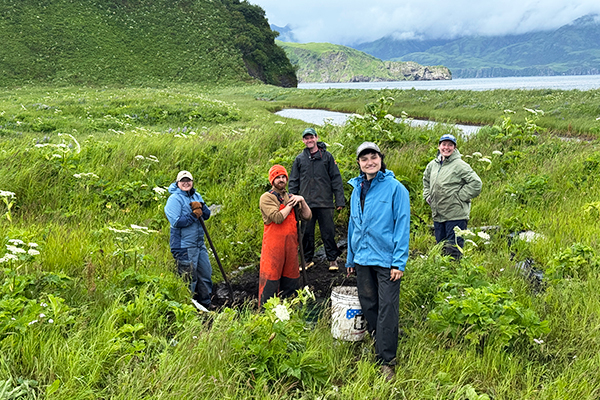
Research: A legacy of beads: An analysis of imported beads in Ing'yuq, Alaska.
Amelia Konstanty
Major: biochemistry
Faculty mentor: Katherine Hicks
Funding: National Science Foundation through principal investigator Katherine Hicks
Research: Structural characterization of the bacteria strain Streptomyces hygroscopicus jingganesis’ L-DOPA dioxygenase enzyme.
Nicholas McMahon
Major: biology
Faculty mentor: Andrea Dávalos
Funding: W. Hubert, Ph.D. and Ms. Sally Keen Undergraduate Research Summer Fellowship
Research: Effects of invasive jumping worms on terrestrial salamanders in Catskill Forest ecosystems.
Rachida Ali Noma
Major: biomedical sciences
Faculty mentor: Santanu Banerjee
Funded by: Dr. David F. Berger Summer Research Fellowship
Research: Environmental toxicants: Analysis of the toxicological effects of bisphenol A (BPA) versus bisphenol AF (BPAF) using zebrafish as a model.
Hawa Oulale
Majors: biochemistry and business economics
Faculty mentor: Sarah Wolf
Funding: Daniel G. Scheffer ’96 Undergraduate Research Summer Fellowship
Research: Can the impact of polymers on glass-to-crystal growth help us understand the mechanism of this type of crystal growth?
Kayla Pendergast
Major: adolescence education: biology
Faculty mentor: Katie Laux
Funding: Michael J. O’Reilly ’58 Undergraduate Research Summer Fellowship
Research: Reframing non-major biology labs: A rubric guided approach to inquiry-based redesign.
Mary Repass
Major: psychology
Faculty mentor: Joshua Peck
Funding: Dr. William M. Hopkins Undergraduate Research Fellowship
Research: The effect of specific environmental enrichment stimuli on sex differences with ethanol consumption in male and female rats.
Cynthia Saravia Reyes
Major: physical education
Faculty mentor: Jeongkyu Kim
Funding: Paul S. Fardy ’63, Ph.D. and Judith Rice Fardy Undergraduate Research Summer Fellowship
Research: Exploring cultural relevance in a rural after school physical activity program: An autoethnographic reflection of a pre-service physical education teacher.
Meghan Sainsbury
Major: sport management
Faculty mentor: Erin Morris
Funding: Nancy A. Johnson ’48, M ’56 Undergraduate Research Summer Fellowship
Research: How participation in women’s learn-to-play ice hockey programs influences self-efficacy, motivation and sense of belonging among adult women, and the psychological factors that predict continued participation.
Anthony Santiago
Major: biomedical sciences
Faculty mentor: Julius Green
Funding: Daniel G. Scheffer ’96 Undergraduate Research Summer Fellowship
Research: Substituent effects on the electronic and photophysical properties of N-substituted 2-Phenyl-1,3,2-Benzodiazaboroles.
Matthew Solan
Major: archaeology
Faculty mentor: Hollis Miller
Funding: Peter F. Eisenhardt ’67 and Susan Fish Undergraduate Research Summer Fellowship
Research: Understanding colonialism’s impact on indigenous tool making using experimental archaeology.
William Snyder
Major: chemistry
Faculty mentor: Jeffrey Werner
Funding: Arden P. Zipp Summer Research Fellowship
Research: Polyethylene terephthalate (PET) plastic degradation in simulated ocean water.
Roberto Crisostomo Suarez
Majors: teaching English to speakers of other languages (TESOL) and Spanish
Faculty mentor: Jean Costa Silva
Funding: Nancy A. Johnson ’48, M ’56 Undergraduate Research Summer Fellowship
Research: How learning languages changes the way we think: A study of pre-service TESOL teachers in Brazil and the U.S.
Analie VanManen
Major: English
Faculty mentor: Ivana Ancic
Funding: Nancy A. Johnson ’48, M ’56 Undergraduate Research Summer Fellowship
Research: Multicultural literary ecocriticism
Annabelle Wolchak
Major: adolescence education: biology
Faculty mentor: Julius Green
Funding: Peter F. Eisenhardt ’67 and Susan Fish Undergraduate Research Summer Fellowship
Research: The synthesis, characterization and electronic structure of pseudoaromatic heterocycles and their applications as DNA binding agents and in functional materials.
Photo, from left: Students Madison Houghton, William Kennedy, Matthew Solan, Abby De Leon (Dartmouth College) and Anna Tanzman at the Ing'yuq Village archaeological site on Sitkalidak Island, Alaska. Houghton and Solan were chosen for Undergraduate Research Fellowships this year.