03/23/2026
A SUNY Cortland speaker series continues to bring leading voices in science to campus as part of an initiative celebrating diversity in STEM.
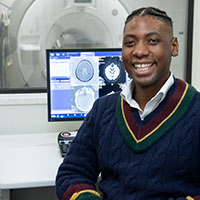
The most recent guest of the Diverse Voices in STEM lecture series, Senegal Mabry, a fifth-year Ph.D. candidate in Cornell University’s Department of Psychology, visited campus on Feb. 16 for his discussion on “Your Black and Blue Brain Regions and the Story They Tell About Brain Disease.”
In 2024, Mabry was named a Cell Press Rising Black Scientist of the Year in the Life Sciences.
“Speaker series like this expand what students see as possible,” Mabry said. “I wouldn’t have become a scientist without people who welcomed me into the field and invested in me personally. Creating spaces where students encounter diverse perspectives, pathways and people helps them see that they also can contribute to science.”
Thirty-three students and 12 faculty members attended the multidisciplinary talk on how brain regions vulnerable to Alzheimer’s and Parkinson’s change over time and the evidence that factors like exercise can maintain brain health. They represented academic departments including biological sciences, chemistry, childhood/early childhood education, economics, foundations and social advocacy, kinesiology, physics and psychology,
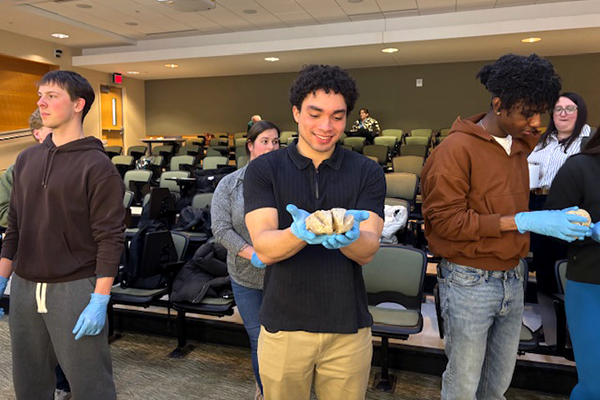
Mabry shared his journey in graduate school and the importance of democratizing neuroscience. He also led a hands-on workshop with the Cornell Human Brain Collection.
“It really helps demystify neuroscience because once they can hold a brain and see the structures we’re discussing, everything becomes much more real and tangible,” Mabry said.
When he was asked to be a guest lecturer, Mabry said it was an easy decision.
“SUNY Cortland is very close to my heart,” he said. “I have strong research collaborations with the Kinesiology Department there through my work on Parkinson’s disease, and through the Community Neuroscience Initiative at Cornell we partner with the Cortland C.U.R.E. program to train teachers in neuroscience and support classroom practice.”
The lecture series began in 2021, following the formation of the Biological Sciences Department’s DEI Committee the previous year. A major goal is to give students, especially from historically marginalized backgrounds, exposure to scientists that more directly reflected who they are.
“This lack of representation can deter students from pursuing careers in science or math,” said Theresa Curtis, professor of biological sciences.
Since then, three guest speakers have held seminars on campus. All were chosen with a focus on scientists from typically underrepresented backgrounds whose work has the potential to interest students across multiple departments.
A recent grant through the 2025-26 inaugural SUNY Cortland Inclusive Incubator Network of Grants (SCIING) Program, obtained in collaboration with the Chemistry DEI Committee, should support more speakers to come to SUNY Cortland. Another series lecture is planned for the fall.
The added funding also enabled a group of students to have a chance to sit down and learn more from Mabry while enjoying a dinner, something that Curtis plans to repeat with future guests as an added mentorship opportunity.
“These speakers will share their journeys in science and offer advice and inspiration to students,” she said.