05/01/2026
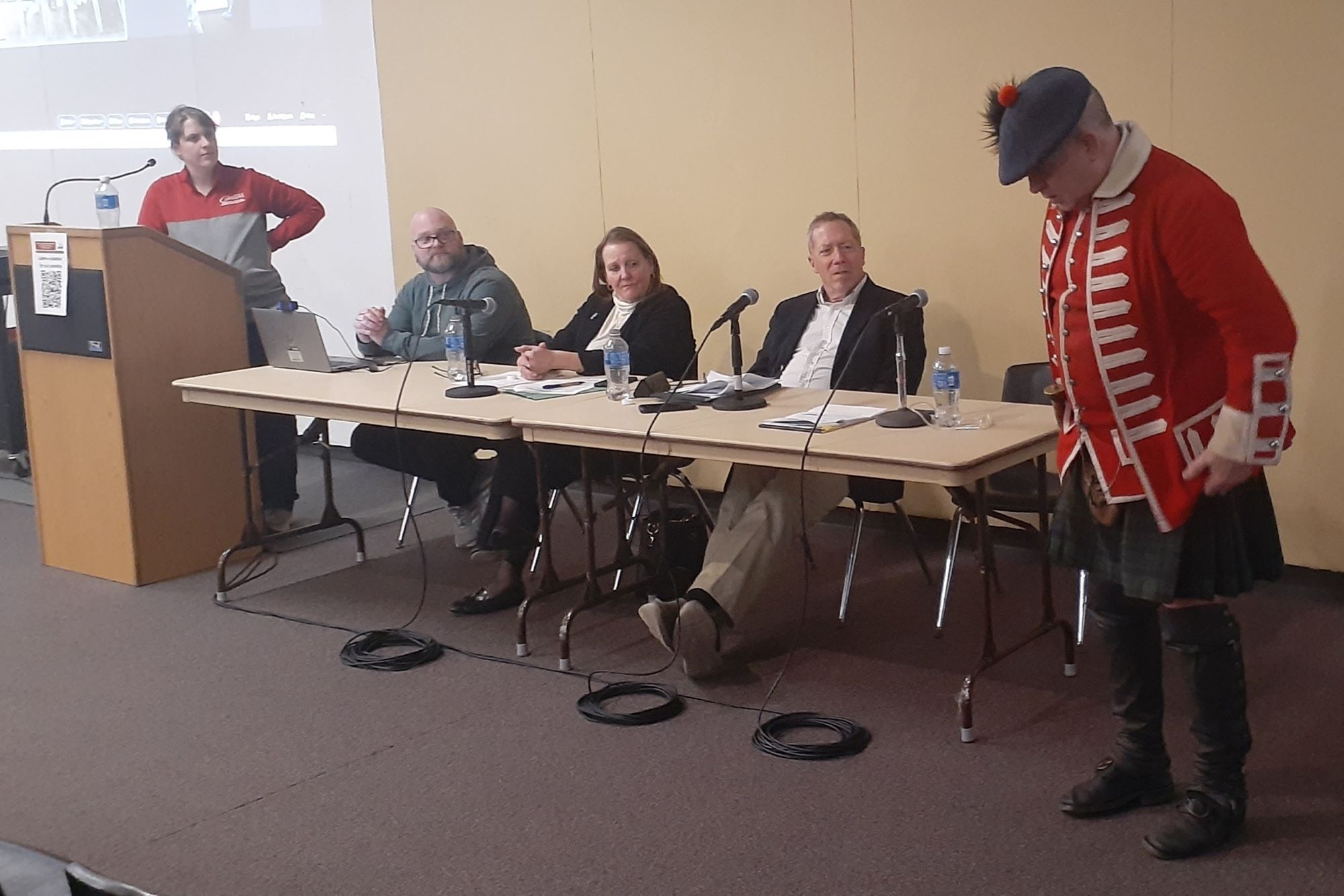
On April 23, five panelists described the range of considerations that they balance as they plan enlightening and engaging experiences for visitors at historic parks in New York’s Lake George Region.
The panelists were –
- Andrew Menzie (Director of Historic Interpretation and Lead Guide, Fort William Henry), who described activities related to site-level historical interpretation.
- Gina Mintzer (Executive Director, Lake George Chamber of Commerce) who explained decision-making around tourism marketing, especially in the evolving economic context, which included the pandemic.
- John DiNuzzo (President, Board of Trustees, Lake George Battlefield Park Alliance), who described his work in community preservation.
- Stan Cianfarano (Treasurer, Warren County 250th Commission), who detailed ways in which county representatives and volunteers coordinated efforts around the region’s celebration of the 250th anniversary.
- John Berry (Town of Queensbury Historian and Chairman of the Warren County 250th Commission) who discussed upcoming events in the county and how they were brought to life. Both Stan and John participated via Zoom.
Panelists described the importance of the 250th anniversary to their work, and why Lake George matters to America’s revolutionary story, beginning before the revolution, with – for example – The French and Indian War (1754-1763). They also explained ways in which their organizations work independently and in collaboration to make that history accessible to visitors.
Each speaker helped the mostly-student audience appreciate ways in which people in different fields of study help produce programming that is economically sustainable, and continually historically accurate and modern day-relevant.
Archeologists, for example, have unearthed 250+-year-old bones and buttons, along with items believed to have come from as far afield as modern Idaho, reshaping our understanding of early trade networks in colonial and revolutionary America.
Forensic specialists analyzed bones to identify cases of smallpox. Chemists and anthropologists noted the condition of the teeth in a particular skull that were markers for a quality of water that is only located in what is now Utah/Idaho - showing that at least one indigenous individual travelled to the Lake George area to participate in activities there.
Mr. Gianfarano said that historians of the Lake George area have pointed to reports that are echoed in current news: After the Battle of Lake George, initial reports claimed that about 100 people had died during the fight. As news of the battle spread, the number of deaths grew to at least 1,000. Similar exaggerations take place today over “legacy” news outlets and over social media.
Other career fields are important to the success of this programming. Ms. Mintzer named audience analysis/market analytics and graphic design/media communications, explaining that experts in these fields help determine the needs and wants of potential visitors.
People skilled in educational methodology contribute to the design of displays and activities and for the training of personnel to balance narrative engagement with historical rigor so that visitors learn from – and enjoy learning from – their experiences and tell others about the historical parks.
One of the panelists, Mr. Menzie, described one of the displays – the suit he was wearing (photo), including its purpose and use.
He asked audience members to imagine themselves as English soldiers firing their muskets. Unlike current rifles, mid-18th century firearms created a lot of smoke. Many soldiers fired their weapons within moments of each other, creating clouds of smoke. “You’d have had a hard time making sure you weren’t shooting your comrades!,” he said.
He then explained that, to help avoid that situation, English soldiers wore uniforms that were red (easier to see), and they stood in lines so that their location would be predictable. Unfortunately for British soldiers, these decisions helped American fighters ambush them. Mr. Nuzzo pointed out that fighting alongside the English in the French and Indian War showed American colonists that the British were not invincible – an attitude that would become critical in providing faith that Americans could defeat the world-dominating British forces.
The Revolutionary War was, of course, still a war, and Dr. Menzie reminded the audience that American leaders’ decision to split from England was made with mixed emotions, including fear: The signing of the Declaration of Independence was an act of treason against England, punishable by death.
During the Q&A session, panelists offered suggestions for career success, regardless of that career. One key suggestion was to be curious, be inquisitive. Travel and read widely; make connections between your experiences to create new ideas.
Professor Jason Page and Qwynne Lackey (Recreation/Parks/Leisure Studies) co-organized and conducted the discussion, and they edited this article.
The Galpin Institute helped organize the event, which was part of SUNY Cortland’s celebration of the 250th anniversary of the signing of the Declaration of Independence.