05/03/2026
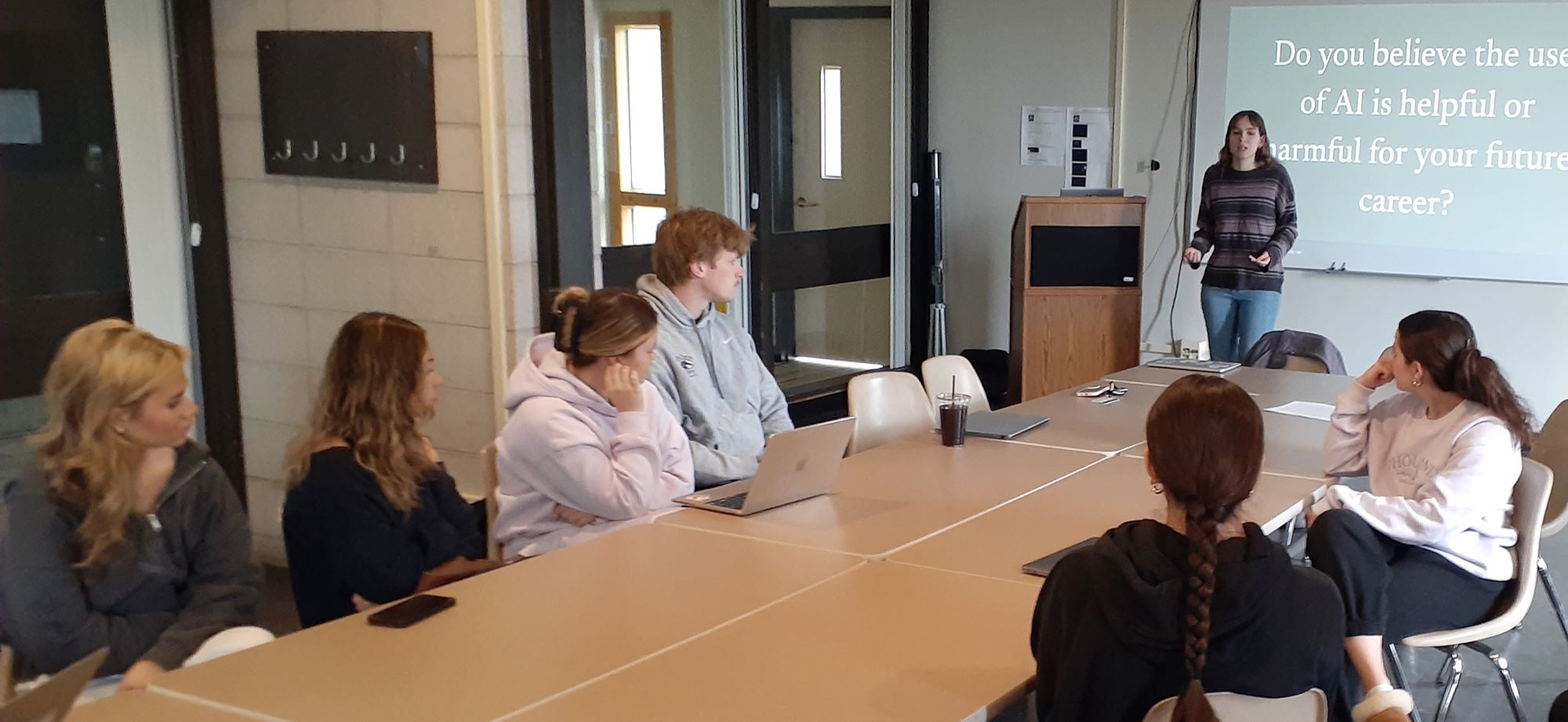
Dragons for Democracy Intern Michelle Winderman designed and conducted her “Debate and Deliberate: Artificial Intelligence in Your Career” Workshop on May 1. The event helped ten participants consider the benefits and drawbacks of two ways of reaching decisions: debate and deliberation.
Participants included students majoring in Spanish Education, History Education, Communication and Media Studies, and Sociology. Professor Denise Finneran (Communication Disorders and Sciences) also participated.
After introducing the topic and format, Winderman assigned five participants to the “con” group, which generated ideas in opposition to the use of AI in the workplace. She then assigned five participants into the “pro” group, which identified benefits of AI in the workplace.
Participants adhered to civil discourse guidelines that Winderman posted on her PowerPoint.
Arguments against AI included the claims that it hurts people’s critical thinking skills, that it can hurt students’ faith in their teachers’ knowledge, it can replace people in their jobs, and it can be difficult to regulate.
Arguments in favor included AI as an aid to learning, improvements in efficiency and effectiveness for data collection, which could lead to more comprehensive research in fields such as history.
Participants then shifted from debate to deliberation, using ideas from the debate session to identify ways of using AI safely and productively in the workplace.
They mentioned the use of AI in audience analysis and in marketing, along with the technology’s ability to pinpoint previously unrecognized ways of using existing drugs to treat certain diseases and conditions.
Deliberation also led to cautionary tales, such as the experience of one participant’s family member who is in the medical field. That individual was asked to use AI to translate a doctor’s medical advice to a non-English speaking patient. Fortunately, someone who spoke that patient’s language entered the room and noticed that the translation was incorrect, so that person was able to provide the correct translation.
Another example was from the legal profession: Some lawyers have presented AI-generated documents to judges, claiming that the documents included court cases that serve as precedent. Unfortunately, that research was the result of AI “hallucinating” - AI described non-existent cases. The participant said that, in one case, the lawyer was fined $2,000 for using such a document.
Finally, participants considered the outcomes of their two approaches to the topic. At least one participant liked the way in which debate helped people “test” ideas, including their own.
Another appreciated deliberation’s collaborative, non-confrontational atmosphere. It brought more of a teamwork approach to decision-making.
After the workshop ended, Winderman reflected on her preparation for the event and on ways in which she could use it in her education and career. She noted that the deliberation portion of her workshop resulted in freer flowing and wider-ranging ideas.
She is planning to promote the use of deliberation in meetings of an organization she belongs to. That organization’s members are wrestling with a decision. Debate has not led to a resolution of the issue, so Winderman will propose a deliberative approach. She expects that deliberation will help her colleagues reach a mutually agreeable solution.