05/04/2026
SUNY Cortland undergraduates are eager to present their own academic research, if their participation at the 2026 13th SUNY Undergraduate Research Conference (SURC) is any indication.
Each spring semester, SURC attracts undergraduates and faculty mentors from across the SUNY system to different campuses, this year at SUNY Upstate Medical University in Syracuse, N.Y., for a full day of activities.
Some 25 SUNY Cortland students and their faculty mentors seized a vibrant opportunity to network with peers in many disciplines from other campuses during the academic showcase on April 24.
“This is the fourth conference experience I’ve had presenting my undergraduate research, and I must say this one was definitely different from the rest,” in its focus on medical research, said Nicolette Carluccio, a senior conservation biology major from East Northport, N.Y.
She and classmate Catherine Crowley, working with Associate Professor of Biological Sciences Laura Eierman as faculty mentor, showcased their investigation on the application of environmental DNA techniques to assess the abundance of a species called Diadema antillarum (Long-Spined Sea Urchin) on the Belizean coral reefs.
“I really enjoyed learning about the projects others are conducting in different fields,” Carluccio said. “It was a great experience, and it provided me with a new realm of conference experiences that will definitely help me in my future career.”
More than a dozen faculty mentors also attended to advise the students. They included Theresa Curtis and Elizabeth McCarthy in biological sciences; Kent Johnson, sociology/anthropology; Jeongkyu Kim, physical education; Keshab Raj Dahal, mathematics; and Benjamin Wilson, economics. Peter Ducey, biological sciences, had students present but did not attend.
Two Kinesiology Department mentors, Professor Jim Hokanson and Associate Professor Erik Lind, advised three Cortland undergraduates who gave presentations this year. Many Kinesiology Club members attended as well. Professor Kevin Dames was a third kinesiology mentor.
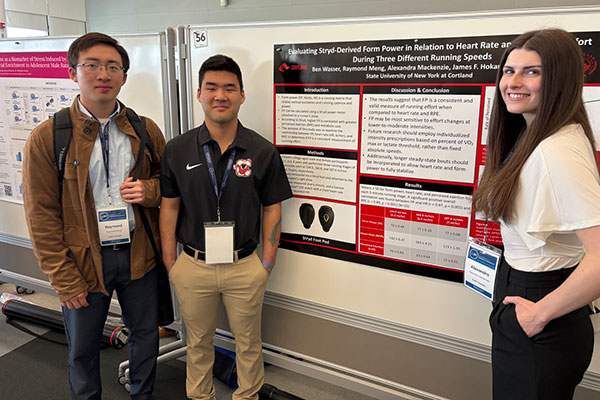
“Being at SURC showed myself and other SUNY students alike why research is so important,” said Alexandra Mackenzie, a junior exercise science major from Long Beach, N.Y., who presented on the impact of lower body positive pressure support on cardiovascular loaf and vertical oscillation during treadmill exercise.
“I got a lot out of this conference,” Mackenzie said. “It showed me how to network and what possible career ideas I can pursue.”
“I had a great time meeting people from all over the state, and I had an amazing time overall,” said Raymond Meng, a junior exercise science major from Cortland, N.Y., whose presentation explored the relationship between the two variables of cadence and power when someone is running on a treadmill. “I would do it again next year for sure.”
Ben Wasser, a sophomore exercise science major from Dumont, N.J., presented his team’s poster on evaluating the effects of running in place, called form power, at different speeds. They used a Stryd foot pod, Garmin heart rate monitor and manual RPE chart to compare heart rate and perceived effort at different speeds.
“We found that there is a positive correlation between form power, metabolic cost and perceived effort,” Wasser said.
“We are so proud of their work,” Hokanson said. “Their presentations drew excellent questions and earned well-deserved praise. Moments like these remind us why undergraduate research matters.”
The kinesiology contingent also flocked to sessions on the requirements and processes for getting into SUNY Upstate Medical University’s graduate programs in physical therapy, public health and medicine.
Michael Levy, a senior dual biology and economics major from Beacon, N.Y., joined the research project of Economics Professor Benjamin Wilson to explore the UNI — one form of complementary currency floated by the Global Institute for Sustainable Prosperity — to demonstrate the relationship between government spending and taxation.
Wilson issued the ‘UNI’ to students for performing volunteer activities, making Title II documents accessible for SUNY Cortland or attending on-campus lectures, Levy explained. In turn students would need to pay their “UNI tax” at the end of the semester for 10% of their grade.
“The project was designed to demonstrate government can spend money without the limitation of taxation dollars, the main teaching point of the project,” he said. “The private sector — us, firms, etc. — gain money via government expenditure.
“Overall, the UNI mobilized over 250+ volunteer hours for non-profits in the Cortland area,” Levy said.
“Michael is not only assisting in data collection, but he is actively helping me to think through different designs of the system that will allow us to develop new hypotheses about money design and how these micro classroom models might scale to larger institutions,” Wilson said. “He is really helping me think about this project from a new creative perspective.”
Hokanson suggested that this year brought the largest Cortland campus contingent in the roughly 15 years the Kinesiology Department has participated in SURC.
“This year, there were probably the most students presenting of any years I have gone,” Hokanson said.
Moreover, at least 16 of the SUNY Cortland students enrolled in a wide variety of majors presented their own work that day.
Maria Timberlake, associate professor of foundations and social advocacy and director of the university’s Undergraduate Research Council, credited Zach Braman in the Research and Sponsored Programs Office for organizing the university’s registrations. Andrea Dávalos, associate professor of biological sciences, will soon assume the role of URC director and help lead Cortland’s participation in the annual SURC gatherings.
This year’s SURC again featured sessions devoted to student presentations — oral, performance, artistic displays and poster. Participants also networked during a luncheon, explored a graduate school and career fair and engaged in professional development workshops for students and faculty.
SURC is supported by the offices of the SUNY Chancellor, Provost and Research Foundation, as well as the university system’s student and faculty governance organizations.
For more information, visit the SURC webpage or email [email protected].
Select an image to begin slide show
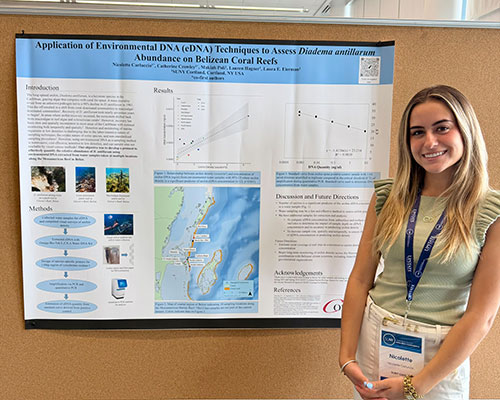
Nicolette Carluccio gave a poster presentation
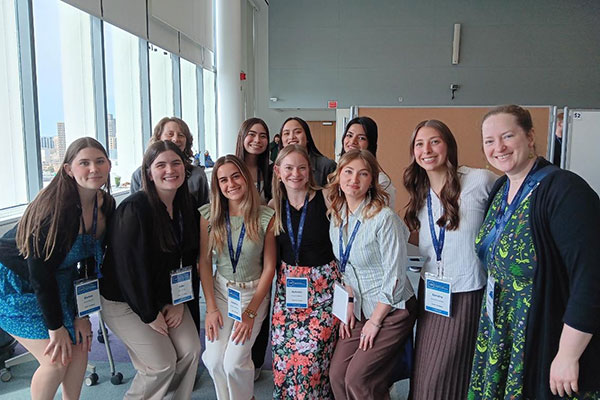
SURC attendees from Biological Sciences (image by Elizabeth McCarthy)
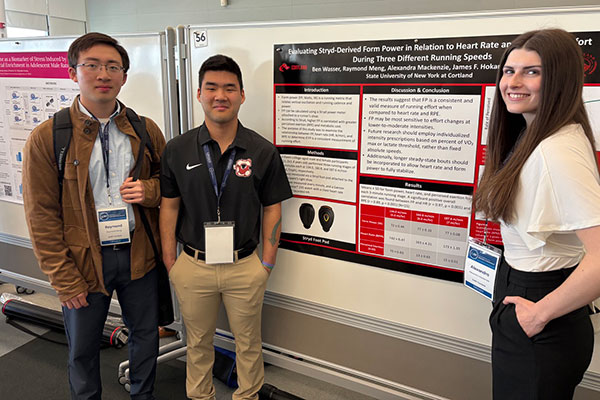
Three kinesiology student researchers, from left, Raymond Meng, Ben Wasser and Alexandra Mackenzie