06/02/2026
SUNY Cortland’s Cortland Applied Learning Practitioners (CALP) Democracy Engagement Fellows have been contributing to the field of democracy engagement (DE) by creating new DE syllabi, refining their existing DE syllabi, and conducting civics education and civic discourse events at and beyond SUNY Cortland.
In spring 2018, the Galpin Institute launched the CALP professional development program, through which faculty incorporated applied (experiential) learning into one of their syllabi. SUNY’s term “applied learning” encompasses a range of learning-by-doing strategies that are examples of “High-Impact Practices” (HIPs). HIPs are notable for their effectiveness in improving students’ learning, among other considerations.
CALP’s foundation is active listening – a skill set through which a person listens for understanding without judgement. It is a key component to applied learning because students will be engaging with people from backgrounds and perspectives that might differ from their own. To be effective problem solvers, they need to know how to understand those individuals’ points of view. This skill is also key to SUNY’s new General Education Civic Discourse Core Competency.
Between spring 2018 and spring 2022, 18 faculty members from across our three Schools completed the CALP program, which was funded by a SUNY Cortland grant from the Provost’s office and by a SUNY Performance Improvement Grant.
In spring 2024, CALP relaunched as CALP/DE with applied learning focused on projects with an appropriate government office. (In the original CALP program, applied learning projects often involved collaboration with a not-for-profit agency.) By highlighting the importance of governments’ policy- and law-making powers, CALP DE Fellows help students realize ways of addressing causes – rather than the symptoms – of issues that they care about.
As of spring 2026, 23 faculty members have become DE Fellows, again representing departments from each of our three Schools. The article below describes the work that some of our DE Fellows have been doing. Their work contributes to the development of this increasingly important field in education and to our mission of nurturing engaged citizens.
DE Fellows noted in this article are:
- Communications and Media Studies: Paul Arras, spr ‘25 (CALP/DE semester)
- Economics: Justin Bucciferro, spr ‘25
- English: Noah Wason, spr ‘25
- Foundations and Social Advocacy: Jeremy Jimenez, fall ‘25; Jose Ortiz, spr ‘25
- Geography: Christopher Badurek, spr ‘25
- History: Caitlin Goodwin, spr ‘26
- Modern Languages: Jean Costa-Silva, spr ‘26
- Physics: Eric Edlund, spr ‘26
- Psychology: Karen Lister, spr ‘25; Kim Khánh Nguyễn-Nalpas, spr ‘26
- Recreation/Parks/Leisure Studies: Jason Page (spr ‘24), Kenneth Cohen, fall ‘25; Qwynne Lackey, spr ‘25
- Sociology: Samantha Applin, spr ‘25
NEW and REVISED Democracy Engagement (DE) SYLLABI.
Caitlin Goodwin is already incorporating assignments into her Writing in the Social Studies (AED 310) course that will help her students – future teachers – create assignments for their (future) students. Those assignments will help those future students earn the New York State Seal of Civic Readiness.
Jeremy Jimenez refined his Foundations of Modern Education syllabus: Instead of addressing a Parent Teacher Organization (as in his original DE syllabus), his students will speak at a city common council or county legislature meeting. In this way, students are engaging with organizations that are more obviously part of the civic decision-making process. He is also incorporating DE into his International Education course by expanding into “Global Citizen” advocacy to help students understand that their skills and knowledge are important at the local and international levels.
Justin Bucciferro introduced his “Make Your Voice Heard” assignment in his Political Economy and Social Thought (POL 105) syllabus. Students compose an advocacy letter to an elected official. Working in one of the course’s themes, such as poverty and civil rights, each student chooses a particular issue that is important to them, such as decisions regarding taxes vs. spending. Next, they identify an appropriate government official, then they compose an advocacy letter that acknowledges opposing points of view. He also incorporated new readings into the syllabus on the Enlightenment origins of democratic thought.
Karen Lister designed a new course: Special Topics in (PSY 329). In it, students develop foundational skills for interacting professionally with government agencies, especially in the context of mental health issues. They do so as they consider a variety of settings, such as the court system or with organizations (such as nonprofits) whose funding is influenced by government funding. Critically, students learn to rely on corroborating evidence, empirical research, and other factual information so that they lessen the potential impact that their personal beliefs or biases may have on their professional work. This lessons is one of the foundations of forensic psychology.
Kenneth Cohen continues to revise his DE courses, such as Wilderness and American Culture (REC 310), which are structured around competing stakeholder perspectives. Stakeholders include Indigenous communities, government agencies, recreation users, and private interests.
Students refine skills that help them engage differences in perspective with precision and respect. They participate in discussions of controversial land management issues, evaluating multiple forms of evidence, including lived experience, policy frameworks, and historical context.
With that knowledge, they analyze ways in which public land decisions are made, what evidence is used, and whose voices are included or excluded. This situates wilderness as the outcome of civic processes shaped by policy, governance, and public input.
Noah Wason revamped the podcasting assignment in his Rhetoric in the Public Sphere: Surveillance and Social Media (PWR 330) course. In that assignment, students make a podcast for other students. The podcast covers an academic reading and current events. Wason has made it even more “civically focused”: Students will attend three SGA club events to apply their listening skills as they learn about other students’ interests and communication needs. He also added an in-class “listening party” that lets students listen to, and respond to, each other’s work.
Samantha Applin made changes to her Critical Thinking in the Social World (SOC 329) course’s reflection prompts. Those reflections help her students answer questions such as, "Why do I believe what I believe?" By answering questions like these, students sharpen their critical thinking skills. Applin also continues to emphasize the importance of active listening skills, noting that “my students have really taken to the active listening lessons and practices. It is one of the practices they report is the most consequential to their lives and their futures.”
Beyond the Syllabi
SUNY Cortland Campus Projects and Events
On February 17, Eric Edlund and Jeremy Jimenez designed and conducted a Curious and Unqualified: Energy Ignorance Interactive Panel Discussion in which the two professors shared their evidence-based, yet differing opinions in mutually respectful ways – as they did with students’ questions and perspectives. In this way, they modelled civic discourse skills and behaviors for the roughly 40 students attending.
On February 25, Kim Nguyen-Nalpas facilitated Strategies for Managing Challenging Conversations in the Classroom, an event that she arranged with our Institutional Equity and Inclusion Office. The event featured Bodi Regan, who provided research-based strategies on how to navigate and facilitate difficult conversations in the classroom.
On April 23, Jason Page and Qwynne Lackey co-facilitated the Preserving and Promoting America’s Revolutionary History: Lessons from New York’s Lake George Region. This multi-disciplinary, civics education panel discussion featured five panelists who personalized and dramatized a part of our history and ways for students to participate in civics education, regardless of their major. An earlier Newsletter article provides additional information.
Paul Arras, faculty advisor for the Dragon Chronicle student newspaper, guided the newspaper’s writers for a September 2026 Dragon Chronicle Special Edition on the 25th anniversary of 9/11. Students interviewed a variety of sources, from family members to people both on and off campus. One of the Dragon Chronicle editors created this version during the spring. Many more articles will run online on in the Chronicle’s throughout September. That Edition will have some of the articles that came out of Arras’s CALP/DE student reporting project.
Noah Wason is considering future events, including –
- Encouraging students from his PWR 33O class to submit a proposal for next year’s Transformations
- Proposing his own session for next year’s Teaching and Learning Conference regarding a new project that he is developing: A student-designed and -conducted podcast that is designed as a digital literacy act of civic engagement.
Kim Khánh Nguyễn-Nalpas is preparing to launch the Mapping Reverberations (MR) Lab at SUNY Cortland. To prepare, she is attending a Critical Participatory Action Research (CPAR) Summer Institute in early June. Nguyen-Nalpas will use lessons from that professional development program to expand her collaborative spring 2025 Revealing Roots Arts Initiative (RevealingRoots.org) into a Cortland CPAR project aimed at understanding the complexities of immigration issues impacting Cortland County.
In partnership with local Cortland immigrants, the MR Lab will ground its work in the needs, priorities, and knowledge generated by the collective to learn how policies have shaped (are shaping) the local immigrant community, and to help address those concerns through, for example, policy papers, academic scholarship, and community projects like Revealing Roots.
Multi-campus collaborations
Jeremy Jimenez has partnered with a Stony Brook professor to create a Pen Pal sustainability assignment in which students collaborated in email exchanges over the course of a month, sharing their views on some ways that sustainability ideas could be better incorporated on their campuses. Students share their ideas with each other so that, ideally, some of their ideas lead to student designed, applied learning sustainability projects.
SUNY Academic Fellowships
In 2023, the SUNY System launched its Academic Fellows program, beginning with its Diversity, Equity, Inclusion, and Social Justice (DEISJ) cohort, adding the Civil Discourse and Civic Education and Engagement cohort in 2024, then the AI for the Public Good and the Sustainability cohorts in 2025.
During the 2025-2026 academic year, SUNY Cortland was represented in each of SUNY’s four Academic Fellows cohorts, including two DE Fellows:
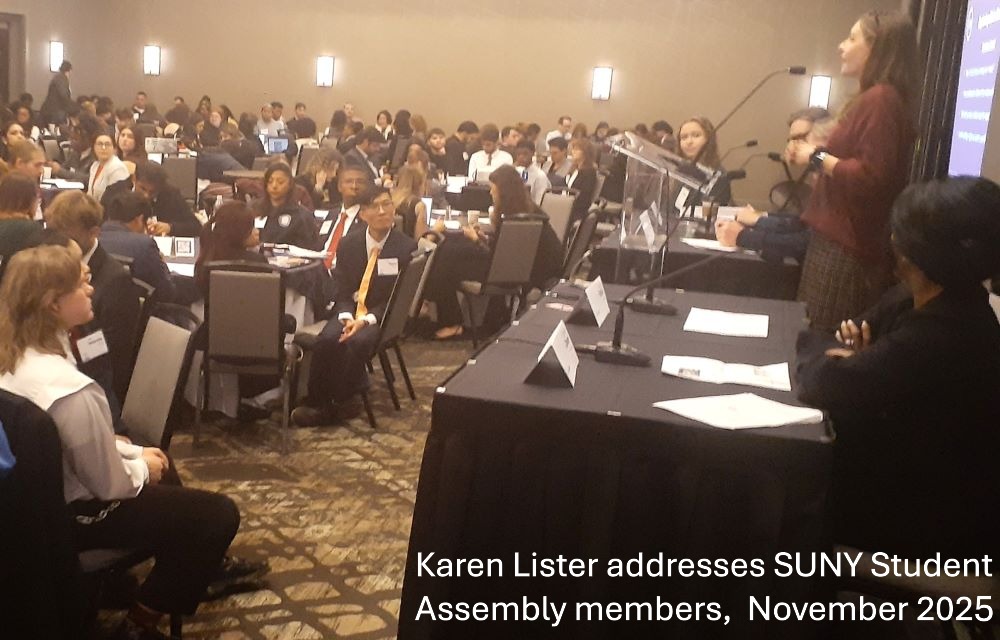
- Karen Lister, who co-facilitate civic discourse workshops at the SUNY Student Assembly Conference in November 2025, and presented her Strategies to Address Psychological Barriers to Civic Discourse webinar on February 19, 2026.
- Jeremy Jimenez served as a Sustainability Fellow. In that role, he collaborated with other SUNY Academic Fellows to design and present five advocacy-related sustainability webinars, including Sustainability in Action: Approaches to Applied Learning on April 24.
Our other two current SUNY Academic Fellows colleagues are Danica Savonick (English) in the DEISJ cohort, and Lauren deLaubell (Information Literacy/Instruction Coordinator at Memorial Library) in the AI for the Public Good cohort.
Collaborations with local and nationwide civics and civic discourse organizations
Caitlin Goodwin, Jose Ortiz, Karen Lister, and Kim Nguyen-Nalpas volunteered to participate in the Campus Discourse Challenge. Their initiative helped SUNY Cortland become one of only twenty campuses nationwide to be accepted into this program’s initial cohort. Additional information is in a separate newsletter article.
Jeremy Jimenez joined the Cortland Climate Smart Committee, planning to help advise local officials on how the city or county can apply for climate sustainability-focused grants as a way of improving our area.
Publishing
Ken Cohen has a textbook chapter in press, and he is devoting his sabbatical year (2026-2027) to generating a book on transformative tourism, which includes elements of democracy engagement.
SUNY Journal of the Scholarship of Engagement (JoSE) Reviewers.
JoSE is a peer-reviewed and open-source academic journal that provides current and future K-16 educators with evidence-based theory of, and methods and justification for, applied learning as it relates to students' career- and civic-readiness.
JoSE’s reviewers represent a wide range of disciplines. Reviewers include DE Fellows Christopher Badurek, Jean Costa Silva (also an Editor), Jose Ortiz, Justin Bucciferro, and Karen Lister, among other faculty from Cortland and other (mostly) SUNY campuses.
One DE Fellow has submitted a co-authored article (along with three graduate students). Three DE Fellows are among the people who have notified JoSE that they are considering – or are already working on – submissions to JoSE; one has already done so. JoSE’s Reviewers and Editors are still accepting submissions for the September 2026 issue.