
10/13/2026
Campus Sustainability Month is an international celebration of sustainability in higher education. SUNY Cortland Green Reps celebrate through writing in different mediums on topics that motivate them and their work in sustainability.
The first medium is poetry. SUNY Cortland Green Reps wrote a poem after a walk in nature, reflecting on their experience in connecting with the natural world.
A Distant Dream of Home
By Abhipsha Bhandari
Through a small window, I see the strange, new city,
But my thoughts drift to the hills,
Where heavy clouds sit low on the green mountains back home.
The cold mist on my face today feels just like a morning in Nepal.
I wonder what the weather looks like over my city right now.
I feel a quiet ache in my chest, just really missing home.
I hear the wind blowing softly through the trees above me.
I keep walking slowly, looking up at the gray sky.
I search the fog over these local hills, trying to see something familiar.
This dirt path under my shoe feels like the steep trails I grew up walking.
These hills have held this same cold mi st long before I ever came here.
The fog doesn't care how many miles away I am; it just covers everything quietly.
I hope the city back home stays green and peaceful while I’m gone.
When the clouds come down like this, the distance doesn't feel so big.
As long as I can look up and see the hills wrapped in gray, home is never really gone.
Slowing Down with Colden
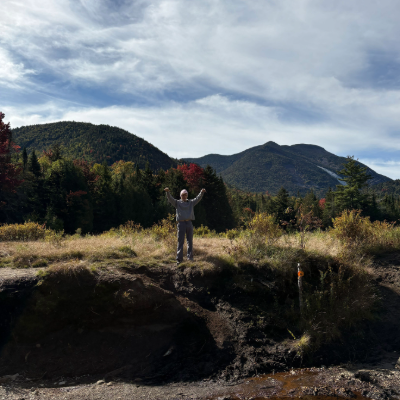
By Conner Ditzler
I wanted to see what I could learn by slowing down.
The September air was cool, with clouds stretched across the sky.
I thought about how small my problems felt compared to the mountains.
I felt peaceful hiking there, surrounded by so much nature.
I could hear the wind moving through the trees and water running over the rocks.
Each step along the rocky trail reminded me that getting somewhere takes time and effort.
A bird flew through the trees, instantly disappearing into the dense forest.
The path reminded me that sometimes the journey matters just as much as the destination.
People have explored these Adirondack mountains long before I ever hiked Mount Colden in all of its September splendor.
If the mountain could speak, I think it would tell me to slow down and appreciate what is around me.
I hope this place stays beautiful for generations to come.
Standing there made me realize how easy it is to get caught up in everyday life and forget about the world around us. Hiking reminded me why protecting nature matters.
As a sustainability officer at SUNY Cortland, I want to help others recognize the value of these places and do their part to protect them. I hope that future generations can experience the same feeling I had looking out at the mountains.
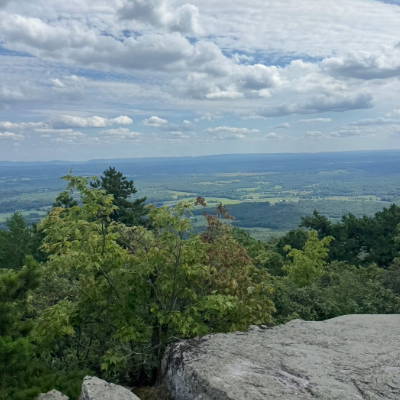 Gertrude's Nose Hike
By Elon Zanetti
My head feels heavy with thoughts I haven’t yet sorted.
The day is beautiful, sunny, with the perfect breeze across my body to keep it just cool enough.
I think about how long it will take for my mind to feel like it has escaped the stress of my life.
A sense of peace trickles through me, like the water finding its way between stones
I hear songbirds in the distance chirping in the trees.
My steps are cautious as my sneakers slip on the uneven stones.
A vulture circles above, flying in invisible circles in the sky.
The path unwinds my worries, with each step loosening the stress that has run my mind for too long.
These rocks held generations of footprints, from early Paleo-Indian hunter gathering to weekend wanderers.
The ridge watches me quietly, unmoved by my small footsteps.
May the cliffs keep their wildness, safe from the reach of careless hands.
At the overlook, I stand quiet, watching the wind move the trees as the valleys breathe.
My head feels lighter now, my worries blow away like the leaves in the wind, my head is finally clear.
The Path to Class 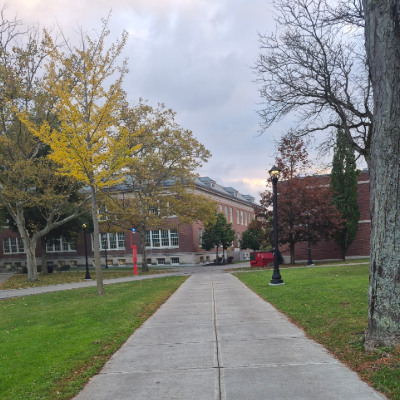
By Emma Stork
In the morning, when I walk outside,
The brisk air chills my bones.
In my head, I feel like I have to take long strides.
I feel calm as I make my way to class.
Hearing all the chatter of students around me.
With every stride, I get closer to where I need to be.
A small squirrel runs across the sidewalk in front of me.
A path I walk every day, taking me somewhere new.
Many people have walked this path for generations before me.
The leaves shiver as the wind blows through the trees.
I hope I can always make it to class on time.
As I keep walking, the fall leaves crunch beneath my feet, and I realize that even an ordinary walk to class can become a memory of my college days.
Appreciating the Autumn Sunset
By Kira Covey 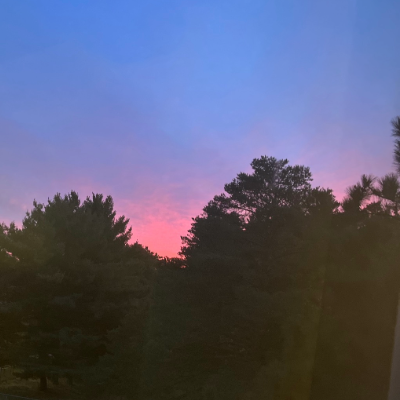
The sky is gorgeous outside, I have to go see it
It's gotten colder and autumn is near
I wonder who else is looking at the sky the same way I am
The world is so hectic, I'm finally feeling free
I hear the wind blowing through my hair and all around me
I travel a different way every time and yet I always end up in the same place
A stray cat likes to hang out around here too, sometimes we cross paths with each other
It's not always where we end up but what we do to get there
Who knows how many people have been here before me
I wonder what the trees have seen through their many years here
I hope they continue to grow along with the many people they encounter
My time is up; it's time to go home
As I settle back in all I can say is thank you for the sky
The second medium is through a sustainability story. This format was shared with SUNY Cortland Sustainability Office by Professor Orla Smyth-LoPiccolo of Farmingdale State College at the SUNY Sustainability Conference in June 2026. "A sustainability story is a path from a shared problem to a visible result that people can believe in, fund, use, and repeat," said Smyth-LoPiccolo in her presentation of this format.
Reflecting on My Time as a Green Rep
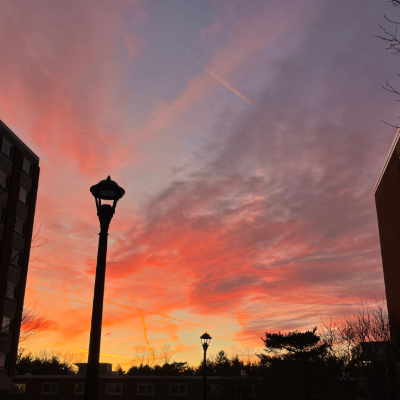
By Kelsey Thornton
I think one of the most valuable things humans have the ability to do is learn. Learning does not always have to mean studying for a test or completing a project; it can mean discovering new information, finding solutions to problems, and gaining a better understanding of the world around us. One issue that I believe is especially important to continue learning about is sustainability on college campuses. As Green Representatives, one of the ways we have worked to address this is through educational programs in residence halls throughout the semester.
I have had the privilege of helping run many of these programs, and one of my favorite parts has been seeing students become genuinely interested and excited to learn about sustainability. One event that especially stood out to me was our “Bin It to Win It” program that I ran in Bishop Hall, where students answered a quick quiz about recycling on campus. It was so much fun watching students think through their answers, ask questions, and sometimes even surprise themselves with what they learned. Being able to turn something as simple as recycling into an engaging and interactive experience showed me that education does not have to feel like a classroom lesson. It can be fun, social, and something that brings people together.
What made these programs so meaningful to me was seeing students walk away with even a little more knowledge about how their everyday choices can contribute to a more sustainable campus. It reminded me that learning is not just about gaining information, it is about using that knowledge to make a difference. Watching students learn, engage, and become more aware of sustainability has made me appreciate the power of learning even more and has shown me that sometimes, one small lesson can inspire someone to make a bigger change.
Photo Credit: Kelsey Thornton
How We All Can Reduce Our ‘Fast Fashion’ Impact on the Environment 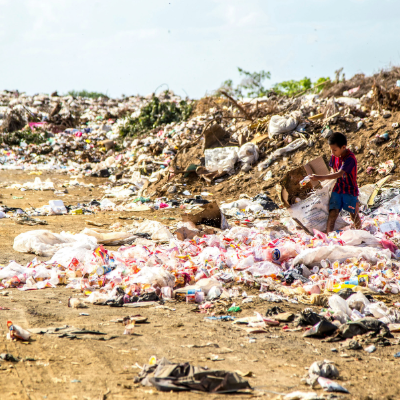
By Caden Riegger
When we think about sustainability, we often think about recycling or metal reusable water bottles, but what we wear can also have a major environmental impact. The fast-fashion industry encourages us to constantly buy inexpensive clothing, but producing and transporting those clothes requires energy, water, and other resources that damage our environment severely. Clothing pollution can also affect the environment through textile waste, chemicals from dyes, and microfibers released when synthetic clothes are washed.
The good news is that the path to becoming more sustainable does not mean giving up fashion. One of the easiest things we can do is buy less and make our clothes last longer. Instead of replacing a shirt because it has a small tear or because you no longer like the style, maybe try to repair it or find a creative way to restyle it. Also, donating clothes, shopping secondhand at for instance a thrift store and participating in clothing swaps are also great ways to give clothing a longer life. As college students, we can make sustainability part of our everyday choices. Before buying something new, we can ask ourselves: Do I really need this? Will I wear it often? Could I find something similar that is used? These simple questions can help us avoid unnecessary purchases and reduce clothing pollution. Sustainability does not require everyone to completely change their lifestyle. Small choices can add up when many people make them and make them often.
Photo Credit: Hermes Rivera
As the Green Reps celebrate Campus Sustainability Month, the students reflect on their experiences working on campus and research other sustainability related topics near and dear to them. Below are articles from each Green Rep answering the big question: "What would you like everyone at SUNY Cortland to know?"
Five Sustainable Tales V. Truths
By Brianne Leak
Tale: You are only making a difference if you practice perfectly.
Truth: Everyone must start at some point. It’s more important to implement sustainable acts in your daily life as often as possible, setting goals and making an effort to improve as you move along than it is to wait to live sustainably because of the idea that you must be “perfect”. The “all or nothing” idea is unrealistic and harmful. You are not expected to never buy another item with plastic packaging or to never go on vacation in an attempt to reduce gas emissions produced by airplanes. However, you can remember to bring a reusable bag with you to the supermarket before shopping to avoid using a plastic bag unnecessarily. As well as pick up your reusable water bottle before leaving home to avoid buying a plastic one.
Tale: Sustainable living is more expensive.
Truth: The most sustainable products are the products that you already own. Sustainability is not about clearing out every item you own to replace it with an “eco-friendly” version. For example: if you are currently using body wash from a plastic bottle, the sustainable solution would not be to throw away a full bottle of soap and replace it with a bar of soap packaged in a cardboard box. The more sustainable option would be to use and finish the soap that you already have and make plans to purchase a more sustainable alternative next time. The goal is to consume less, not to swap out perfectly working items unnecessarily.
Tale: Your Carbon Footprint is the only area you should be concerned about.
Truth: Sustainability does not stop and end with the carbon footprint. The carbon footprint is the amount of greenhouse gases (especially carbon dioxide and methane) released into the atmosphere by a person or activity. Driving as an example, if the car is gas powered, carbon is released, adding to your carbon footprint. Sustainability also includes water use, waste, pollution, biodiversity, resource depletion, and many other social and economic factors. While your carbon footprint is something you should be mindful of, the carbon footprint of you and I is generally less than those of businesses and large corporations.
Tale: “If I wanted to eat sustainability I would have to go vegan”
Truth: While veganism is a fantastic way to reduce environmental impact, it is not the only way to help create change. Sustainable diets can include meat, dairy, and other animal products. The goal is to set things in moderation. It also matters where and how the food is being produced as well as how much is being consumed. It would be ideal for all of the meat and dairy products purchased to be consumed rather than wasted. Introducing more plant-based foods into your diet can also be a great starting point.
Tale: Recycling is the most important thing I can do.
Truth: While yes, recycling is very important, the goal would be to avoid the item in the first place. Recycling a single-use plastic bottle is the best move to make after usage. But using a reusable water bottle would have been the most sustainable decision. Recycling is great, but it still does require energy, transport, and recourse. Of course, the use of energy, transportation and resources in the case of recycling is far more beneficial than the effects of deciding not to recycle or littering, thereby creating more pollution. Another important thing to consider is the “reuse” in the phrase “reduce, reuse, recycle”. Try to repurpose items before recycling them; extending their lifespan will save you money. Clothes, for example, can be repurposed or even sold secondhand. This helps avoid fast fashion shopping. An old marinara sauce jar can be repurposed as a glass container before being recycled. This saves you the price of buying a new container and decreases the need for manufacturing!
Sources:
- https://www.colorado.edu/ecenter/2022/04/26/debunking-recycling-myths
- https://www.pcrm.org/good-nutrition/vegan-diet-environment
- https://plasticsrecycling.org/how-recycling-works/the-plastic-recycling-process/
- https://www.scientificamerican.com/article/top-10-myths-about-sustainability/
- https://www.zerowasteweek.co.uk/sustainable-living-doesnt-have-to-be-perfect/
Greenwashing in corporate marketing: Analyze how to spot false eco-friendly claims by major brands 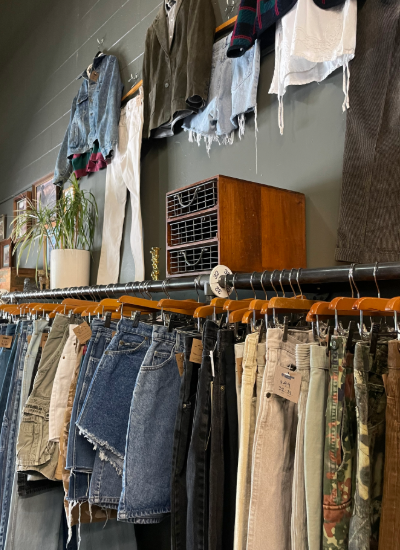
By Rian Thomas
Greenwashing is when a company makes its products or business look more environmentally friendly than they really are. Companies may use words like “eco-friendly,” “natural,” or “green” to attract customers without giving enough proof.
Here are some ways to spot Greenwashing!
- Look for vague words, companies will make claims like “good for the planet” and do not explain what the company is actually doing. Check the evidence, a company should provide facts or data to support its environmental claims. Be careful with green images! Pictures of trees, leaves, and nature can make a product seem environmentally friendly even when there is little evidence.
- Check recycling claims. A product labeled “recyclable” may not be recyclable everywhere. Check who gave the company a sustainability label and what the label actually means.
- A company might also advertise one small environmental improvement while ignoring larger environmental problems. “Carbon neutral” does not always mean a company has stopped producing emissions. It may rely on carbon offsets.
Greenwashing can make it difficult for consumers to make environmentally responsible choices. It can also allow companies to gain a positive reputation without making major changes to their environmental impact. Familiarize yourself with common terms and definitions related to sustainability and greenwashing. Use guides to identify common tactics employed by companies to mislead consumers.
Sources:
- https://repurpose.global/blog/5-ways-to-tell-when-brands-are-greenwashing
- https://emagazine.com/spotting-greenwashing-key-signs-to-identify-misleading-eco-friendly-product-claims/
Photo Credit: Rian Thomas
An Invisible Threat to Birds 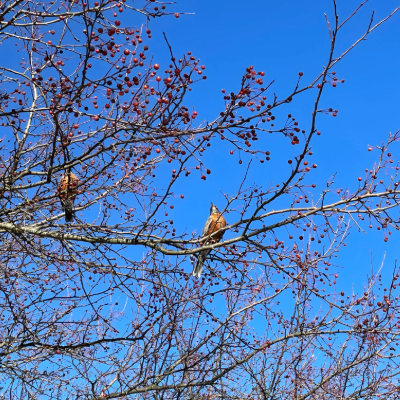
By Fiona Joss
Have you ever noticed a blue tint or patterns on some windows? It might not just a design choice, it could be helping to save lives. Birds have a hard time differentiating between reflections of the surrounding environment and the real thing. This can cause birds to fly directly into the glass, resulting in serious injuries or death. According to Vitro Glass, more than one billion birds die each year because of collisions with glass, making it one of the major human-related causes of bird deaths in the United States (Vitro Architectural Glass, 2026). Bird-safe glass is designed to reduce these collisions.
In New York City, bird-safe glass is part of building codes. In 2020, local law 15 was passed which stated, “new buildings and alterations that replace all exterior glazing of a building must comply with bird friendly design construction requirements” (Local Laws, 2020). This means that new construction projects and full-scale replacements must follow bird-friendly design requirements. The NYC Bird Alliance has been working for 45 years to preserve habitats, migration areas, and nesting grounds within the city. Project safe flight is an initiative of theirs to protect birds from glass collisions and artificial night-time lighting (Conservation Work, 2026).
This issue is especially important for communities like Cortland, where birds are an important part of the local ecosystem. Birds control insect populations, spread seeds, and support biodiversity. As college campuses continue to develop and use more architectural glass in buildings, considering bird safety can be an important part of sustainable design. It’s important to recognize that sustainability is not only about recycling or reducing waste. It also means considering how the spaces we create affect the organisms around us. Something as simple as changing the design of a window could potentially make a meaningful difference for local wildlife.
Bird-safe glass is a reminder that sustainability can be built into the places we live, work, and learn. By making improvements to our campus and community environments, we can create spaces that are safer for both people and wildlife.
Sources
Conservation work. NYC Bird Alliance. (2026). https://nycbirdalliance.org/our-work/conservation
Local laws of the City of New York for the year 2020. LOCAL LAWS OF THE CITY OF NEW YORK FOR THE YEAR 2020. (2020). https://www.nyc.gov/assets/buildings/local_laws/ll15of2020.pdf
Vitro Architectural Glass. (2026, August 18). Bird-safe glass: What it is and how it works. Blog. https://glassed.vitroglazings.com/bird-safe-glass-what-it-is-and-how-it-works
Photo Credit: Fiona Joss