10/01/2026
SUNY Cortland’s Dowd Gallery will present “Discardia,” an exhibition that brings together an all-female roster of contemporary creators whose artwork relies on discarded, repurposed and found materials.
On view from Thursday, Oct. 22 to Friday, Nov. 27, the show features a range of mediums, genres and artistic practices by New York state artists Leslie Brack, Leeza Meksin, Ahndraya Parlato, Anastasia Sargent and Lilian Shtereva.
A free opening reception with refreshments will take place on Thursday, Oct. 22, from 4:30 to 6:30 p.m. in the Dowd Gallery.
Gallery hours are 10 a.m. to 5:30 p.m. Monday through Friday with hours extended on Thursday until 7 p.m. Walk-ins are welcome.
Additional events during the exhibition include:
- A visiting artist talk by Parlato on Tuesday, Oct. 27, at 5 p.m. in Dowd Gallery
- A gallery walk-through led by Sargent and Shtereva on Thursday, Nov. 5, at 5 p.m.
Visit the Dowd Gallery website and Facebook page, or follow @dowdgallery on Instagram for more information.
At varying stages of their careers, the artists behind “Discardia” share an interest in the cultural, aesthetic and material possibilities for what has been cast aside. Collectively, their work invites viewers to reconsider everyday objects and waste, exploring questions of consumption, reuse, value and transformation — and the capacity of art to generate new meanings and associations from the discarded.
The exhibition was conceptualized and curated by Wylie Schwartz, assistant professor of art and art history at SUNY Cortland, and Ithaca-based artist Leslie Brack, who teaches painting as a lecturer at Cornell University.
“Together, the artists in ‘Discardia’ challenge conventional distinctions between art and waste, permanence and disposability, value and worthlessness, depletion and continued life,” Schwartz said. “Through acts of collecting, recontextualizing, transforming and reimagining, they demonstrate how the overlooked scraps can become sources of aesthetic discovery and unexpected possibilities.”
Brack contributes to the exhibition a series of “portraits” of dumpsters and roadblocks. By isolating overlooked objects, she seeks to draw attention to their individuality based on their diverse designs and accumulated histories of everyday use, encouraging viewers to look more intently at objects in the built environment that typically escape notice.
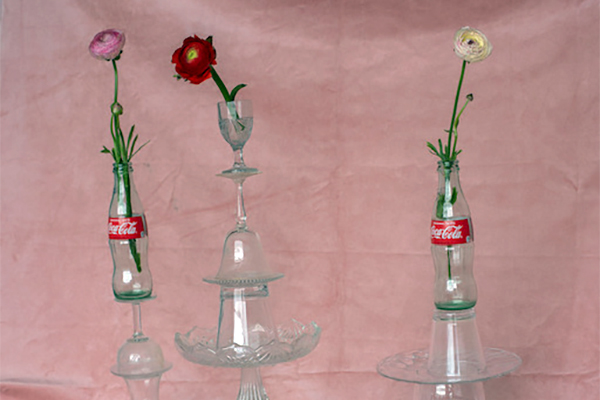
Parlato, an assistant professor at the Rochester Institute of Technology, creates photographic still lifes that incorporate refuse and thrifted objects, designed to focus on the unexpected relationships and associations that emerge when disparate materials are brought together. She is interested in the capacity of found objects to evoke meanings beyond their original contexts and the ways we are often drawn to things for seemingly irrational or unconscious reasons.
“I often think about how objects act as receptacles for emotion and memory — and how the meanings we invest in them can be difficult to parse or understand,” Parlato said. “The intensity of these attachments often exceeds our ability to explain them.”
Leeza Meksin’s work, paintings and sculptures are constructed from combinations of found fabric, ceramic pieces, paint and packing materials. The Ithaca-based artist’s paintings consist of structures made of recycled packaging with neoprene stretched over top. They incorporate found objects such as glass slides, beads and plastic vials, or handmade ceramic additions in some cases.
Meksin described her practice as rooted in an exploration of how the language of the materials themselves makes meaning through juxtaposition; binaries such as old and new, traditional and unconventional, clothed and naked, and public and private are often at stake.
Additionally, the exhibition’s work by Cornell M.F.A. students Sargent and Shtereva highlight the emerging artistic perspectives alongside those of more established practitioners.
Sargent makes mixed-media sculptures combining natural, industrial and found objects as reflections on time and speed, from the geological to the digital. As part of that interest in time and its material impact, Sargent placed her family photographs outdoors. They became vulnerable to the weather, as the chemistry of the prints dissolved and blurred the images, casting them into a painterly space open to subconscious readings.
Shtereva will build a site-specific work created in response to the architecture of Dowd Gallery and the exhibition’s theme, in which her materials, their history, her own history, and the exhibition space come into dynamic relation. The Brooklyn-based artist has collected textiles from abandoned factories and family residences in her native Bulgaria where she was born and raised.
This extensive textile archive has crossed multiple borders and undergone near-constant transformation. In her ceramic work, Shtereva seeks to create whimsical, slightly functional vessels inspired by animal forms, infusing them into her installations as vital and playful participants.