03/24/2026
Many biologists study just one species or family at a time.
Andrea Dávalos, an associate professor of biological sciences at SUNY Cortland, prefers to investigate the combined effects on native species of several different stressors in North America’s forests, including invasive jumping worms, the invasive plant Pale Swallow Wort and indigenous white-tailed deer.
She studies the relatively large, metallic invasive jumping worms that were introduced accidentally from Asia as long ago as the late 1800s or early 1900s. These earthworms are reviled by gardeners not only for their quick, snake-like movements but for the way they quickly degrade the quality of the topsoil. Her second major focus, the Eurasian invasive plant called Swallow Wort, has few predators and quickly crowds out native plants that support the local ecosystem.
“For many of the species that are classified as invasive, we don’t necessarily have strong evidence that demonstrates their negative impacts,” said Dávalos, who earned her doctorate in natural resources from Cornell University and completed her undergraduate studies at Pontifical Catholic University of Ecuador in Quito.
And there are unusual patterns seen in her research mainly in soil changes — since replicated by other scientists — such as fewer invasive worms found in forest spaces fenced off from deer feeding. It’s a mystery.
“Ecosystems are complex and we just don’t know what happens when new interactions occur,” she said. “And what happens when you pull one piece out? There’s a lot of surprises. We need to make decisions about management and conservation, considering that there’s going to be surprises and uncertainty.”
Since 2017, Dávalos has participated as a principal or co-principal investigator in nine separate research projects focused on conservation of native ecosystems and developed with collaborators from multiple universities and government agencies. Much of her work has involved a partnership with the New York State Office of Parks, Recreation and Historic Preservation and the New York Invasive Species Research Institute hosted at Cornell University.
For her achievements to date, SUNY Cortland awarded Dávalos the 2026 Dr. Peter A. DiNardo ’68 and Judith Waring Outstanding Achievement in Research Award.
The award is given to an outstanding SUNY Cortland faculty or professional staff member for their record of research achievements. In addition to scholarly productivity and publication in journals, evidence for research achievements may include accomplishments in the creative and performing arts. The awardee is recommended by the Faculty Research Committee and selected by the provost based upon at least five years of research-related activities at Cortland.
Dávalos earned the honor for the applied research impact of her scholarship, collaboration across institutions and her overall contributions to addressing real-world environmental challenges.
Dávalos has co-authored numerous published scholarly articles and co-authored one book chapter on “Management of Invasive Earthworms in North America,” published in Sustainable Management of Invasive Species in 2025 by World Scientific, London.
She has developed and taught undergraduate courses in Conservation Biology, Biology and Plant Ecology. Her trendsetting approach to science has also reaped many benefits for the 23 student research assistants she has mentored since joining SUNY Cortland in 2015.
“I usually have two to three students in the lab per semester," Dávalos said. “They develop their own projects or aid in ongoing efforts. Sometimes they process samples from fieldwork; roots and worms. And we have a lot of field work during the summer months.”
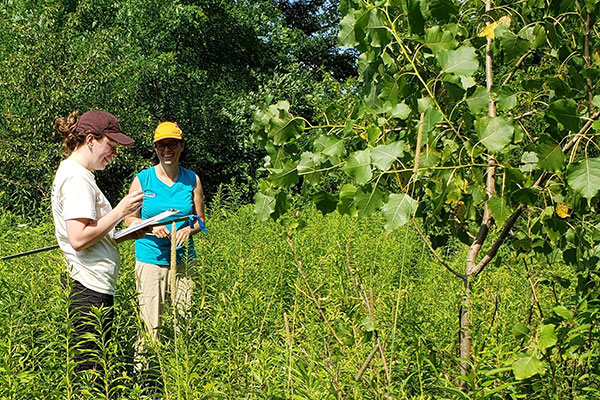
The undergraduate student researchers have assisted her in the development, execution and dissemination of findings of projects assessing ecological impacts across multiple taxa and habitats. The future biologists can be found tending seedlings and young plants in the laboratory beside her Bowers Hall office, setting up deer fencing or working on patches of non-native herbs in forests across the region to measure their abundance over time.
“Students engage in the projects in different ways,” she said, pointing to pictures of individual students monitoring pale Swallow Wort or putting up tall, mesh deer fencing or shocking worms out of the ground using a solution containing a mustard irritant. “Some want to come out with me into the field and some pick up on a piece of my research and develop an independent project.”
Developing individual plans for each student, Dávalos trains them in field and laboratory methods in ecology, including plant and invertebrate monitoring, earthworm collection and identification, experimental design, data analyses, result interpretation and writing of reports and research proposals. Some students participate in research for multiple semesters and complete independent projects, while others provide technical support for ongoing projects.
Many of her students take part in the New York State Parks, Recreation and Historic Preservation’s Friends of Recreation, Conservation and Environmental Stewardship (FORCES) program.
“This is a fantastic program that offers internship for undergraduate and graduate students,” Dávalos said. “FORCES exposes them to different land-management projects, and we have a partnership to assess combined effects of invasive species.”
She has advised students pursuing internal or external grants to underwrite the expenses of their research.
Dávalos has supported the presentations of 16 students at both of the university’s annual scholarly conferences, Transformations and the Michael J. Bond ’75, M.D. Alumni/Undergraduate Science Symposium.
She has included the research assistants in travel to professional conferences of the Northeastern Naturalist, Ecological Society of America, Botany, Society for Conservation Biology, Tri-Beta, Student Conference in Conservation, and Cuba Ties.
Her student research partners are co-authors on many of her articles and expected to contribute to publications, including one published manuscript and five in preparation with student co-authors.
In addition to a stipend, as part of the DiNardo-Waring Award, Dávalos will present a lecture on her scholarly work Thursday, April 30, as part of Transformations: A Student Research and Creativity Conference, SUNY Cortland’s annual celebration of student research and creativity.
Her talk, titled “Don’t Jump to Conclusions: We Know Less About Invasions Than We Think,” will begin at 4 p.m. at a location to be announced. It is open to the public.
The lecture will focus on her lab, where she studies the ecological impacts of invasive species and potential options to manage them, including biocontrol. She is investigating jumping worm impacts within the framework of multiple stressors, such as deer browse or invasive plant competition. She is also exploring current assumptions about jumping worm spread by tracing their expansion from known introduction points in urban parks.
The Dr. Peter A. DiNardo ’68 and Judith Waring Outstanding Achievement in Research Award is named in honor of the late Peter A. DiNardo ’68, a widely respected clinical psychologist and SUNY distinguished teaching professor, and Judith Waring. The endowed award’s creation in 2015 replaced the university’s Outstanding Achievement in Research Award, which had been presented since 2004. DiNardo-Waring Award honorees committed to a campus named lecture, first tied to Transformations in 2022.
Select an image to begin a slide show
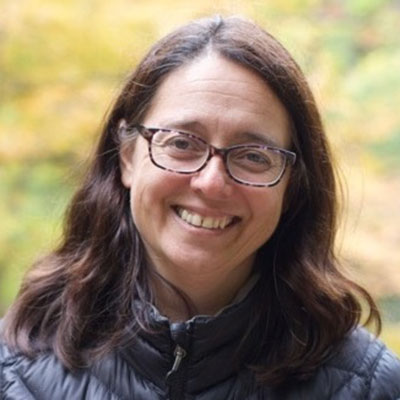
Andrea Dávalos
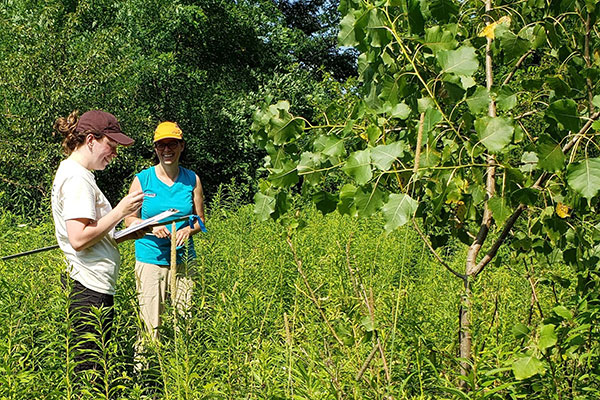
Andrea Dávalos, right, and a FORCES steward collect vegetation data
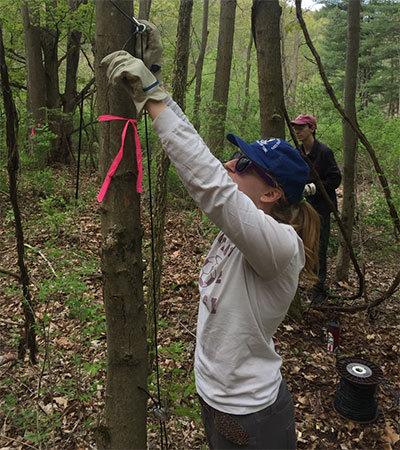
Cortland student Emily Ammons sets up a deer fence at Buttermilk Falls near Ithaca, N.Y.
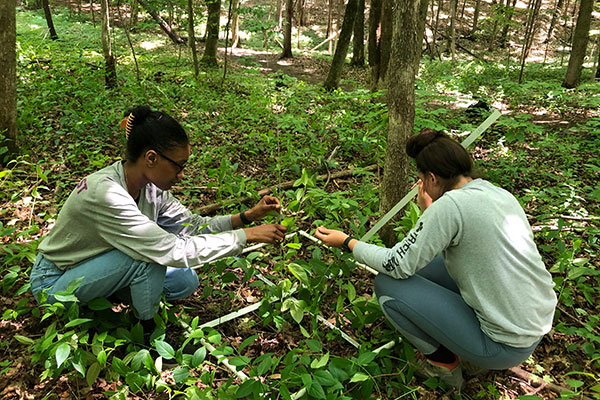
Cortland students Elizabeth Serafin and Azaria Laster collect pale swallow wort demography data
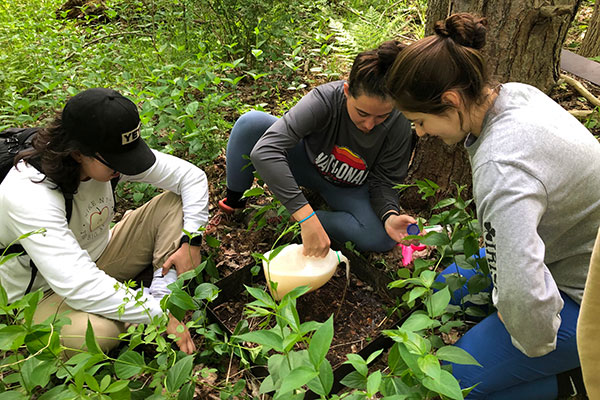
FORCES coordinator Carlin Wakefield and Cortland students Azaria and Kayelah resurface worms using a mustard solution