|
|
Issue Number 3 • Tuesday, Sept. 29, 2026 |
Campus ChampionPatricia Martinez de la Vega Mansilla, lecturer in the Modern Languages Department, brought together educators from across New York state as coordinator of the recent Virginia Levine Second Language Educators’ Conference. Patricia has worked hard to create a welcoming atmosphere during her 36 years at SUNY Cortland, contributing to outlets that include the Clark Center for Global Engagement and Kente Ceremony Committee. Always a source of help for those who need it, Patricia also volunteers to translate parental permission documents into Spanish for student teachers, letting them better connect with their classrooms. Upcoming EventsWednesday, Sept. 30 Sustainability Workshop: Acorn Foraging: This Green Days Committee do-it-yourself workshop explores racialized and classed histories of foraging, while also providing information about how to forage and process acorns to make acorn flour. 12:30-1:30 p.m., Old Main Colloquium, Room 220. Wellness Wednesday: Put the Myths about Sleep to “Bed”: Learn more about facts and myths around sleeping, napping and how to get a good night sleep. Free sleep masks and ear plugs will be given out. 1-3 p.m., Corey Union steps. Poskanzer Lecture: “The Status of Abortion Law after Dobbs: “Public Health, Policy and the Future of Reproductive Rights,” given by Steven Poskanzer, is free to attend and open to the public. 3 p.m., Corey Union Exhibition Lounge. Study Abroad 101: Learn about study abroad opportunities. 3-4 p.m., Old Main Colloquium, Room 220. Thursday, Oct. 1 The Laramie Project: The documentary-style play that draws on hundreds of interviews conducted in Laramie, Wyoming, following the murder of Matthew Shepard in 1998. 7 p.m., Dowd Fine Arts Center Theatre. Tickets available. Friday, Oct. 2 The Laramie Project: 7 p.m., Dowd Fine Arts Center Theatre. Tickets available. Saturday, Oct. 3 Screening of “Best Day Ever”: View the award-winning documentary on adaptive mountain bikers Greg Durso and SUNY Cortland alum Allie Bianchi ’19. Tickets are free for all campus community members. A Q&A session with Bianchi will follow. 4 p.m., Old Main, Brown Auditorium. The Laramie Project: 7 p.m., Dowd Fine Arts Center Theatre. Tickets available. Sunday, Oct. 4 The Laramie Project: 2 p.m., Dowd Fine Arts Center Theatre. Tickets available. Wednesday, Oct. 7 Filled Fridge at SUNY Cortland Cupboard: Students can take a pre-packed meal from the SUNY Cortland Cupboard’s fridge. 8 a.m.-6 p.m., Old Main, Room B-05. Sandwich Seminar: Attentive Teaching: Explore how “Attentive Teaching” fosters deeper learning by helping students connect knowledge, identity and creativity to build meaningful understanding. 12:30-1:30 p.m., Old Main Colloquium, Room 220. Study Abroad 101: Learn about study abroad opportunities. 3-4 p.m., Old Main Colloquium, Room 220. Wellness Wednesday: Survivor, Brain Gains Edition: Teams will compete in “Survivor-style” challenges. Throughout the challenges, discover how movement fuels and supports your brain. 6-7 p.m., Student Life Center, Multi-Activity Court. Thursday, Oct. 8 Safer Sex Express: Pick up free pre-made bags or make your own. Bags include external condoms, internal condoms, lube and dental dams. Ask questions about safer sex, getting tested, abstinence and more. 2-3:30 p.m., Corey Union steps. Filled Fridge at SUNY Cortland Cupboard: Students can take a pre-packed meal from the SUNY Cortland Cupboard’s fridge. 8 a.m.-6 p.m., Old Main, Room B-05. Friday, Oct. 9 Filled Fridge at SUNY Cortland Cupboard: Students can take a pre-packed meal from the SUNY Cortland Cupboard’s fridge. 8 a.m.-5 p.m., Old Main, Room B-05. |
Health research project puts empathy into action09/29/2026SUNY Cortland senior Andy Rivera Ramirez migrated on her own to the United States six years ago, encouraged by her family to pursue new educational opportunities. Now, through an undergraduate research project focused on community health, her own experiences are supporting migrant families as they navigate life in the U.S. Rivera is conducting health equity research through SUNY Cortland’s Health Department, under the mentorship of Professor Jena Curtis, the department’s chair. Thanks to a partnership with the Cortland Migrant Education Tutorial and Support Services (METS) Program and Family Planning of South-Central New York, Rivera researched how migrant agricultural families experience U.S. healthcare, with a focus on reproductive health. To do that, she has interviewed METS tutors to learn about the challenges migrant families face when accessing reproductive healthcare. She also has joined home visits alongside METS staff. By understanding how the program serves families, and building a better rapport with them, Rivera’s work will help ensure future outreach is better tailored to their needs, all of whom have members working on local farms.  “I was very happy and it made me feel very excited and motivated to work with these communities and to make them feel like they’re not alone and that somebody cares,” she said. “And if I am that resource after being here for almost six years, that’s great. I grew a lot personally, professionally and academically.” Rivera was seeking a way to get research experience during her senior year and approached Curtis about potential opportunities. “The timing was uncanny,” Curtis said. “I had been talking with local healthcare providers about ways to improve access for migrant communities, and then Andy stopped me after class one day to ask whether I was conducting any research that summer.” Curtis saw Rivera as the perfect student to develop an authentic relationship, as the work has also involved transcribing interviews, translating posters and analyzing data. “This project would not be possible without Andy’s language skills and deep cultural understanding,” Curtis said. The information collected aims to support the development of culturally responsive health education resources, professional development opportunities for METS tutors and stronger partnerships with local healthcare providers. “We’re seeing a lot of issues with healthcare and access to reproductive health, but the barrier was the language and people not feeling comfortable because it was a different culture,” Rivera said. By identifying challenges such as language barriers, transportation limitations and healthcare navigation — as well the community's strengths — this work aims to improve reproductive healthcare access for migrant communities across the counties METS serves. The migrants helped are mostly Mexican, Rivera said. She herself migrated from Mexico six years ago at the age of 18. Her parents stayed in Mexico, so she learned firsthand the difficulties of adapting to a new culture and new requirements.  It was frustrating then, but invaluable for her work now. “The healthcare system is completely different. I have never had to deal with insurance — the different types of care that you get here,” she said. Both of Rivera’s parents earned a Ph.D. in Mexico, so applying to colleges in the U.S. also introduced her to a new education system. She benefited from attending in bilingual schools and speaking English most of her life. “I had also come to the U.S. many times before, which is maybe something that’s very different from what the families are facing,” she said. “But I still understand it, because in some ways I’m still an outsider just like they are, and it feels like it sometimes.” After migrating, Rivera worked two gap years as an au pair on Long Island. She started college in Mexico and volunteered as a paramedic there for three years, so she already had exposure to the medical sector. “I knew I didn’t want to be a doctor,” Rivera said. “Looking at different programs in SUNY, I found Cortland’s healthcare management program.” Rivera still views her career path as wide open but said that her time on the project has opened her eyes to new possibilities after graduation. She and Curtis continue to work on the project, developing educational materials, with plans to publish their research. “Right now, we’re still working on how to connect families directly to clinics to get treatments.” Two Cortland faculty members earn SUNY fellowships09/29/2026Two SUNY Cortland faculty members have earned competitive fellowships from the State University of New York to further their academic work related to timely social topics. Christopher Badurek, professor of geographic information systems, will focus on artificial intelligence (AI) for the public good while Karen Lister, associate professor of psychology, continues efforts dedicated to advance civil discourse, civic education and engagement in the classroom. The SUNY Academic Affairs Fellows Programs provide support across four key areas that align with the SUNY General Education Framework and systemwide priorities. Badurek joins the second cohort of SUNY AI for the Public Good Fellows. He is one of 11 faculty and staff members from across the system who will help colleagues consider ways to incorporate AI into the student experience responsibly. The cohort’s work seeks to provide professional development resources for the effective and ethical use of AI in teaching and learning. This year’s focus aims to offer support for discipline-specific exploration and integration of AI. Lister, who initially participated in the fellowship program in 2025-26, will join the third cohort of Civil Discourse and Civic Education and Engagement Fellows. The group includes 12 colleagues across SUNY who were announced in celebration of Constitution Day. Lister also is contributing to the university’s participation in the Advancing Campus Pluralism initiative, a partnership between 10 SUNY campuses and the non-profit Interfaith America. That effort focuses on new curriculum and programming to promote civil discourse. Badurek and Lister both earn a stipend to support the integration of their topic areas into coursework and they will consult on SUNY’s general education efforts. More information about both fellowship recipients is included below. Christopher Badurek  Specializing in geographic information systems and serving as the co-coordinator of SUNY Cortland’s computer applications program, Badurek has led the university’s participation in several AI-focused partnerships across SUNY. His research integrates AI analytical tools, machine learning and geospatial data for land use change modeling and large-scale environmental data analytics such as estimating exurban growth in New York state. That work has been supported by NASA, the National Science Foundation and SUNY. Karen Lister  As a licensed clinical psychologist and forensic evaluator, Lister has worked closely with individuals involved in the criminal justice system and victims of violence. Her work in outpatient and inpatient settings highlights the importance of professional civic engagement and discourse and continues to be central to her teaching and scholarship. At SUNY Cortland, Lister has developed the university’s forensic psychology minor and four courses focused on the intersection of psychology and the law. Civic discourse is integral to her teaching as students focus on current issues such as criminal justice reform, human trafficking and working with marginalized groups involved in the criminal justice system. Lister has supervised student research assistants to strengthen media literacy and highlight the importance of ethical and professional practice. These projects have examined how the media frames mass shootings and sexual abuse allegations as well as popular media portrayal of psychopathy and intimate partner violence. Capture the MomentFamily Weekend brought good vibes and fun times for Red Dragon parents, siblings and loved ones. The annual tradition invites the families of current SUNY Cortland students to experience campus life. This year’s highlights included a comedy show, planetarium demonstration, brunch with President Erik J. Bitterbaum and a weekend of home athletic events that welcomed more than 8,000 fans. In Other News‘The Laramie Project’ is a stark look at a painful loss“The Laramie Project” is a story that must be told, even if it’s easier to look away. An unflinching look at the pain, hate and tragedy of the 1998 murder of gay University of Wyoming student Matthew Shepard, the documentary-style play will be performed this week at SUNY Cortland’s Dowd Fine Arts Center Theatre.
Tickets can be purchased at SUNY Cortland’s Box Office website. Audience discretion is advised. The show includes discussion of anti-gay violence, hate speech and death. Following Sunday’s matinee, Dennis Shepard, Matthew’s father and cofounder of the Matthew Shepard Foundation, will participate in an online Zoom discussion open to anyone who bought a ticket to one of the performances. University and community organizations will be present at performances to share resources and spread awareness, including Cortland Pride, PFLAG and The Center. On Oct. 6, 1998, Matthew Shepard was robbed then murdered, his body found tied to a fence 18 hours afterward. His death led to the eventual passing of new state and federal hate crime legislation. 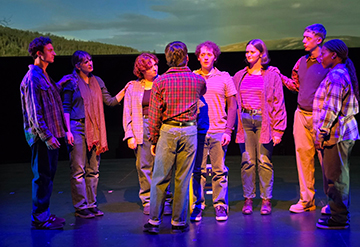 Told through the voices of Laramie’s own residents, the dialogue is transcribed from hundreds of interviews that the play’s creators shared with community members. Each actor portrays at least 10 different characters. “It has been a deeply sensitive and challenging rehearsal process,” said director Mark Reynolds, who also directed Cortland’s earlier production of the play in 2016. “While the tragedy is the catalyst for the story, “The Laramie Project” is about the people of Laramie, Wyoming, and how this terrible event changed a small college town,” Reynolds explained. First staged in 1999, the play inspired an HBO movie of the same name in 2002. Cortland’s cast and crew were able to have direct question and answer sessions with those connected to death and its history. Those included Kelli Simpkins, an original member of the Tectonic Theatre Company who interviewed Laramie residents, Jedadiah Schults, a University of Wyoming student in 1998 who is now a theater professor at New York University, and Dennis Shepard. “The challenge of ‘The Laramie Project’ compared to other productions is remembering that everything about it is real, it’s verbatim,” said Athena Molina, stage manager and junior musical theatre major. “There’s nothing to hide behind because it wasn’t just a story that someone developed on their own. In other shows, it’s easy to separate yourself from fiction, even realistic fiction.” 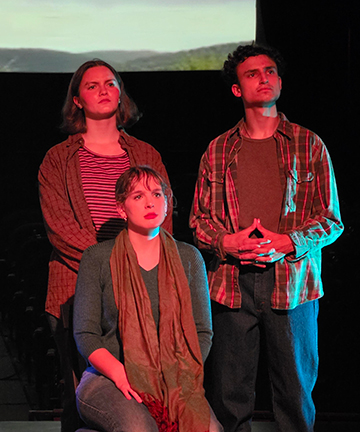 She explained that each line in this show is a quote about a tragedy — and a level of hate — that is all-too-real. “It’s hard to ingest every day, so many rehearsals have been emotional,” Molina said. “I can’t even begin to imagine what it puts my actors through every day having to put themselves into the material over and over.” Molina said that the play’s cast and crew have prioritized creating safe, comfortable spaces for rehearsals. Senior musical theatre major Sidney Humes-James performs the parts played by original cast member Mercedes Herrero. “It reminds us that the characters we are playing are human and that reminds us to bring natural speech and movement into our performances,” Humes-James said. She mentioned the value of consulting with Kelli Simpkins, who explained that cast members should feel like they are standing side by side with their characters. Hume said that conversation with Simpkins improved her performance. Humes-James added that those talks put the play into perspective in a way that would be impossible to imagine otherwise. “It has been difficult because of how heavy the material is but also so rewarding to tell the story of this town and how people react to tragedy,” she said. EOP scholars participate in research programSUNY Cortland’s Educational Opportunity Program (EOP) scholars continue to excel through high-impact learning — with the most recent evidence coming through undergraduate research. Two exercise science majors — sophomore Stephanie Elizabeth Martinez and junior Dillian Vittini — were among 42 students from across the SUNY system who participated in the EOP STEM Summer Research Program. Both students earned a stipend, housing and additional support that allowed them to join in meaningful hands-on work in the sciences during the summer. Martinez participated in psychology research at Binghamton University that considered how infants perceive faces, while Vittini worked in a chemistry lab at SUNY Brockport that relied on environmentally friendly methods to study chemical compounds. Martinez and Vittini also presented their findings at a system-wide research symposium at the SUNY System Administration Building in Albany that brought together 62 students from both the STEM Summer Research Program and SUNY’s EOP Liberal Arts Summer Research Program. The larger SUNY Undergraduate EOP Summer Research Program started last summer with 30 students at five SUNY campuses. This year, SUNY has doubled the program participants to 62 students at 10 campus host sites. Both Martinez and Vittini aspire to work in the healthcare field — Martinez as a pediatric surgeon and Vittini as a physical therapist. Despite being the youngest person working in a lab with graduate and Ph.D. students, Martinez found the experience to be rewarding. “I had the chance to learn about topics and methods I had never encountered before,” she said. “Collaborating with them and receiving thoughtful feedback helped me strengthen and refine my own research.” Although Vittini’s work focused on chemistry rather than kinesiology, he was introduced to new equipment in a lab setting. “It taught me how to approach problems carefully, pay attention to detail, work through challenges and apply what I have learned in a hands-on environment,” he said. More information about each EOP scholar is included below. Stephanie Elizabeth Martinez  Major: exercise science Hometown: Brentwood, N.Y. Class year: sophomore Title/focus of summer research: Quantifying Face Similarity: An Individualized Stimulus Set for Infant Habituation Tasks Research mentor: Stefania Conte, assistant professor of psychology, Binghamton University Explaining my research: “My summer research consisted of creating a habituation study on how infants find similarities in faces, like their primary caregiver or a stranger to test for novelty versus unfamiliarity.” Favorite part of summer research experience: “My favorite part of the experience was working in a lab with graduate and Ph.D. students. As the youngest person in the lab, I had the chance to learn about topics and methods I had never encountered before. Collaborating with them and receiving thoughtful feedback helped me strengthen and refine my research.” Extracurricular involvement: Pre-Medical Club Most rewarding part of SUNY Cortland EOP: “My favorite part of EOP has been my advisors and connecting with older students in my major and concentration, who have shared advice that has helped me grow academically and professionally.” Future aspirations: “My future goal is to enter the medical field and become a pediatric surgeon. I want to use my skills to care for children and improve their health outcomes.” How summer research will help in the future: “My summer research will help my future plans by giving me early experience with infants and child development, which is the population I hope to serve as a pediatric surgeon. I learned how to design a study, work with data and use tools like machine learning to answer questions objectively. Working with graduate and Ph.D. students also taught me how to collaborate, take feedback and keep improving my work. These skills will help me in medical school and in a career that values teamwork and careful thinking.” Dillian Vittini  Major: exercise science Hometown: Bronx, N.Y. Class year: junior Title/focus of summer research: Clean, Green, High-Impact Machines Research mentor: Michael Coleman, associate professor of chemistry, SUNY Brockport Explaining my research: “My research focused on using more environmentally friendly methods to create and study a specific chemical compound. I worked through the process of producing the compound, purifying it and using scientific instruments to confirm that the compound had been successfully isolated. The research also looked at how the compound could potentially be used in future chemical reactions.” Favorite part of summer research experience: “My favorite part of the experience was being able to use advanced scientific instruments that I normally would not have access to in a traditional college classroom. It was really interesting to see the ‘behind the scenes’ of the chemistry concepts I have learned in class and actually apply them in a research setting.” Extracurricular involvement: Resident assistant in Glass Tower; supplemental instruction leader for BIO 301; and personal trainer at the Student Life Center. I also regularly participate in Curly, Coily, Kinky; Men of Value and Excellence; the Multicultural Male Initiative; and intramural flag football. Most rewarding part of SUNY Cortland EOP: “What I have enjoyed most about SUNY Cortland EOP is the sense of family and community within the program. I feel very connected to the EOP staff and my fellow students, and the friendships and connections I have built through EOP are ones that I believe I will remember for a lifetime.” Future aspirations: “My goal is to attend graduate school to earn a Doctor of Physical Therapy degree and ultimately become a licensed physical therapist.” How summer research will help in the future: “Although my research was focused on chemistry rather than physical therapy, the experience helped me develop skills that I will carry into my future career. It taught me how to approach problems carefully, pay attention to detail, work through challenges and apply what I have learned in a hands-on environment. It also gave me greater confidence working with scientific equipment and conducting research, which I believe will be valuable as I continue my education and pursue a career in physical therapy.” Poskanzer Lecture to feature namesake’s sonThe SUNY Cortland Health Department’s upcoming Poskanzer Lecture will feature its namesake’s son: respected higher education leader and legal scholar Steven G. Poskanzer. A professor of political science and president emeritus of Carleton College, Poskanzer will help celebrate the 20th anniversary of the event on Wednesday, Sept. 30, at 3 p.m. in the Corey Union Exhibition Lounge. The lecture is named after his late father, Charles N. Poskanzer, distinguished service professor emeritus of health who served SUNY Cortland for more than 40 years. Steven Poskanzer’s talk, “The Status of Abortion Law after Dobbs: Public Health, Policy and the Future of Reproductive Rights,” is free to attend and open to the public. “This year’s lecture continues the tradition of engaging our campus and community in timely and important public health discussions,” said Jena Nicols Curtis, professor and chair of SUNY Cortland’s Health Department. “This year also marks the 20th anniversary of the lecture series, which recognizes Dr. Poskanzer’s contributions to public health and continues to shed light on the critical public health issues we face today.  “We are especially honored to welcome his son, Steven, who has followed in his father’s footsteps as a brilliant scholar.” An expert on higher education and constitutional law, Steven Poskanzer previously served as vice provost for the SUNY system and later as president of SUNY New Paltz from 2001 to 2010. He was Carleton College’s president from 2010 to 2021. Poskanzer’s research focuses on issues of academic freedom and how colleges and universities seek to achieve educational goals in a complex legal and policy environment. In 2025, he published The University’s Voice: Principled Silence and Purposeful Speech. His SUNY Cortland talk will examine abortion law and reproductive health policy in the wake of the Supreme Court’s 2022 decision in Dobbs v. Jackson Women’s Health Organization, which ended federal constitutional protection for abortion. Drawing on legal analysis and current public health challenges, he will explore how the ruling has reshaped access to reproductive health services across the U.S. and consider the legal disputes and policy questions likely to arise in the coming years, how courts and legislatures may respond and what evolving debates mean for public health outcomes. His father, Charles, joined the SUNY Cortland Health Department in 1950, earning the title of SUNY distinguished service professor in 1989. As a specialist in healthcare administration, Charles Poskanzer co-authored a study that led to the passage of the Medicare and Medicaid Act. He attended the 1965 signing of the groundbreaking legislation at the invitation of President Lyndon B. Johnson. Contact Curtis or the SUNY Cortland Health Department at 607-753-2979 for questions about accessibility or to request accommodations for the Poskanzer Lecture. Brooks Lecture Series focuses on ‘The Culture of Narrative’The many facets of storytelling are the focus of the 2026-27 Rozanne M. Brooks Lecture Series, as it explores “The Culture of Narrative.” The topic is designed to examine the different meanings a narrative can have and how they are used for better or worse. “Stories, or narratives, tell of the past, predict the future, and serve as the vessels that explain the universe,” said SUNY Distinguished Professor of Sociology/Anthropology Sharon Steadman, who serves as series organizer and director of the Brooks Museum. “In short, stories rest at the nexus of human experience.” The Brooks Series honors the late distinguished teaching professor of sociology and anthropology emerita, Rozanne M. Brooks, whose donated collection of ethnographic objects to the Sociology/Anthropology Department established the Brooks Museum in 2001. It is supported by a grant from Cortland Auxiliary Services and the Cortland College Foundation. Three scheduled lectures will take place in Moffett Center, Room 115. Pre-lecture receptions for each begin at 4 p.m. in the Brooks Museum (Moffett Center, Room 116). All events are free and open to the public. Seating will be limited and reasonable room capacity will not be exceeded. Wednesday, Nov. 11 Looking to the Past and the Future: Using Braided Storytelling in Community-Based Archaeology Presenter: Hollis Miller, assistant professor of sociology/anthropology 4:30 p.m., Moffett Center, Room 115 Exploring storytelling methods in archaeology, as situated within a community-based project in Old Harbor, Alaska, a Sugpiaq village in the Kodiak Archipelago. Different methods of storytelling have a place in the practice of archaeology, from the initial formation of a research question to the sharing of results with community members and heritage professionals. Miller will discuss how she and her collaborators have used storytelling to present new archaeological data from the Ing’yuq Village site, for community-oriented communication and as an interpretive framework within archaeology. Braiding together different threads of story creates a more nuanced picture of Sugpiaq lifeways that includes the context of Sugpiaq relationships to this specific place on the land. The talk will conclude by discussing how storytelling and heritage are important factors in imagining Sugpiaq futures in Old Harbor. Wednesday, Feb. 24 The Story of Ahalya and More: Unsavory Narratives of Sexual Assault in South Asia Presenter: Anisha Saxena. associate professor of history 4:30 p.m., Moffett Center, Room 115 Premodern South Asia was the birthplace of several major religious traditions, including Hinduism, Jainism and Buddhism. Narratives about gods and goddesses, teachings of religious founders, oral traditions surrounding founders and other significant figures, and accounts of their lives were memorized, circulated and eventually recorded. These narratives became integral to South Asian collective memory, cultural identity, and understandings of heritage. The talk will focus on “unsavory narratives” of sexual assault within South Asian narrative traditions, examining how certain accounts were selectively forgotten or marginalized, while elements that glorified male power and authority were preserved. Wednesday, April 7 The Exception Principle: Fantasies of Inclusion in Shakespearean Drama Presenter: Willnide Lindor, assistant professor of English 4:30 p.m., Moffett Center, Room 115 The inception of this talk arises from emerging scholarship in critical whiteness studies that has broadened conversations about race and gender in Shakespeare studies. These recent conversations call upon scholars to interrogate how whiteness operates as a complex matrix of identities encompassing marginal experiences that shape racial and gender constructs. This talk aims to examine how fantasies of inclusion function as mechanisms of gender and racial formation. Questions will consider what happens when individuals positioned within structures of privilege come to experience marginalization and how privileged-marginalized identities complicate conversations about early modern constructs of race and gender. For more information, contact Steadman by email or by phone at 607-753-2308. SUNY Cortland joins suicide prevention effortsMore than 100 SUNY Cortland students joined a recent effort led by Conley Counseling and Wellness Services with a simple message for people contemplating suicide: There is hope — and lots of it. The university recognized World Suicide Prevention Day on Sept. 10 with a campuswide awareness event outside Cornish-Van Hoesen Hall. In addition to sharing information about mental health resources and the 988 suicide and crisis lifeline, organizers created a “hope wall” of student-written notes offering encouragement to classmates and peers. The response was overwhelming. “So many students came out to write an inspirational message in hopes that other students would take them,” said Jennifer Talarico, assistant director of counseling services. “We were flooded.” The event was part of a larger system-wide initiative to increase awareness and promote mental health resources during Suicide Prevention Awareness Month in September. “Mental health is health, and across SUNY’s campuses, we recognize that addressing and protecting mental health is an essential component of achieving academic excellence and student success,” said SUNY Chancellor John B. King Jr. “During Suicide Prevention Month, I want to ensure that we raise awareness, so SUNY students are fully aware of the resources and support available to them throughout their academic journeys.” Suicide is the second-leading cause of death among college-aged young adults and college students in the U.S., according to the American Foundation for Suicide Prevention, with an estimated 1,100 student suicides occurring on college campuses each year. Talarico said the SUNY Cortland event focused on promoting awareness and prevention on a topic that continues to be a priority, from counseling centers to residence halls to classrooms. Cortland students lined up to participate and they shared emotional stories while penning notes of encouragement for others. “They said things like, ‘I’m a senior now, but when I was a freshman, I really wish someone had given me these words of advice that I mattered or things would get better,’” Talarico said. “It’s so important to create those connections — whether it’s through counseling or friends or loved ones or even online — to build that sense of hope that things can get better.” She also noted that the success of the university’s World Suicide Prevention Day efforts amplifies the importance of conversations about suicide throughout the year. Conley Counseling and Wellness Services organizes events throughout the year focused on grief and loss, insecurities and body image, stress tied to academics and many other topics. Students can contact SUNY Cortland’s Counseling Center at 607-753-4728, stop by in person at Cornish-Van Hoesen Hall, Room C013 or visit cortland.edu/counseling to learn more about resources. “It’s wonderful to have a day and a month (acknowledging suicide awareness and prevention), but it’s also something that needs to be every day, year round,” Talarico said. “It always needs to have light shined on it.” Pictured above left: Jennifer Talarico, assistant director of counseling services; Stacey Massari, senior counselor; Ami Aiken, senior counselor Latiné Heritage Month celebrated at SUNY Cortland through Oct. 15SUNY Cortland is inviting campus community members to join in the celebration of Latiné Heritage Month with educational, cultural and social events taking place through Oct. 15. The recognition of Hispanic Heritage Month officially began in 1968 when an annual week of observance was signed into law by President Lyndon Johnson. That was expanded by President Ronald Reagan in 1988 to cover 30 days from Sept. 15 to Oct. 15 The day of Sept. 15 is significant because it is the anniversary of independence for Latin American countries Costa Rica, El Salvador, Guatemala, Honduras and Nicaragua. A lecture on “Understanding Latiné Heritage Month” kicked off activities on campus on Sept. 16. Upcoming events include: Afro-Latino Hair Care Night Thursday, Sept. 24, at 6 p.m. Van Hoesen Hall, Room B112 (new Voice Office location) Hosted by the Caribbean Student Association, Women of Color, Spanish Club and Curly Kinky Coily this talk considers the history of women’s representation of Afro hair in the Caribbean and Latin America. Participants can learn tips and tricks about how to maintain hair in different climates. Unpacking Assumptions: Recognizing and Responding to Microaggressions Impacting Latiné Communities Friday, Oct. 2, from 3 to 4:30 p.m. Corey Union Fireplace Lounge Facilitated by Chief Diversity Officer Renee Wells, this 90-minute workshop will explore the most common microaggressions experienced by members of the Latiné communities. It aims to help participants understand the assumptions underlying these micro aggressions, their impact and different response strategies. Copa Mundial Soccer Tournament Friday, Oct. 2, at 4 p.m. Student Life Center This social event is hosted by La Familia Latina and Men of Value and Excellence. Dominoes Tournament Thursday, Oct. 8, at 6 p.m. Van Hoesen Hall, Room B112 (new Voice Office location) Hosted by La Familia Latina and the Caribbean Student Association, this event offers the opportunity to play the internationally popular tile-based game. Nuestra Cultura Saturday, Oct. 10, at 7 p.m. Dowd Fine Arts Center, Room 110 Sponsored by the Performing Arts Department, this event celebrates Latin heritage through song and dance. More Than One Language: Latiné Identities, Translation and Belonging in Latin America Thursday, Oct. 14, from 5:30 to 7 p.m. Taking place online through Microsoft Teams Facilitated by bilingual language educator Wesley Henrique Prates and sponsored by the Literacy Department, this interactive workshop celebrates the linguistic and cultural diversity of Latin America while exploring how language shapes identity, belonging and participation. Participants will consider the relationship among the terms Latiné, Hispanic, Latino/a and Latin American; encounter Portuguese, Spanish, Indigenous and Creole linguistic and cultural examples; and engage with brief literacy excerpts and translation activities. The program is designed for a general campus audience and requires no prior knowledge of Portuguese or Spanish. Sandwich Seminar: Beyond the Monolith: Resilience, Race and Myth of “The Latinx Student” Thursday, Oct. 15, from noon to 1 p.m. Old Main Colloquium, Room 220 Sponsored by the Multicultural Life and Diversity Office and the university’s Latino and Latin American Studies program, this research-informed presentation will be delivered by Tibisay Hernandez, who serves as chief equity officer for the New York State Office of Addiction Services and Supports. The talk will focus on what can be misinterpreted as disengagement — and what is required to support Latinx and Afro-Latinx students. Raices y Ritmo Friday, Oct. 23, from 5 to 11 p.m. Corey Union Exhibition Lounge This social event is hosted by La Familia Latina, the Caribbean Student Association and Ritmo Latino. For more information about the university’s Latiné Heritage Month events, contact AnnaMaria Omilanowicz, director of multicultural life and diversity, or Jose Ortiz, assistant professor of foundations and social advocacy. SUNY Cortland climbs in U.S. News & World Report rankingsSUNY Cortland was named one of the top public schools among regional universities in the north, rising in multiple categories of the recently released U.S. News & World Report rankings. The university climbed in two main rankings among its peers:
In both rankings, SUNY Cortland was second among similar SUNY university colleges. “Moving up in these rankings reflects the continued progress of SUNY Cortland and the extraordinary education that our students discover here,” said President Erik J. Bitterbaum. “Now more than ever, students want value in their college experience. They discover it at SUNY Cortland through an emphasis on high-impact practices, a culture of belonging and an education that lays the foundation for success in their careers and in their personal lives.” U.S. News rankings are based on student reviews, graduation outcomes, faculty resources, financial aid and data from the National Science Foundation and Department of Education. This past year, SUNY Cortland received 18,789 first-year applications for an incoming class totaling approximately 1,420 first-year students and 420 transfers. The university’s most recent first-year retention rate was 84.2%, which ranked second among SUNY university college peers. Among other recent highlights, the university joined the SUNY system’s Advancing Completion through Engagement initiative, the Cortland College Foundation funded a record number of summer undergraduate research fellowships and the Educational Opportunity Program welcomed one of the largest classes in its recent history. Learn more online about SUNY Cortland’s most recent institutional accolades and achievements.  Suggest a feature story Suggest a feature story
Faculty/Staff ActivitiesJeremy JimenezJeremy Jimenez, Foundations and Social Advocacy Department, was an invited plenary speaker at an international conference, Ecological Challenges in the 21st Century: Between Nature and Society – Interdisciplinary Reflections on our Environmental Crisis, held Sept. 11 and 12 in Chișinău, Republic of Moldova. Saige KelmelisSaige Kelmelis, Sociology/Anthropology Department, published an article titled “Motives for Getting Tattooed and the Connections to Well-Being Among Tattoo Recipients” in the interdisciplinary journal Deviant Behavior. The article explores motives for getting tattoos, investigating their associations with demographic factors and body well-being and perceived mental health. Sharon SteadmanSharon Steadman, Sociology/Anthropology Department, received a $10,000 Charles Harris Project Grant from the American Society of Overseas Research for her project, “Climate and Economy at Late Chalcolithic Çadır Hoyük.” Nance S. WilsonNance S. Wilson, Literacy Department, earned the Mary F. Roe Equity in Literacy Education Award from the Association of Literacy Educators and Researchers for her commitment to ensuring all students have access to equitable educational opportunities and the literacy experiences necessary for success. Tiantian ZhengTiantian Zheng, Sociology/Anthropology Department, published her paper titled “Affective Risks, Criminal Justice System, and Intimate Partner Violence in Postsocialist China” in Routledge International Handbook of Criminology and Affect (eds). 2026. Routledge. Submit your faculty/staff activity
|
The Bulletin is produced by the Communications Office at SUNY Cortland and is published every other Tuesday during the academic year. Read more about The Bulletin. To submit items, email your information to [email protected]
© 2026 SUNY Cortland. all rights reserved.