|
|
Issue Number 8 • Tuesday, Dec. 2, 2025 |
Campus ChampionFor Jackie Morse, dining services supervisor, her positive outlook comes down to one simple thing: love. Love for the campus community, love for her job and a strong belief that giving love will eventually brings it back to you. That mindset has made Jackie a warm, welcoming presence while she’s serving coffee and kind words at Sawubona in Moffett Center or working elsewhere on campus. For anyone in need of a pick-me-up, Jackie provides a burst of energy, encouragement and enthusiasm. Every day shines brighter because of her smile. Upcoming eventsFor the most up-to-date information, check online. Tuesday, Dec. 2 December Karaoke: A night full of music, laughter and unforgettable performances. 7 p.m., Corey Union First Floor. College-Community Orchestra Concert: Music arranged and directed by Max Buckholtz includes Arcangelo Corelli’s “Christmas Concerto,” Romanian folk-song suite and more. 8-9 p.m., Rose Hall, 19 Church St., Cortland. Wednesday, Dec. 3 De-stress Pop-Up: Stop by to grab free goodies and test prep supplies to help you through final exams. 2:30-4:30 p.m., Corey Union First Floor. Sandwich Seminar: Direct Democracy Issues and the Voter Turnout Gap in Florida: Does direct democracy promote civic engagement?: Do ballot measures stimulate peripheral voter turnout, helping to equalize rates of electoral participation? 12:30-1:30 p.m., Old Main Colloquium, Room 220. Study Abroad 101: Learn about study abroad opportunities. 3-4 p.m., Old Main Colloquium, Room 220. Friday, Dec. 5 Classes end Monday, Dec. 8 Finals Week: Monday, Dec. 8, to Friday, Dec. 12. PAWS for Stress Relief: Relax with furry four-legged friends. Noon-4 p.m., Student Life Center, Three-Court Gymnasium. Teaching, Research and Service Awards Ceremony: 4:30-6:30 p.m., Corey Union Function Room. Moonlight Breakfast: Enjoy a free late-night meal to help make it through finals week, open to all students regardless of meal plan status. 10-11:30 p.m., Student Life Center, The Bistro Off Broadway. Tuesday, Dec. 9 PAWS for Stress Relief: Relax with furry four-legged friends. Noon-4 p.m., Student Life Center, Three-Court Gymnasium. Friday, Dec. 12 Move-out Day: Residence halls close at 9 p.m. Visit the Residence Life and Housing Office webpage to learn more. |
Google credentialing coming to SUNY Cortland12/01/2025SUNY Cortland will partner with the State University of New York in transforming select English Department courses to prepare students to earn the kind of industry-recognized credentials that new graduates need in today’s U.S. workforce. Cortland is among a chosen handful within the 64-campus system to participate in a second cohort of the Embedding Industry Credentials in Academic Coursework (EICAC) initiative. Supported by the SUNY Chancellor’s Economic Development and Upward Mobility funds, EICAC represents a partnership with the National Association of Systems of Higher Education, Google and University of Texas at Arlington. The latest EICAC initiative, which rolls out next semester and continues through the end of spring 2027, supports SUNY campuses as they work to embed industry credentials into multi-disciplinary coursework with specific emphasis on students in arts, humanities and social sciences majors. Titled “Career-Ready Graduates in the Humanities: a Coordinated Approach to Embedding UX Design and Generative AI Certificates in SUNY Cortland’s English Department Programs and Courses,” Cortland’s pilot project will receive the maximum grant for $50,000 to adapt its three bachelor’s degree tracks — adolescence education: English (7-12), professional writing and English — to contain the career-boosting elements that will help future graduates. The grant also supports recruiting three undergraduate researchers to help expand the initiative’s reach. A 2022 survey conducted by Coursera found that 86% of U.S. students agree that earning an entry-level professional certificate could help them stand out to employers. American employers agreed, with 86% believing industry certifications strengthen a prospective employee’s application. “Our students take a wide variety of literature and writing courses which prepare them to think critically, pull together complex ideas and analyze complex situations,” said Laura J. Panning Davies, professor of English, one of three co-principal investigators and author of the successful proposal.  “Students in our major programs graduate with deep reading, critical thinking and flexible writing skills,” she said. “It can be hard, though, for students to make these skills visible as they apply for entry-level positions. These credentials might help make students’ skills and expertise more legible on the job market.” Cortland’s project will integrate elements from three Google Essentials industry credentials — Google UX Design Professional Certificate; Google AI Essentials; and Generative AI for Educators with Gemini — into four English Department course offerings. Kati Ahern, associate professor, and Noah Wason, instructor, are co-principal investigators with Davies. Both the English Department faculty members also serve students across the disciplines in the university’s Composition Program and Writing Intensive Courses program. Ahern, whose scholarship is focused on sound studies, sonic rhetorics and digital writing, will incorporate modules from Google’s Universal Design into two of her courses, PWR 210: Digital Writing with Data, and PWR 375: Digital Storytelling. Wason, who researches digital rhetoric and algorithmic technologies, will adopt modules from the AI Essentials certificate in PWR 310: Surveillance, Rhetoric and Technology. Davies will bring Gemini for Educators, an introductory generative AI course for teachers, into AED 408: Teaching Writing in Secondary Schools, a course that’s designed for Cortland’s adolescence education: English (7-12) majors. These future teachers also will benefit as they observe real classrooms through a school/university partnership Davies has with Cortland Junior-Senior High School. “They’ll be having conversations with the English language arts teachers at Cortland Junior-Senior High and the students at the school,” Davies said. “My goal is that this will enrich that fieldwork experience for them.” Given free rein, the trio decided Google certificates will be the best fit. “We really looked at our courses and our own expertise and interests as we were deciding the modules to embed,” Davies said. “We also thought about the kinds of jobs that many of our English Department students go on to pursue. We thought that universal design and generative AI make a lot of sense for these careers.” In December, the three faculty members will be trained by SUNY and collaborate with instructional design teachers to document the alignment of course learning outcomes with Grow With Google certificates. They also will develop a plan for integrating the certificates into course syllabi or program outcomes and create an assessment plan to measure student achievement of these outcomes. SUNY’s first Embedding Industry Credentials cohort was established in 2024-25 in partnership with the National Association of Systems of Higher Education (NASH) and Google. Eleven campuses joined a Community of Practice moderated by the University of Texas at Arlington and supported in part by the Strada Education Foundation. In that pilot, faculty members integrated content from a wide range of certificate programs — such as UX design, project management, data analysis and cybersecurity — into graduate and undergraduate courses and programs including business management, emergency preparedness, homeland security, marketing, computer technology and IT support. These campuses rolled out their pilot offerings this past summer. A more comprehensive rollout began this fall. The overall EICAC initiative is outlined in SUNY’s Office of Workforce Development and Upward Mobility Strategic Plan 2025. Professor’s idea brings county together for Crown Table Feast11/26/2025In the spirit of Thanksgiving, the Cortland County community had its own special day for a free meal last weekend, thanks to a grassroots effort led by SUNY Cortland faculty and staff members. The Crown Table Feast offered free food to those who need it, no questions asked, on Saturday, Nov. 29, from 1 to 4 p.m., at Access to Independence of Cortland County, 26 N. Main St., Cortland. The 41 guests were able to sit down together to eat from a menu that included meatless chili, chili dogs, fruit, rolls with butter, other dishes and drinks, choose a takeout option or bring home a bag of groceries with essentials like rice, potatoes, pasta, peanut butter and canned soup. The free meal began with Casey Pennington, assistant professor of literacy. She said she has been amazed to see so many local businesses and community members come together to give what they can during a time of year when many people go without the cherished holiday basics. Cortland ReUse, which has partnered with SUNY Cortland for Red Dragon ReUse sales, supported plans for the feast and supplied dishes and other houseware items. Texas Roadhouse in Ithaca donated the rolls and butter while Moe’s Southwest Grill in Cortland donated takeout boxes. In addition, there were 40 $10 grocery gift cards to Aldi or P&C Fresh Markets available and Kara Rode Webber, a Cornell University professor, is supplied free take-home COVID-19 tests. 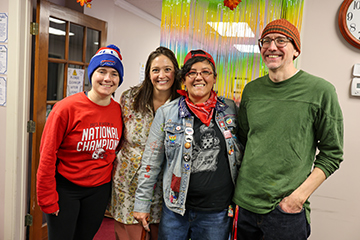 Further support from Ake Gallery, Cortland Mutual Aid Group, Main Street Farms and other volunteers from SUNY Cortland and the wider area have been invaluable in turning an initial kind idea into a project with real benefits, Pennington said. Finding that so many people cared — and to keep hearing “yes” when she expected to hear “no” — left Pennington shocked. “There are moments where I think, ‘Yeah, we’re going to do this. This is happening. We’re going to do it and we’re going to meet people and we’re going to build community.’” In late October, Pennington first thought of what would become the Crown Table Feast when she heard about federal SNAP food benefits running out due to the then-government shutdown. “The project started with me just being really afraid of what was going to happen and how that was going to impact Cortland County residents, and also thinking about how it’s going to affect kids and families,” she said. Pennington said she struggled with housing and food insecurity earlier in life while living in California, working multiple jobs to buy groceries. “There was such a lack of dignity in that practice that I still find to be very heartbreaking and, in effect, pretty cruel,” Pennington said. “I want to be able to work across our community members ... and do it in ways that preserve and uphold our dignity as residents.” A childhood lesson she remembered from TV icon Mr. Rogers pushed her to take action: be a helper. “I thought, ‘Well, maybe I can be a helper in this,’” Pennington said. She first talked to Brian Fitz, senior programmer analyst at SUNY Cortland and a board member at Cortland ReUse, to propose a meal for Cortland County residents. Beyond that, she hoped to create a group that could use its collective expertise to learn what was most needed in the community and how it could be provided. “We could become each other’s keeper rather than waiting on someone else,” Pennington said. She hopes the upcoming meal will include dozens of people from around the area who will talk, laugh and eat together. When that happens, the inaugural Crown Table Feast will become something that, quite appropriately, Cortland County can be thankful for. Those good tidings aren’t planned to end after Thanksgiving, either. Pennington hopes future efforts can continue to aid the local community. She would like to create a toy swap ahead of the holiday season so that used toys get to the children and families that can use them best. Her ultimate goal is to build a system where neighbors help neighbors when they most need it — a kind of all-year Thanksgiving where community members don’t have to wait until the last week of November to be reminded how powerful friendship really is. “If we have folks who have a need and it’s not getting the type of support that is necessary, then we can have other community members take that role on,” Pennington said. “I think the goal is for things to be decentralized.” Capture the MomentIn celebration of International Education Week, the International Programs Office and International Club hosted a sushi making, origami and game night on Friday, Nov. 21. Students learned to roll sushi with Chef Mizuho of Cortland Auxiliary Services. They also sampled a tasty selection of veggie, tuna and California rolls, miso soup and karaage, a type of Japanese fried chicken. In Other NewsSUNY Cortland adds AI-powered recycling assistantCortland Auxiliary Services (CAS) has introduced a technology-assisted zero waste station to educate the campus community on recycling and make it fun in the process. The university’s new Oscar Sort machine is located in Brockway Hall’s Hilltop eatery. “Every county has a different recycling rule, and it’s a challenge for people to know and remember what is or is not recyclable on campus,” said Megan Swing, SUNY Cortland’s energy and sustainability engagement coordinator. “Oscar will join the SUNY Cortland Green Reps in sustainability education surrounding recycling.” Oscar Sort provides feedback to users — down to the coffee sleeve — of what goes in each of the bins, using sensors and artificial intelligence (AI) to scan the waste someone is ready to discard. The Oscar program instructs campus community members in which of four bins that refuse belongs — compost, recycling, trash or bottles and cans. Through a PepsiCo, Inc., partnership, CAS brought Oscar Sort to campus as part of its sustainability initiatives. “Oscar is designed to gamify trash and waste sorting to build new patterns to help get things where they need to go,” said Nichole Edwards, associate executive director for CAS. Frequent contamination of bins with the wrong items prevents CAS from expanding its compost program to include Hilltop and dining units in Corey Union. “Hopefully Oscar will help us all get better at knowing what can be composted, recycled or must be wasted,” Edwards said. “Once it’s a learned behavior, we can replicate the sorting in other units and gain some campuswide regularity.” Cortland chosen for green campus partnership grantSUNY Cortland further grew its Earth-friendly approach to education when it recently won funding from climate action nonprofit Second Nature. Cortland was one of eight schools across the country to be awarded one of the Catalyst Grants, which are designed to serve as a “spark” that strengthens campus climate action projects. The $3,500 from Second Nature will be split in half, with $1,750 to support a new student intern position that will analyze the success of the university’s sustainability efforts and $1,750 to strengthen the school’s support of local partner Cortland ReUse. “The Catalyst Grant emphasizes collaboration between higher education and the community,” said Megan Swing, energy and sustainability engagement coordinator. “Cortland ReUse has consistently been a supportive partner in efforts to reduce campus waste and divert it from the landfill. When we applied for this grant, we were hoping to strength the partnership and help support Cortland ReUse because of all the work they do with SUNY Cortland.” Cortland ReUse joined SUNY Cortland’s Residence Life and Housing, Facilities Management and Sustainability offices to collect student residence hall donations in past Red Dragon ReUse Sale events, with more sales planned. More than 40 tons of items were collected from SUNY Cortland at the end of the Spring 2025 semester, keeping them out of the trash and saving the university about $4,050 in landfill tipping fees. One of the Sustainability Office’s main goals for the grant money is to encourage the idea of a “circular economy” that keeps products and materials in circulation longer through thrift stores and buying secondhand. To better gauge the impact of ReUse sales and other green projects on campus, the new student intern will aid the Sustainability Office in developing common measurement metrics, develop measurement tools and create long-term project guidance for SUNY Cortland’s waste reduction and federally designated Scope 3 greenhouse gas goals that also align economic and health benefits. Scope 3 emissions are an organization’s indirect emissions caused by its supply chain, such as food purchases, office supplies and travel. “Through our annual Catalyst Grants initiative, we’re able to empower colleges and universities to launch or scale projects that create meaningful, lasting climate impact,” said Tim Carter, president of Second Nature. “This year’s recipients represent a diverse group of institutions tackling the urgent need to decarbonize, increase resilience and advance equity within their communities. Their creativity and commitment continue to drive higher education’s leadership in addressing the climate crisis.” SUNY Cortland has been a leader in sustainability for many years. Among its accomplishments, the university:
Senior’s B.F.A. exhibition focuses on nightmaresNightmares, insomnia and sleep paralysis inspire in many a trip to the refrigerator or a few hours with a soothing book. When SUNY Cortland senior Melissa Kummrow of DeRuyter, N.Y., awakes in the dark in a state of real anxiety and fear, she picks up her artist’s tools. Now a B.F.A. candidate and senior studio art major with a concentration in fibers who is graduating in December, Kummrow’s senior thesis exhibition on these deeply disquieting, almost universal human experiences, titled “Parasomnia, A presentation of Fiber and Drawings,” opened on Nov. 21 and continues through Friday, Dec. 5, at the university’s Dowd Gallery. Kummrow’s drawings, paintings and fiber art appear alongside artwork from classmate Sarah Goldberg, in an exhibition that is titled “BOLTHOLE.” Gallery hours are 10 a.m. to 5:30 p.m. Monday through Friday with hours extended on Thursday until 7 p.m. Walk-ins are welcome. Admission is free and open to the public. Graduating candidates display their final collection of artworks supported by writing and oral presentations that fulfill the year-long thesis requirement in their designated programs. Displayed works are evaluated by a B.F.A. committee comprised of Art and Art History Department faculty members. Kummrow, a native of Pompey, N.Y., attended Fabius Pompey High School and obtained a degree in psychology before returning to college as a non-traditional student at age 24. She aspires to teach art. “My recent work examines the darkest parts of dreams and how they merge into reality,” Kummrow said in her artist’s statement. “’Parasomnia’ describes the abnormalities I experience at night, including insomnia, sleep paralysis, paranoia and nightmares,” Kummrow said. “These restless nights have caused some emotional and physical distress, but they have also been an incredibly fascinating phenomenon I enjoy sharing with others,” she said. The endless cycle of falling asleep, jolting awake, having a nightmare and waking up paralyzed creates intense feelings of frustration, fear and disorientation, Kummrow said. “There is no way to predict when sleep paralysis will strike, forcing me into a paranoid state where I believe sleeping may lead to regret,” she said. “The hallucinations that follow paralysis have become engraved in my head, and I still struggle to decipher reality with dreams. ‘Did a rat really run across my face at 6 a.m., just after moving into an old farmhouse?’” Kummrow also works with fibers to express the visuals and feelings of parasomnia. “Linens, pillowcases and woven fibers are easily recognizable as common objects associated with sleep and comfort,” she said. “These symbols of rest have been altered to show the discomfort of my nights.” Using hand embroidery, she stitched multiple self-portraits showing the effects of sleep paralysis. Kummrow’s background in psychology helps her understand how parasomnia can be a frightening experience when someone wakes up without understanding their reality. “This work serves as a visual journal of my experiences, helping me remember the alternate reality I only meet during my sleeping hours,” she said. Visit the Dowd Gallery website or follow @dowdgallery on Instagram for detailed information about future artists, speakers and events. Select an image to start a slide show SUNY Cortland takes big steps to fight hungerThe 31st annual Cortland area CROP Hunger Walk raised almost $8,500 to help address food insecurity locally and across the globe. SUNY Cortland campus community members walked up to three miles through downtown Cortland during the event held Sunday, Oct. 12. A total of 256 walkers registered, with 90% of them representing SUNY Cortland. This is the 20th year that SUNY Cortland was a major factor in the success of the walk. Part of a global walkathon sponsored by Church World Service, the event helped to raise millions for global and domestic disaster relief, agricultural development, refugee resettlement and emergency food aid. Out of the money raised at the Cortland event, 25% will stay with the local community to support food pantries and feeding programs, including the SUNY Cortland Cupboard. Golden Sneaker plaques are awarded each year to the SUNY Cortland organizations that raise the most funds. The cost of the plaques is underwritten by the James M. Clark Center for Global Engagement. The overall winner, and winner of the Greek community plaque, went to sorority Delta Phi Epsilon, whose members raised $1,520. The athletic team plaque was won by the university’s softball team, raising $1,022. The top fundraisers among campus clubs or organizations was the AED 315: History Buffs, with $385, while a final plaque was awarded to COR 101-037, part of the Cortland Experience class required of all first-year students, raising $141. For more information on how to be a part of the CROP Hunger Walk, contact local event coordinators Jim Miller, lecturer in the History Department, or Jeanine Rose, tutor in SUNY Cortland’s Learning Center. 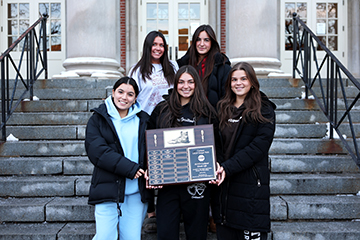 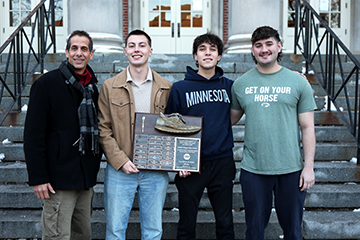 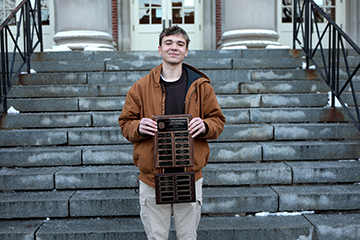 Cortland leads SUNYAC Commissioner’s Cup standingsSUNY Cortland’s intercollegiate athletics program currently sits in first place in the 2025-26 Dr. Patrick R. Damore State University of New York Athletic Conference (SUNYAC) Commissioner’s Cup standings following the fall season. The competition recognizes overall sports excellence within the conference. Cortland has an average score of 9.39 points, followed by New Paltz at 7.25 and Buffalo State at 6.40 in the 10-team standings. Commissioner’s Cup points are awarded based on each team’s finish in the SUNYAC standings, both during the regular season and in league postseason tournaments, when applicable. Cortland won four SUNYAC titles in the fall — in men’s and women’s cross country, women’s soccer and women’s volleyball. The Red Dragons also placed second in SUNYAC postseason tournaments in field hockey and women’s tennis after third-place regular-season finishes, and the men’s soccer team won the SUNYAC regular season title and tied for third in the conference tournament. Seven of Cortland’s nine fall sports compete in the SUNYAC. Of the two that do not, the football team won the Empire 8 Conference title, while the women’s golf team will compete at the Northeast Women’s Golf Conference championship in the spring. Cortland qualified for NCAA Division III team tournaments in men’s soccer, women’s soccer, women’s volleyball and football, with the men’s soccer team advancing to the “Sweet 16” to tie for ninth place nationally. Cortland has won the SUNYAC Commissioner’s Cup each of the last two years and 19 times overall since the competition originated in the 1996-97 season. Red Dragons beat Bombers in Cortaca Can CollectionThe perennial Cortaca gridiron rivalry brought a new kind of competition this year, with SUNY Cortland coming out on top. The SUNY Cortland and Ithaca College Sustainability Offices teamed up to host the first ever Cortaca Can Collection Competition to see which campus could collect the most cans. The competition ran from Nov. 7 until 14, the day before the big game took place in Ithaca College’s Butterfield Stadium, with all proceeds donated to Cortland ReUse and Finger Lakes ReUse. In the end, Cortland beat Ithaca in can collections, 1,638 to 1,554, with the Red Dragons raising more than $80 for Cortland ReUse. SUNY Cortland’s Green Reps and Ithaca College’s Eco Reps were crucial members of the effort — helping to engage the campus populations and count all of the cans collected. “Watching the number (of cans) increase going head-to-head with the Bombers all week was so fun,” said Tiana Schelble, a Green Rep at Cortland. “I had such a fun time participating and can’t wait to do it again next year.” The idea came from a brainstorming session about how to incorporate sustainability into the Cortaca celebrations, according to Megan Swing, Cortland’s energy and sustainability engagement coordinator. “We wanted to do something that promoted sustainable behaviors in a fun way,” Swing said. “Especially one where we can come together and look at our collective impact. “Just because the competition is over doesn’t mean proper recycling is.” The 5-cent deposit collection cans remain in the Student Life Center, Hilltop and residence halls. Swing encourages students to apply to become a Green Rep to join similar initiatives in the Spring 2026 semester. Interested students can find more details and apply online for the paid opportunity.  Suggest a feature story Suggest a feature story
Faculty/Staff ActivitiesLisa Czirr and Jenifer Sigafoes PhelanLisa Czirr and Jenifer Sigafoes Phelan, Memorial Library, recently published a chapter, “Empowering Future Educators: A Spiral-Based Information Literacy Curriculum,” in Libson, Scott P., et al. Teaching Information Literacy by Discipline: Using and Creating Adaptations of the Framework. Edited by Scott P. Libson and Malia Willey, Association of College and Research Libraries, a division of the American Library Association, 2025. Kent JohnsonKent Johnson, Sociology/Anthropology Department, co-authored a paper in the journal Nature Anthropology. Kent JohnsonKent Johnson, Sociology/Anthropology Department, recently completed an Erasmus+ Teaching Mobility in the Department of Ancient History and Archaeology at Babeș-Bolyai University in Cluj-Napoca, România. Kent JohnsonKent Johnson, Sociology/Anthropology Department, was selected by the American Anthropological Association to participate in The Op-Ed Project's "Write to Change the World" workshop to be held Dec. 10-11, 2025. Tisa LoewenTisa Loewen, Sociology/Anthropology Department, with senior Emma Caraher and Samantha Horn '24, wrote a textbook review, "Pedagogy in Practice, A Collaborative Textbook Review of: Forensic Anthropology, an Introductory Lab Manual," that was published in the American Journal of Biological Anthropology. Dianne WellingtonDianne Wellington recently published a co-authored article titled "Critical Dialogue as a Decolonial Feminist Approach to Healing and Restoration in Antiracist Literacy Education" in the journal Intersections: Critical Issues in Education. The article explores critical dialogue as a healing practice in antiracist literacy education. Using duoethnography and decolonial feminist perspectives, Dr. Wellington and her co-author examine how meaningful conversation supports sustained antiracist work. The study frames healing as an intergenerational movement and positions literacy education as a catalyst for transformation. Dr. Wellington advocates for restorative literacies that challenge systemic oppression through relational, justice-driven teaching practices that honor students' lived experiences, histories, and ways of knowing — fostering resilience, transformation, and coalition-building in educational spaces. Submit your faculty/staff activity
|
The Bulletin is produced by the Communications Office at SUNY Cortland and is published every other Tuesday during the academic year. Read more about The Bulletin. To submit items, email your information to [email protected]
© 2026 SUNY Cortland. all rights reserved.