
|
|
Issue Number 11 • Tuesday, Feb. 24, 2026 |
Campus ChampionSUNY Cortland has drawn record interest from first-year students again in 2026. Fortunately, there’s a steady, behind-the-scenes leader in Michael Johnson, senior associate director of admissions, to oversee the review of more than 18,000 applications. For 30-plus years, Johnson has provided consistency in the Admissions Office. He travels across the country to engage prospective students, collaborates with SUNY partners and works hard to enroll a diverse and talented incoming class. Ironically, Johnson was a three-time All-American in track and field at Ithaca College, earning induction in the rival’s Athletic Hall of Fame. But there’s no denying he’s forever a Red Dragon. Upcoming EventsTuesday, Feb. 24 February Karaoke: A fun-filled evening of music, food and prizes from the Campus Store. 7-9 p.m., Corey Union, first floor. Wednesday, Feb. 25 Strategies for Managing Challenging Conversations in the Classroom: Drawing on more than 25 years of experience in negotiation, mediation and conflict resolution, Bodi Regan, J.D., will lead this session on navigating the classroom during tumultuous times. Open to all faculty. Refreshments served. 9-10:30 a.m., Old Main Colloquium, Room 220. Wellness Wednesday: Education and Action Toward Racial Equity: Build awareness and education to unlearn bias and engage in anti-racist action, including SUNY Cortland’s 21-day Anti-racism Challenge. 1-3 p.m., Neubig Hall lobby. Race, Technology and Labor: The Legend of John Henry, the Luddites and Labor in the Age of AI: This lecture uses the John Henry legend to explore AI issues, drawing parallels to the Luddite movement and U.S. labor history. 3-4 p.m., Moffett Center, Room 125. Study Abroad 101: Learn about study abroad opportunities. 3-4 p.m., Old Main Colloquium, Room 220. Thursday, Feb. 26 Sandwich Seminar: Second-Hand Saints; A Book Talk About Exemplars in Living Morality: Learn more from the author and illustrator of this book sharing the life stories of nominated Christians who are examples of extraordinary faith. Noon-1 p.m., Old Main Colloquium, Room 220. Mr. Marmalade: A darkly comic, surreal play follows a precocious 4-year-old and her cocaine-addicted imaginary friend, exploring childhood, loneliness and growing up too soon. 7:30-9:30 p.m., Dowd Fine Arts Center Lab Theatre. Tickets available. Friday, Feb. 27 Mr. Marmalade: 7:30-9:30 p.m., Dowd Fine Arts Center Lab Theatre. Tickets available. Saturday, Feb. 28 Mr. Marmalade: 7:30-9:30 p.m., Dowd Fine Arts Center Lab Theatre. Tickets available. Sunday, March 1 Mr. Marmalade: 2-4 p.m., Dowd Fine Arts Center Lab Theatre. Tickets available. Tuesday, March 3 Educator Networking Event: Hear directly from superintendents, principals and hiring managers about securing a teaching job during this dinner and presentation. Registration required. 6-8:30 p.m., Corey Union Function Room. Wednesday, March 4 Study Abroad 101: Learn about study abroad opportunities. 3-4 p.m., Old Main Colloquium, Room 220. Spectral Power: The Subversive Spirits of Silenced Women: Talk explores how modern U.S. ghost stories have brought buried women’s stories to the surface. 12:30-1:30 p.m., Old Main Colloquium, Room 220. Wellness Wednesday: Unity Without Harm: Hazing Prevention for a Safer Organization: Michael Ayalon provides a comprehensive, research-based program designed to eradicate hazing practices by fostering a culture of respect, safety and genuine camaraderie. 7:30-8:30 p.m., Corey Union Function Room. Thursday, March 5 Safer Sex Express: Pick up free pre-made bags of items that promote safe sex practices and have questions answered. 2-3:30 p.m., Student Life Center lobby. |
Teacher educator noted for STEM dissertation research02/25/2026Preparing future science teachers is about helping them design curriculum that lets children of all ages envision themselves as scientists, according to Sage Andersen, a newly appointed SUNY Cortland assistant professor of childhood/early childhood education. As a graduate student and now as a promising university scholar, Andersen has researched a method called storyline instruction. It’s fast becoming the gold standard in teacher education given its focus on students’ sensemaking, agency and curiosity. Her work fills a very real gap in science education research through the development of a framework to prepare preservice teachers to teach using storylines. Andersen’s ongoing research — as reflected in her doctoral dissertation on the innovative approach to teaching STEM — has not gone unnoticed. Recently, she was chosen to receive a prestigious national award for outstanding doctoral research in her academic specialty of science teaching. Andersen will be honored with the 2026 Outstanding Doctoral Research Award by NARST: A Global Organization for Improving Science Education through Research. NARST, which stands for National Association for Research in Science Teaching, will recognize Andersen during a ceremony on Monday, April 20, during the organization’s annual conference in Seattle. Andersen, who arrived at SUNY Cortland last fall after earning a doctorate in STEM education from the University of Texas at Austin, also will share her research with members during a 15- to 20-minute virtual talk followed by a question-and-answer session next fall. According to Andersen, the storyline instruction method replaces hands-on demonstrations in the classroom and lab, once considered the pinnacle of teaching science, technology, engineering and mathematics (STEM). In her dissertation, Andersen illustrated the difference between the two methods with the classic water density demonstration involving dropping two grapes into a pair of glasses of water. Salt is added to one of the glasses, causing its fruit to gain buoyancy. The classic hands-on method has its shortcomings, however. “While students in this class may have opportunities to engage in science practices through investigations planned across the unit, they are not positioned as capable sense makers who figure out and explain complex scientific phenomena or as agentic in this sensemaking work,” Andersen wrote in her doctoral dissertation. “What you would do in a storyline approach is give them a phenomenon that is actually meaningful that we can only explain if we understand water density,” Andersen said. For example, her future teachers might instead work on learning how to get the schoolchildren to discuss water density tied to something that they can relate to, for example, melting ice at the earth’s poles that is leading to less salty water and the slowing and potential collapse of one of the world’s major ocean currents — an event that would impact weather and climates around the globe. In her Cortland classroom, future teachers engage in this very unit, using individually placed Post-it notes to model a Driving Question Board to model this approach to teaching where the children are developing their own creative new scientific avenues. The ideas can flow freely with just a little guidance from the college students or Andersen. “The learning throughout a storyline unit is guided by their questions, their ideas and their curiosities,” she said of the schoolchildren who will ultimately benefit on her students’ preparation. “So, it’s really a student-centered approach to science teaching and learning and it gives students agency in the classroom.” Also, the storyline lessons don’t rely on lengthy, stand-alone science lessons, lending this approach to science instruction to quick, but meaningful 20-minute sessions at schools where little or no time at all is formally set aside for a science class, she noted. Andersen twice has taken her education students to the William H. Parks Family Center for Environmental and Outdoor Education in Raquette Lake, N.Y. In both the fall and spring class trips she’s led to the university’s Adirondacks campus, Andersen has focused on equity and how to make science learning, both in and out of doors, accessible and meaningful to any child that participates. “One of the things that I try to do with my preservice teachers is center these different equity lenses in the work that we’re doing in science,” Andersen said. “Many of my students think that science is separate from equity, that they’ve never even thought of doing equity work in a science education space.” A native of California, she also has an M.S. in biological sciences and educational media design from University of California, Irvine, and a B.A. integrative biology from University of California, Berkeley. Before joining SUNY Cortland, she taught at the University of Texas at Austin and University of California, Irvine. For almost a decade, Andersen has served Teach for America in science teaching capacities. She began her career teaching at Whittier Health Science Academy in the San Antonio Independent School District. “I am deeply honored to receive this award and am excited to continue this important work here at SUNY Cortland with our preservice teachers,” Andersen said. “My research and work with teachers inform one another, so I am also very grateful to have such a wonderful and supportive community here, from our amazing students to our incredibly welcoming faculty and administration.” Select an image to begin a slide show ‘Mr. Marmalade’ brings dark comedy to SUNY Cortland02/24/2026Audiences will be entertained when the dark, surreal comedy, “Mr. Marmalade,” brings humor and heavy topics to SUNY Cortland this week. The play, written by Noah Haidle, explores the imaginative world of 4-year-old girl Lucy and how she processes adult themes with the help of a very imperfect imaginary friend, Mr. Marmalade. Performances take place in the Dowd Fine Arts Center Lab Theatre at the following times:
The show is intended for mature audiences only, with references to violence, domestic abuse, suicide and child neglect. Tickets are on sale at SUNY Cortland’s online Box Office. “While we want audiences to be prepared for these topics, we also want to remind them that it’s OK to laugh and enjoy the many light and hopeful moments,” said Benjamin Wells, production manager and publicity coordinator for the university’s Performing Arts Department. 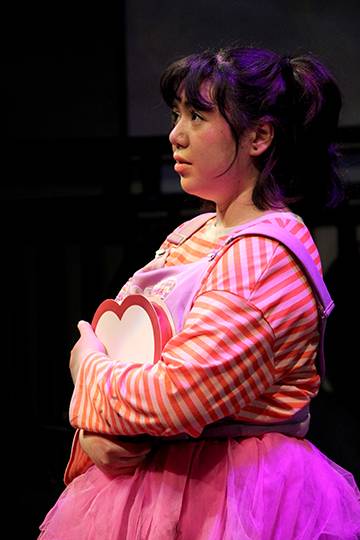 Photos by Carlita Withers Wells said the show relies on a strong script and deep characters addressing serious topics in smart ways. When looking at possible shows, the Performing Arts Department reviewed options suggested by guest director Tanner Efinger. The goal was to balance larger scale productions like the upcoming “Rodger and Hammerstein’s Cinderella” with a smaller show that works well in the close-quartered Lab Theatre. “Mr. Marmalade” features a cast of seven, including sophomore Athena Molina performing in a lead role as Lucy. “Something that has been challenging about the show is the concept of playing a child pretending to be an adult,” said Molina, a musical theatre major from Staten Island, N.Y. “Even though (Lucy) is four, in her eyes she is very mature. I am not strictly playing a child, meaning I am not purposely doing a child-like voice and always behaving like a toddler. “It’s difficult sometimes to find the medium between adult and child; I have to be very specific of the different characteristics that Lucy displays as she presents herself in different scenarios — especially if I want to carry the right tone and intention to the audience.” Molina said it’s been rewarding to tap into her “inner child” while exploring Lucy’s character on a deep, emotional level, particularly in the play’s pre-show. “While the show has very serious topics, there are still many moments that allow play and imagination,” she said. That contrast between humor and heartbreak makes “Mr. Marmalade” a powerful artistic and emotional test for the cast and crew. “We’ve spent time asking a fundamental question: how do you perform extreme emotional circumstances — how do you play Lady Macbeth, so to speak — without carrying that weight home with you?” said Efinger, who noted that tools for emotional boundaries, decompression and psychological safety have been an essential part of rehearsal. Marissa Rowley, the play’s stage manager a sophomore musical theatre major from Sayreville, New Jersey, said being able to create a safe space for the cast and crew during the rehearsal process was important. “I believe there is a different mentality for this show with the cast and crew because it does explore such serious themes and it is such an intimate show,” Rowley said. The end goal is honest and powerful theater that also protects the well-being of the artists telling the story. Syracuse-based Efinger said that, while living in England, he would visit fringe festivals held in the area, giving him deep appreciation of inventive theater. When approached to direct, he hoped to make something similar at SUNY Cortland, and envisioned a contemporary show with strong female roles. The show is staged with seats surrounding the stage in a way that Efinger said invites the audience immediately into Lucy’s world. “Having the opportunity to bring some of that spirit to Central New York — and to broaden the range of what audiences might expect from a local production — is something I find especially meaningful.” Capture the MomentThroughout Ramadan, the Cortland Islamic Student Association (CISA) hosts weekly Iftar gatherings open to the campus community Thursdays from 5 to 7:30 p.m. in Corey Union, Room 204-205. Iftar offers an evening meal served at sunset to break the daily fast of Muslims during Ramadan. In addition to food and dessert, these events offer time for Maghrib prayer and the opportunity to learn more about Islam. Ramadan continues through Thursday, March 19. In Other NewsSUNY Cortland to recognize two alumni with honorary degreesSUNY Cortland will award honorary degrees to a pair of alumni who have excelled as leaders in sport-related positions at the university’s 2026 Commencement. Greg Sankey ’87, commissioner of the Southeastern Conference (SEC), and Stacey Bohne Hengsterman ’93, president and chief executive officer of Special Olympics New York, each will be awarded a Doctor of Humane Letters at undergraduate ceremonies taking place Saturday, May 16. Both honorees are widely respected in their fields and hold bachelor’s degrees from SUNY Cortland. Sankey, a former physical education major, has earned a reputation as a visionary in college athletics for guiding the NCAA’s most successful Division I conference. Hengsterman, who majored in English language and literature, stands out as a trusted advocate for people with disabilities, directing one of the largest and most prominent Special Olympics organizations in the world. “Greg Sankey and Stacey Hengsterman offer extraordinary examples of SUNY Cortland alumni who have shined in positions of leadership,” said President Erik J. Bitterbaum. “Both are innovators recognized for their bright minds, consistently striving to improve the lives of others throughout their careers. “Their professional accomplishments also reflect SUNY Cortland’s excellence in educating well-rounded student-athletes and promoting inclusivity for all people. For our newest graduates, their success provides evidence of the wonderful possibilities that lie ahead.” Hengsterman will deliver remarks at the university’s Undergraduate Commencement Ceremony A at 9:30 a.m. while Sankey will speak at Undergraduate Commencement Ceremony B at 2:30 p.m. More information on both honorary degree recipients is provided below. Greg Sankey ’87 A native of nearby Auburn, N.Y., Sankey is widely considered one of the most influential voices in college sports. The SEC has prospered under Sankey’s leadership, collecting 66 national championships during his tenure as commissioner since 2015. During recent trips to Cortland for executive-in-residence visits, Sankey credited former physical education faculty members with helping to develop problem-solving skills. He opted for a career in college athletics administration instead of K-12 teaching and coaching, but he has continued to share knowledge and experience with SUNY Cortland sport management classes, leaders from the university’s Student-Athlete Advisory Committee and the wider campus community in recent years. Sankey’s 39-year career featured a meteoric rise because of his talent and work ethic. After graduating from SUNY Cortland in 1987, he was named director of intramural sports at Utica College. By 1996, he was tapped as the leader of the Southland Conference, making him at 31 the youngest commissioner in Division I athletics. He transitioned to an associate commissioner’s role with the SEC in 2002. For more than a decade as its commissioner, Sankey’s guidance has grown and strengthened the conference’s visibility and reputation — introducing a historic broadcast rights deal in 2020 and expanding conference membership from 14 to 16 institutions, including some of the most respected universities in the nation. Nationally, Sankey has helped navigate turbulent and changing times for Division I institutions, from the challenges of the COVID-19 pandemic to the questions surrounding name, image and likeness benefits for student-athletes. In 2021, he was named co-chair of the NCAA Division I Transformation Committee, a group tasked with leading efforts to reimagine the future of college sports. He also has served on several of the NCAA’s most important committees addressing academic performance and governance. Known for his intellect and penchant for learning, Sankey is a longtime advocate for preparing student-athletes for their lives outside of competition, adding student leadership positions in the SEC Office as well as programs to explore career possibilities in various fields. Stacey Hengsterman ’93 Hengsterman has proven to be a champion for people with disabilities and a trusted higher education leader throughout a robust and diverse career in public service. As the president and CEO of Special Olympics New York since 2018, she represents one of the largest statewide Special Olympics chapters in the country and the world. Hengsterman has shaped a bold vision to make New York the most inclusive state in the country. Special Olympics New York serves more than 48,000 athletes, including children, teens and adults with intellectual disabilities, through year-round competition in more than 20 sports and partnerships with nearly 400 schools competing in Unified Sports. All programs and services are offered at no cost to athletes or their families, so the organization is entrusted to raise critical funds and awareness. Under Hengsterman’s guidance, Special Olympics New York has earned the highest rankings from both Charity Navigator and Candid. Among Hengsterman’s notable personal recognitions, she was named to the 2021 Upstate Power 100 list by City & State and she was one of 30 recipients to receive the 2020 City & State Above and Beyond Award, which recognizes women leaders in New York who have made notable contributions to society. Hengsterman, who grew up in Rochester, N.Y., and now resides in Clifton Park, N.Y., is no stranger to the State University of New York system. Prior to her current role, she held various senior leadership positions with SUNY System Administration, serving as assistant vice chancellor for government relations from 2000 to 2015 before rising to the system’s chief of staff. For nearly two decades, she helped inform state higher education policy as a top advisor to the SUNY chancellor, the Board of Trustees and the leadership at its 64 public campuses. In 2024, Hengsterman was recognized by the SUNY Cortland Alumni Association with its Distinguished Alumni Award, an honor presented to influential graduates who have excelled in their careers since their graduation. Staff member recognized as local leader during Black History MonthA SUNY Cortland staff member was honored recently for her community service during a Black History Month event hosted by New York State Sen. Lea Webb. Bernice Cooper, administrative assistant for Campus Technology Services and co-chair of the Cortland County Community of Color (C4), received the New York State Senate’s Commendation Award during a Feb. 19 ceremony hosted at the State Office Building in Binghamton. Cooper was recognized with other community members from Central New York and the Southern Tier for her contributions to C4 and the NAACP Ithaca/Cortland Branch Executive Committee, which she serves as secretary. “I tend to go places and not leave them the way I found them,” said Cooper, who also advises SUNY Cortland’s Gospel Choir. “That means strengthening systems, building connection and leaving communities better supported than before.”  The C4 organization that Cooper helps lead is a collaborative effort between SUNY Cortland and Tompkins Cortland Community College. It focuses on building connections between faculty and staff of color, allies and the local community. Popular C4 initiatives include Cortland County’s Juneteenth celebration and “Coffee with a Cop” events designed to bring together local law enforcement and community residents. The organization also creates social opportunities to improve faculty and staff well-being. In March, C4 again will look to collect menstrual products in collaboration with Sen. Webb’s office and donate them to the YWCA’s Aid to Victims of Domestic Violence program. Originally from Brooklyn, N.Y., Cooper has worked at SUNY Cortland for four years. She is nearing completion of an associate degree in business administration at Tompkins Cortland Community College. Revamped major preps SUNY Cortland writers to stand out in age of AISUNY Cortland students will have a new major they can choose starting next fall: creative and professional writing. It’s a SUNY-approved change to the former professional writing program that Professor Laura Panning Davies, chair of the English Department, believes will strengthen students’ foundation in writing processes, practices and knowledge. Students can expect a common thread through all their courses: emphasis on creative writing as an important career skill that can’t be separated from professional and technical writing. “I think this is especially important in the age of generative AI,” Davies said. “It’s clear that generative AI will affect the workplaces that our graduates will enter. The goal for students is to develop their own voice that reaches readers in a unique, powerful way that can’t be easily outsourced to the growing AI industry. “Writing is a human art and practice, and writers solve problems in so many different domains — education, business, law, medicine, tech industry, nonprofit and governmental work.” The new curriculum has been developed by the department for more than four years, according to Davies. Requirements include six credits in creative writing named Elements of Craft; a new core course, PWR 305: Fields of Writing, on theories and genres; and ENG 290: Introduction to Literary Studies and ENG 380: Literary and Cultural Theory. The program keeps an internship as its final experience. That hands-on work remains a key tool of the curriculum, Davies said, and gives students professional experience in a range of settings before they graduate, including marketing, local news reporting, public relations, and technical and copy editing. Other campus internships are now available through the university’s Entrepreneurship Center, she added. There’s also a new internship for the new major, PWR 425: Literary Magazine Publishing, Hoxie Gorge Review. “(It) is a nationally known literary magazine that our students publish,” Davies said. “They solicit pieces from writers across the country, make editorial decisions and create the digital magazine, all under the direction of Assistant Professor Heather Bartlett. It’s a great opportunity for our students who want to pursue careers in creative writing and publishing.” With its revamped structure, the creative and professional writing major will now have direct connections to the students and faculty of the department’s other two major programs, English and adolescence education: English, through the required ENG 290 and ENG 380 classes. “Good writers are also careful, critical readers, and these two courses give our students more theories, practices and methods for becoming skilled readers of a variety of texts,” Davies explained. Three of the curriculum’s electives — PWR 210: Digital Writing with Data, PWR 310: Surveillance, Rhetoric and Technology, and PWR 375: Digital Storytelling — are also part of the new Google microcredential announced last year. Students in the major who complete any of those courses will earn part or all of the Google industry credentials in UX Design or AI Essentials. “Our classes serve many different audiences,” she added, citing an array of other majors, including childhood/early childhood education, economics, chemistry, exercise science, biological sciences and physics. “We are hoping that the new name and the new curriculum will attract even more students to our program.” March 27 ribbon-cutting planned for Cornish and Van Hoesen renovationSUNY Cortland will host a ribbon-cutting event Friday, March 27, to formally introduce campus community members to the C-Wing renovation of Cornish and Van Hoesen halls. Remarks will take place at 11:30 a.m. in the C-Wing’s main lobby and entryway, located near the building’s production facilities. Guided tours will follow. The $27 million project was completed for the Spring 2026 semester. It began in 2023 and spanned two and a half years, bringing major interior and exterior upgrades to reconfigure internal space, provide state-of-the-art media production facilities and centralize important student services. The renovation included new offices for the Communication and Media Studies Department as well as Conley Counseling and Wellness Services, Disability Resources and the Educational Opportunity Program. Among the many enhancements for student media are a new audio production studio, video production studio, on-air radio station, podcasting room and cinema screening room. The Student Media Commons brings outlets such as the Dragon Chronicle newspaper, CSTV and WSUC 90.5 FM into one building, making it easier for student organizations to collaborate. Industry-standard equipment will benefit academic majors including cinema study, communication studies, new communication media and media production. Other building improvements include:
For more information about the March 27 ribbon-cutting, contact the Campus Event Management Office. Seeking art that tells one’s origin storyCelebrating the humanity behind origin stories has the power to build connections and unite communities. Kim Khánh Nguyễn-Nalpas, a SUNY Cortland Psychology Department visiting scholar and PRODiG+ Fellow, invites immigrants and children of immigrants to celebrate art they will create to do just that in a special, Dowd Gallery exhibition that opens on Saturday, Feb. 28. The gallery exhibition, located in the Dowd Fine Arts Center, is titled “Revealing Roots: Origin Stories” and will be on display until Saturday, March 14. Starting Feb. 28, the show organizers will compile information and artifacts/artworks/video from contributors to build the exhibition until it is completed and on display Sunday, March 8. Gallery hours are 10 a.m. to 5:30 p.m. The artists — SUNY Cortland students, faculty, staff and Cortland community members 18 and older — will then gather at a party to share their own origin stories from 5 to 7 p.m. on Wednesday, March 11. “In a time when divisions feel increasingly tense, I wanted to create a space where immigrants (and their contributions) can be celebrated,” said Nguyễn-Nalpas said. Nguyễn-Nalpas invites all campus and community members, whether they are an immigrant or the child of one, to share their origin stories through their own artwork, or a cherished artifact they bring for display. Music or a video submissions also may be showcased virtually at the event. Participants need not be artists, she said. Instead, they may work independently or partner with a SUNY Art and Art History Department student to bring their vision to life. Art supplies can be provided. Contact Nguyễn-Nalpas to submit a piece, request to work with a student mentor or for more information. Afterward, Nguyễn-Nalpas will design a website dedicated to this project so that the art pieces and the stories that people tell will live on. The project is supported by a SUNY Cortland Inclusive Incubator Network of Grants (SCIING) Program grant, Dowd Gallery and the Institutional Equity and Inclusion Office. SUNY Cortland surveys accessibility of buildings and groundsHow easily can students, faculty and staff get around the SUNY Cortland campus? To find the answer to that question, the university is conducting a survey to explore accessibility and access challenges in coming weeks. The voluntary survey among students, faculty and staff will run from Monday, Feb. 23, through Friday, March 13, at the start of spring break. It should take just 10 minutes and submissions are anonymous. The survey data will help the university set priorities in making physical improvements that enable individuals to fully participate, live independently and enjoy equal opportunity and economic self-sufficiency. The information that is gathered also will be part of an ongoing campuswide study identifying infrastructure improvements necessary to comply with the Americans with Disabilities Act (ADA). “The assessment includes a site survey by contractors, a survey of all students and employees and interviews with specific campus constituents,” said Joseph Westbrook, lead architect in the university’s Facilities Planning, Design and Construction Office. “Although there is an emphasis on physical accessibility, we are also interested in how our spaces are perceived, operated and understood,” he said. His office has teamed up with Disability Resources and Institutional Research and Analysis for the sake of identifying areas for improvement. “The survey is intended to collect information about everyday user experiences, such as how well people of all abilities can access and use our buildings and grounds independently, safely and with dignity,” said Sue Sprague, director disability resources. Based on the input, the planners envision making improvements to campus routes by adding or renovating ramps and elevators, installing clearer signage and taking other measures. Questions about the survey can be directed to the Disability Resources office or Institutional Research and Analysis. Name change for Marketing and Communications OfficeSUNY Cortland recently combined two teams in the university’s Division of Institutional Advancement to be renamed the Marketing and Communications Office. The change aligns with higher education practices and it follows the creation of the university’s new associate vice president for marketing and communications role. Josh Bonner, who most recently served as assistant vice president of marketing and communications and chief marketing officer at Mount St. Mary’s University in Emmitsburg, Maryland, will begin in that position Thursday, March 26. The Marketing and Communications Office serves as a central partner in advancing the university’s brand, reputation and strategic goals. The unit will continue to support the university’s key priorities, including enrollment and faculty/staff recruitment, advancement and donor engagement, campus communications and outreach to additional constituent groups.  Suggest a feature story Suggest a feature story
Faculty/Staff ActivitiesAlexandru BalasAlexandru Balas, International Studies, published a book chapter about organizing experiential learning Model European Union conferences. The book chapter titled “What is Model EU?” was published in the book Practising Transnational Politics. Preparing and Participating in UN and EU Simulations, Edward Elgar Publishers, 2026. Timothy J. BaroniTimothy J. Baroni, Distinguished Professor Emeritus, Biological Sciences, with Todd Osmundson, a mycological colleague and professor in biology at the University of Wisconsin-La Crosse, had their paper on a new eye-catching rose-pink variety of the Bear’s Head Tooth Fungus published in the journal Mycologia. This very rarely collected species was documented by citizen naturalists from northeastern U.S. and eastern Canada only 11 times from 2017 to 2022. The mycophiles who found collections of this bright pink tooth fungus were responding to a request by Baroni in his 2017 field guide (Mushrooms of the northeastern United States and eastern Canada) for information and collections of this highly colored variant of the typical all white form of Hericium americanum. Baroni has never collected or seen this fungus in his 50 years of field work, but learned about this rarity from a single collection documented in the technical literature in 1973. Osmundson confirmed the identity of the collections provided by the citizen naturalists using molecular DNA markers, and Baroni produced the macro description, standard light microscope and scanning electron microscope images and descriptions of the new variety. Also, a first for Baroni and Osmundson, a color image of the new variety in their article was selected by the editorial staff of the Mycologia for the cover image on the January 2026 volume. Caroline KaltefleiterCaroline Kaltefleiter, Communication and Media Studies, participated in an online roundtable discussion, “Journalists Safety in the U.S.: Protecting Data and Devices.” The event was hosted by the Committee to Protect Journalists and the Society for Professional Journalists in Washington, D.C., on Feb. 12. Melinda ShimizuMelinda Shimizu, Geography, prepared and guided a virtual workshop about the Humap mapping platform as a tool for digital cultural heritage for members of WHIPIC in Korea on Dec. 3, 2025. WHIPIC is the International Centre for the Interpretation and Presentation of World Heritage Sites under the auspices of UNESCO, the United Nations Educational, Scientific and Cultural Organization. The workshop developed as a collaboration between Shimizu and Heekyoung Yeo, head of office at WHIPIC, following their work as co-presenters at the 2025 Digital Heritage Forum in Abu Dhabi in a session co-convened by Bekeh Ukelina and Tokie Laotan-Brown. Submit your faculty/staff activity
|
The Bulletin is produced by the Communications Office at SUNY Cortland and is published every other Tuesday during the academic year. Read more about The Bulletin. To submit items, email your information to [email protected]
© 2026 SUNY Cortland. all rights reserved.